There are moments when a single sentence exposes the assumptions of an entire policy.
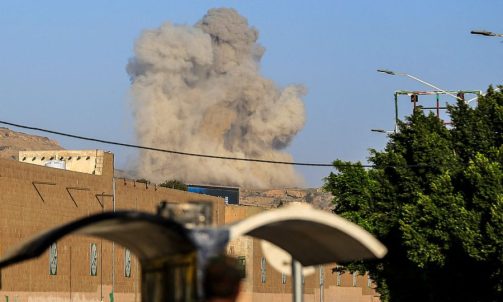
On September 7, 2026, Israeli Defence Minister Israel Katz said that Prime Minister Benjamin Netanyahu and he had instructed the Israel Defence Forces to prepare for the possibility of ‘all-out war’ in the West Bank. The contingency he described was extraordinary. If Israel received firm intelligence that Palestinian Authority security forces or affiliated groups were preparing an October 7-style assault, the IDF should be ready to strike not merely terrorist cells but the PA’s leadership, security services and associated infrastructure.
Katz did not say that such an attack was underway. Public reporting offered no evidence that the Palestinian Authority had decided to launch one. That distinction matters. An argument worth making should not require facts that do not exist.
The significance lies elsewhere. Thirty-one years after the Oslo process established an armed Palestinian police force as one of the instruments intended to make peace possible, Israel’s defence minister was publicly instructing the army to prepare for the possibility of war against it.
How did a police force created by a peace agreement become an organisation against which Israel now considers it prudent to prepare a war plan?
The answer is not hidden in a secret archive. It lies in the agreements themselves, in American appropriations, State Department programs, Government Accountability Office reports, the history of the Second Intifada, and the institutional architecture built during Mahmoud Abbas’s long presidency. The facts have generally been examined separately. Put them together and they pose a question Washington has preferred not to ask.
The story begins with the word Oslo chose: police.
The Oslo Distinction
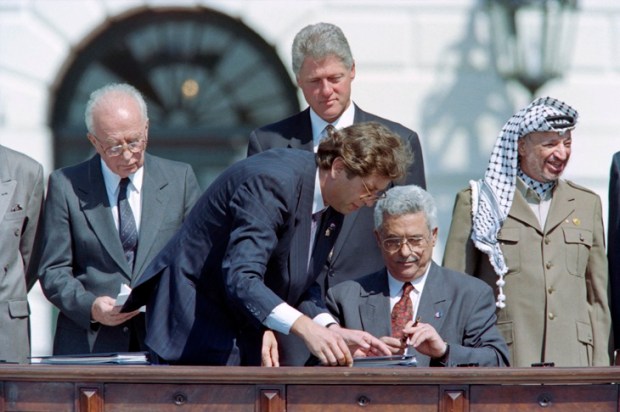
Oslo II was unusually explicit about the security order it sought to create. The Palestinian Authority would establish a ‘strong police force’ to maintain internal security and public order. Israel would retain responsibility for defence against external threats and for the overall security of Israelis. Except for the Palestinian Police and Israeli military forces, the agreement stipulated, no other armed forces were to be established or operate in the West Bank and Gaza.
This was not semantic housekeeping. It was part of the bargain.
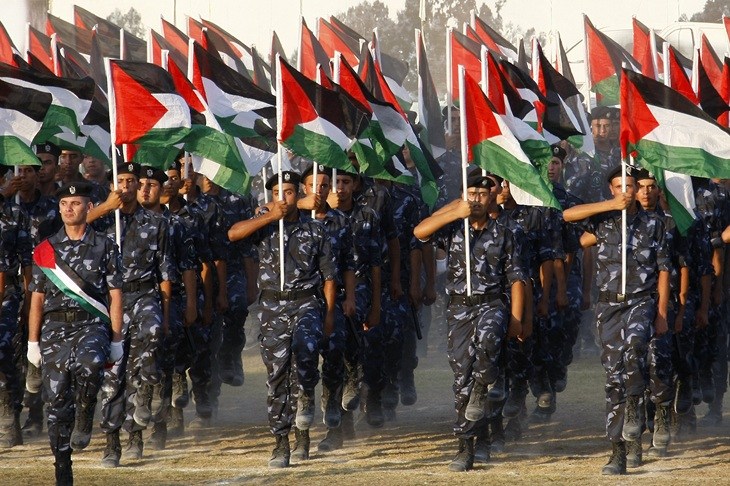
The Palestinian Police was assigned internal functions: maintaining order, protecting people and property, preventing crime, guarding public installations, combating terrorism and violence, and carrying out ordinary police duties. Six branches were specified: Civil Police, Public Security, Preventive Security, Presidential Security, Intelligence, and Emergency Services and Rescue. They were to form a single integral unit under central command.
Numbers were prescribed as carefully as functions. During the interim period the force was not to exceed 30,000 personnel – 12,000 in the West Bank and 18,000 in Gaza – unless the parties agreed to changes. Initial West Bank deployment was smaller still.
The architecture contained a deliberate distinction. Palestinians required enough armed authority to police themselves and combat terrorism; they were not to possess an independent army. Israel retained external defence.
That distinction is indispensable to everything that followed, because the question is not whether the Palestinians were entitled to police. Oslo said they were. Nor is the question whether policemen may carry weapons or whether modern police forces may possess tactical units. They plainly may.
The question is what happens when an institution created for limited internal security acquires, over decades, increasing size, organisational cohesion, tactical training, intelligence capacity, communications, logistics, specialised units, and territorial experience while the political settlement that gave those capabilities their original purpose fails to materialise.
Reality began outrunning the neatness of Oslo almost immediately.
Human Rights Watch reported in 1997 that Palestinian internal-security organisations had proliferated beyond the structure contemplated in the agreements and that personnel totals had exceeded the envisioned ceiling. Estimates varied, as they would continue to do, partly because the Palestinian security establishment contained uniformed forces, police, intelligence organisations, and other services that were not always counted alike.
Numbers alone prove little. New York employs tens of thousands of police officers without possessing a municipal army.
The more important questions are organisation, training, armament, command, doctrine and political allegiance.
The First Warning
The early Palestinian security forces performed some of the work Oslo’s architects intended. Palestinian officers cooperated with Israel against Hamas and other terrorist organisations. Israeli officials credited Palestinian forces with helping disrupt attacks during the mid-1990s.
Then came September 1996.
After the opening of an exit to an archaeological tunnel near the Temple Mount/Haram al-Sharif triggered widespread clashes, Palestinian policemen exchanged fire with Israeli soldiers. Seventeen Israeli soldiers were killed in the violence. The psychological importance of the episode exceeded its duration: men armed in part to police the new Palestinian order had fired on the Israelis with whom that order depended upon security cooperation.
The warning became more serious during the Second Intifada. Members of Palestinian security organisations participated in violence against Israelis. The extent of institutional direction, individual initiative and factional affiliation varied and must not be collapsed into a single claim. Yet the central fact is beyond dispute: political circumstances changed, security cooperation collapsed, and armed Palestinian personnel who had belonged to the peace architecture became participants in conflict.
Israel’s Operation Defensive Shield in 2002 destroyed or damaged much of the Palestinian security infrastructure.
What conclusion should Washington have drawn?
One possibility was uncomfortable: an armed institution does not retain the political purpose of its founders by magic. Its behaviour depends upon leadership, legitimacy, orders, and allegiance.
Washington drew a more optimistic conclusion.
An older American involvement sharpens the question. By the mid-1990s the CIA was training Palestinian security personnel. Contemporary reporting described Jibril Rajoub’s West Bank Preventive Security organisation as receiving extensive CIA training and backing; Mohammed Dahlan in Gaza also worked with the agency. George Tenet later became personally involved in efforts to reconstruct Palestinian security.
The stated purpose was counterterrorism: arrest Hamas and other militants, restore security cooperation and give Israel confidence that the PA could police territory from which Israel withdrew. Israel knew of the relationship, and Israeli security officials sometimes regarded Rajoub and Dahlan as useful counterparts.
Then experience supplied the warning. Palestinian policemen exchanged fire with Israeli soldiers in 1996. During the Second Intifada, members of Palestinian security organisations were implicated in violence. In March 2002, Washington designated the Al-Aqsa Martyrs Brigade a Foreign Terrorist Organisation; the State Department described it as composed of Fatah-affiliated cells. Congress was meanwhile discussing CIA assistance while demanding safeguards against Palestinian security personnel compromised by terrorism.
Intent may explain the beginning of a policy. Knowledge bears upon the morality of continuing it. Once armed personnel from the security architecture had turned against Israelis, recurrence was no longer an unimaginable contingency. It was a demonstrated risk.
Why, then, did the American answer remain greater competence? Why was it America’s responsibility to improve the coercive capabilities of Palestinian organisations whose future political allegiance it could not guarantee? Why did a force born at Oslo as police require counterintelligence instruction, battalion organisation, firearms training, close-quarters operations, checkpoints, detainee operations and paramilitary capability?
The official answer was serious: only capable Palestinian forces could suppress Hamas, Palestinian Islamic Jihad and other armed organisations. Palestinian cooperation did save Israeli lives. Israel participated in later vetting. Those facts rule out any honest claim that Washington’s declared purpose was to train Palestinians to attack Israel.
They do not end the inquiry. A locksmith instructor cannot ordinarily be blamed because a pupil later becomes a burglar. The moral calculation changes if the instructor learns that pupils have used their skills to commit burglaries and nevertheless continues improving their ability. ‘I taught them to protect houses’ may describe the purpose. It does not dispose of the judgment involved in continuing.
The same distinction applies here. Culpability need not require conspiracy; it can arise from knowingly accepting foreseeable risk. American officials knew the history, knew allegiance was political rather than permanent, and knew the peace process was uncertain. The CIA, of all institutions, existed to distinguish declared intention from latent capability.
The question was no longer simply why America trained them. It was why America continued – and what obligation knowledge imposed once misuse had already occurred.
The American Solution
There were serious reasons for doing so.
Yasser Arafat’s maze of competing security organisations was hardly a foundation for responsible government. Hamas and Palestinian Islamic Jihad threatened Israelis and the Palestinian Authority itself. The 2003 Roadmap required the Palestinians to undertake security reform and sustained operations against terrorism. After Hamas seized Gaza in 2007, the danger became immediate. If Mahmoud Abbas’s Palestinian Authority were to survive in the West Bank, it required forces capable of maintaining order and defeating armed rivals.
In 2005, Secretary of State Condoleezza Rice established the office of the United States Security Coordinator. Its purpose was to facilitate Israeli-Palestinian security cooperation and coordinate international assistance. Beginning in 2007, the United States moved deeply into training, equipping, housing, organising, and professionalising Palestinian forces in the West Bank.
A 2010 Government Accountability Office investigation found that State had allocated approximately $392 million between fiscal years 2007 and 2010: more than $160 million for training, almost $89 million for nonlethal equipment, roughly $99 million for construction and renovation, and about $22 million for the Interior Ministry and strategic planning. Another $150 million was requested for fiscal 2011.
The terminology deserves scrutiny. The State Department described the instruction as ‘law enforcement and para-military focused’. GAO called the National Security Forces a ‘lightly armed and equipped gendarmerie-style force’, short of a true military force, and recorded that it was expected to operate in small-unit or company formations ‘in a military fashion’ when supporting civil police against heavily armed threats.
Washington planned ten National Security Force special battalions of approximately 500 men each. Training at the Jordan International Police Training Centre included firearms, crowd control, close-quarters operations, patrolling, detainee operations and checkpoint operations, followed by leadership and specialised instruction.
Why train whole battalions? American officials told GAO that battalion training fostered unity of command and camaraderie. There were courses in leadership, headquarters work, communications, map reading, maintenance, human rights and use of force. Washington was helping construct an organised security system, not merely teaching individual policemen.
It also helped construct the physical architecture: operational camps, training centres, tactical communications facilities, maintenance capacity, logistics warehousing, barracks, and command facilities. Israel approved equipment packages, and participants were vetted by the United States, Israel, Jordan and the PA. American-supplied equipment was largely nonlethal.
The most revealing objection came from Israel itself. In 2008 Israel insisted that Palestinian forces be trained and equipped as police rather than an army capable of threatening the Jewish state. Israeli objections blocked some protective equipment. ‘You never know when these things are going to be used against you,’ an Israeli Defence Ministry spokesman told The Washington Post.
That warning matters. It means the danger now contemplated by Katz was not beyond imagination. Israel was articulating the problem while the American program was being built.
If this remained simply a police force, why was the training explicitly paramilitary? If its mission was ordinary civil policing, why battalions, military-style formations and collective tactical competence? At what point does the distinction between police and army reside less in capability than in the name governments give the institution?
Washington’s answer remained that such capability was necessary to confront terrorists and armed disorder. That may explain the policy. It cannot erase the ethical problem created by foreseeable misuse.
America was Israel’s principal ally while simultaneously improving the organised coercive capacity of a Palestinian security establishment whose future commanders, political alignment and mission it could not guarantee. That is not proof of a secret two-sided design. It is a documented strategic contradiction.
Once Israel itself had warned that these capabilities might someday be used against it, Washington could no longer claim that such a reversal was inconceivable.
The Army That Wasn’t
When does a police force become an army?
The obvious answer is not when it reaches a particular head count.
Armies ordinarily possess missions police do not: external defence, territorial warfare and sustained combat against organised enemies. A gendarmerie occupies the territory between police and military. It may be organised in military fashion and trained collectively while retaining an internal-security mission.
By that conventional definition, the Palestinian Authority Security Forces are not a modern army. GAO itself emphasised that the NSF was ‘short of acting as a true military force’.
They possess no air force, armoured divisions, heavy artillery or independent combined-arms capacity comparable to the IDF. Israel dominates the surrounding military environment.
Yet the absence of tanks and aircraft does not answer the article’s question.
How much of an armed institution’s usefulness resides in heavy weapons, and how much in trained men, commanders, communications, intelligence, unit cohesion, logistics, tactical knowledge and familiarity with terrain?
A lightly armed battalion remains a battalion. An officer trained to command men retains that knowledge if the political mission changes. Communications, close-quarters training and institutional memory possess no political allegiance of their own.
The distinction is therefore not semantic. Washington deliberately developed paramilitary and military-style capabilities while insisting that the resulting institution remained short of an army. The question is what happens to that distinction if the political mission changes.
That was the contradiction embedded in the program’s success.
America’s Success
The American program worked in important respects.
The GAO found that American, Palestinian, Israeli and international officials credited US-supported units with improving security in parts of the West Bank. Trained forces helped control violent situations and conducted counterterrorism operations. Later State Department reporting credited PA forces with constraining Hamas, Palestinian Islamic Jihad and other terrorist organisations, arresting suspects involved in planned attacks and weapons smuggling, and cooperating with Israel.
American assistance created or supported crowd-control units and High Risk Operations units capable of SWAT-style operations against terrorists, militants and dangerous criminals. The United States helped develop training institutions, leadership capacity, communications, operational planning and specialised tactical competence.
In late 2024 and early 2025, PA security forces fought militants in Jenin, including members of Iranian-backed Palestinian Islamic Jihad. The operation was controversial among Palestinians and exposed the PA’s political weakness, but it demonstrated the reason Israel and the United States had wanted a competent Palestinian security establishment in the first place. Washington wanted professional institutions because only disciplined, competent forces could suppress armed rivals, maintain order and support state-building.
The dilemma was genuine. The same discipline, leadership, communications, tactical competence, intelligence, logistics and institutional durability that made the forces useful to Israel also enlarged the organised capability that would survive if political alignment changed.
The difference between asset and liability lay not in those capabilities but in the purpose to which they were put.
Policy by Supposition
The security program did not exist in isolation. It was explicitly attached to a political theory.
The 2003 Roadmap envisioned a viable Palestinian state living beside Israel in peace and security. The USSC existed to help create the security conditions for that outcome. State Department descriptions of American assistance repeatedly tied Palestinian security-sector development to the two-state objective.
There was nothing improper about having a political objective. Foreign policy without objectives is tourism.
The difficulty arises when an objective becomes an assumption.
The United States was not merely training people to perform discrete police tasks. It was investing in an institution whose long-term safety depended upon a particular political future: a Palestinian leadership committed to security cooperation, a negotiated settlement with Israel, functioning Palestinian governance, continued opposition to Hamas and other armed factions, and an eventual state whose security institutions would remain oriented toward internal order rather than conflict with Israel.
The failure of Oslo to produce a final peace did not stop the security institution from developing.
The Second Intifada demonstrated that Palestinian armed personnel could change behaviour when political circumstances changed.
Hamas’ seizure of Gaza demonstrated that Palestinian political institutions could fracture violently.
The long postponement of Palestinian elections demonstrated that political legitimacy could decay.
The advancing age of Mahmoud Abbas guaranteed that the leadership around which the post-2007 security order had been constructed would eventually disappear.
Still the capability accumulated.
One detail in the 2010 GAO report deserves more attention than it received. Washington was very good at counting inputs. Battalions trained. Equipment delivered. Camps constructed. Courses completed. Dollars allocated.
The GAO found, however, that State and the USSC had not established clear outcome-based performance indicators capable of determining whether the program was actually achieving the security objectives of the Roadmap.
Governments naturally measure what can be counted. A trained battalion can be counted. A completed barracks can be photographed. An arrest can be recorded. A month without violence can be reported.
Yet how does one measure the durability of allegiance, the probability that a security institution will remain politically aligned after its present leadership disappears, or the possibility that the diplomatic settlement for which it is being prepared may never arrive?
The measurable could be counted; the supposition could not.
Capability Is Durable
Foreign policy repeatedly confuses present behaviour with permanent character.
Institutions encourage the mistake because continuity is their natural language. A department speaks of ‘the Palestinian Authority Security Forces’ as though the noun described a permanent political object. Yet the same institution can perform different functions under different leadership.
The Palestinian experience had already demonstrated this.
Security cooperation in the 1990s did not prevent armed clashes in 1996.
Cooperation before the Second Intifada did not prevent members of security organisations from participating in violence after it began.
The post-2007 reforms were intended in part to ensure that history would not repeat itself. They rationalised chains of command, improved professionalism and attempted to replace personal and factional loyalty with institutional discipline.
The reforms may have made recurrence less likely, while making the institution more competent.
Capability is durable; allegiance is contingent.
A rifle does not know whom its owner considers an enemy. A radio network does not know which orders it carries. A headquarters does not know the political purpose of the operation it coordinates. A commander trained to move five hundred men does not lose the skill when a government changes.
Washington did not create hostility toward Israel by teaching Palestinians how to maintain order.
It created capability on the assumption of continuing alignment.
The Problem of Sixty Thousand
Before asking what the Palestinian security forces are, begin with the simpler question: How many are there?
Estimates range from roughly 33,500 to upwards of 60,000 personnel. Israeli reporting in 2026 has described an apparatus of approximately 60,000; earlier reporting citing PA data likewise used about 60,000. A recent peer-reviewed study therefore treats force size as a range rather than a settled statistic.
The higher estimate matters because Oslo II was not vague: all six branches together were capped at 30,000 across the West Bank and Gaza, 12,000 of them in the West Bank, unless the parties agreed to changes. Formal violation therefore depends upon any later agreed modifications. The historical comparison is nevertheless extraordinary: an apparatus estimated by some sources at roughly 60,000 is twice Oslo’s original combined ceiling and five times its West Bank allocation.
How did 12,000 in the West Bank become an establishment that may approach 60,000?
The Palestinian Central Bureau of Statistics estimates roughly 3.43 to 3.46 million Palestinians in the West Bank. A 2026 peer-reviewed study also considers an Israeli estimate of about 2.5 million. Critics dispute Palestinian treatment of emigrants, migration assumptions and East Jerusalem residents; Palestinian statisticians and other demographers defend substantially higher totals.
The demographic dispute need not be settled. Give the Palestinian Authority the larger denominator: 60,000 security personnel against 3.46 million inhabitants is approximately 17.3 per 1,000, or one for every 58 people.
Use the lower 2.5 million estimate and the figure becomes 24 per 1,000, or one for every 42 inhabitants.
A recent academic study, combining disputed population and force estimates, calculated 11.2 to 38.5 security personnel per 1,000 inhabitants and described the ratios as among the highest recorded internationally.
Now consider the United States. FBI national law-enforcement data have put the rate of full-time sworn officers at approximately 2.4 per 1,000 inhabitants. Even adding civilian law-enforcement employees produced a rate of about 3.5 per 1,000.
The temptation is to announce that the Palestinian Authority therefore has seven or ten times as many police as America. That would be rhetorically satisfying and analytically careless.
The numerator is not 60,000 beat policemen. It includes civil police, intelligence, Preventive Security, Presidential Guard, National Security Forces and other bodies. American equivalents would not ordinarily fall under one heading. Some perform counterterrorism, intelligence, regime-protection and paramilitary functions far removed from ordinary policing.
Why does an authority governing a population of somewhere between roughly 2.5 million and 3.5 million require an armed security establishment that may approach 60,000 personnel?
The ratio proves no secret offensive design. The PA confronts Hamas, Palestinian Islamic Jihad, armed clans, terrorism, public disorder and threats to its own rule; its intelligence and national-security services perform functions ordinary American police departments do not.
Oslo called it the Palestinian Police because the political settlement required a force for internal security and public order, not an army for external defence. Three decades later, the establishment has become so large and functionally diverse that comparison with an ordinary Western police force is itself misleading.
Perhaps the nomenclature has survived more successfully than the institution it originally described.
Population figures affect per-capita calculations, governmental need, humanitarian planning and international appeals. That does not prove deliberate inflation for financial advantage; intent would require evidence connecting counting practices to funding decisions.
Use the PA’s larger denominator and the security ratio remains remarkable; if its demographic critics are partly correct, it rises further.
The numerator requires equal discipline. Sixty thousand is not an uncontested census of active armed officers. It is a significant estimate within a documented range; payroll strength, active strength and which branches are counted produce different totals.
The numerator is disputed. The denominator is disputed. The composition of what continues to be called a police force extends well beyond ordinary policing.
One figure, however, is written plainly into the agreement that created the system: 30,000 across the West Bank and Gaza, with 12,000 allocated to the West Bank, subject to mutually agreed change.
Washington subsequently helped build battalions, leadership, communications, infrastructure and tactical proficiency. It wanted forces confronting Hamas and Palestinian Islamic Jihad, intelligence discovering plots, organised units restoring order throughout the West Bank itself, and commanders possessing cohesion and institutional discipline.
Their cumulative consequence demanded a question that received far less attention: What would guarantee that an increasingly large and capable security establishment would forever serve the political purposes for which Washington had helped develop it?
The ratio is therefore not proof of an army. It is evidence that the word ‘police’ no longer answers the question. It directs attention toward composition, capability, command and purpose – precisely where the inquiry belongs.
The Abbas Clock
Mahmoud Abbas is now 90 years old.
That fact should concentrate the mind more effectively than another diplomatic communiqué.
For more than two decades Abbas has dominated the Palestinian Authority, the Palestine Liberation Organisation and Fatah. He has opposed another militarised uprising and maintained security cooperation with Israel despite deep Palestinian hostility toward it. The post-2007 security architecture developed under his authority.
He will not govern forever.
In 2025 Abbas elevated Hussein al-Sheikh to a newly created PLO vice presidency, making him an obvious contender in the succession. Yet Palestinian politics does not possess the tested constitutional transfer mechanisms of a stable democracy. Fatah contains rival networks. Security chiefs possess institutional constituencies. Hamas remains a political and military competitor. Other armed organisations operate in the West Bank.
The question is therefore not simply who succeeds Abbas.
It is who commands what after Abbas: the National Security Forces, Preventive Security, Presidential Guard and intelligence services; whether formal succession and actual power coincide; whether Fatah fractures; and whether a new leadership preserves security coordination with Israel.
A prudent security policy does not require certainty before considering contingencies. It exists because certainty is unavailable.
The more capable the institution, the greater the consequence of getting the political assumption wrong.
The Environment Around It
The West Bank into which Abbas’s successor will eventually step is not the West Bank in which the post-2007 security architecture was designed.
Armed groups have become increasingly sophisticated. Israeli officials have warned of ‘semi-military’ terrorist cells. Iran has sought to finance, arm and direct Palestinian militant organisations. Weapons smuggling, explosives and organised cells have become persistent security concerns.
This does not make the PA an Iranian proxy.
The opposite is closer to the truth. PA forces have arrested members of Hamas and Palestinian Islamic Jihad and have fought armed groups whose growth Tehran encourages.
The danger lies not in pretending that every Palestinian with a gun belongs to one organisation. It lies in recognising a stressed political system containing several armed actors, competing sources of legitimacy, foreign interference, and a large security establishment whose future command cannot be known.
A security force can stabilise such a system or become the prize over which it fights.
When political authority is unquestioned, guns remain subordinate.
When political authority fragments, the men who control organised force acquire political weight whether they seek it or not.
This is why succession belongs at the centre of the story rather than in a footnote.
The Fear of Confrontation
Why did Washington not dwell more heavily on this contradiction?
Foreign-policy bureaucracies have a strong preference for problems that can be managed today over dangers that may have to be confronted tomorrow.
The immediate benefits were visible: arrests, disrupted terrorist cells, Israeli-Palestinian coordination, restored order, trained battalions and functioning ministries. Washington could point to tangible evidence of state-building.
The long-term danger was conditional: Abbas would have to leave office, political alignment change, the peace process fail, the PA fragment, or the services split.
To confront that possibility seriously would have meant confronting the political assumption beneath the entire program.
To confront that possibility seriously meant asking whether the political order ultimately commanding this increasingly capable institution was itself durable – and what happened if the two-state destination never arrived or Palestinian legitimacy continued to deteriorate.
The deeper institutional temptation was simpler. Immediate cooperation was measurable; future political reversal was conditional. Arrests, trained battalions and functioning ministries could be counted. The possibility that leadership, allegiance or mission might change could always be deferred to tomorrow.
That is how the absence of confrontation can be mistaken for the disappearance of the conditions that might someday produce one.
Today’s cooperation becomes tomorrow’s assumption; the assumption becomes policy, policy builds institutions, and institutions outlive assumptions.
The Katz Contingency
Which brings us back to September 2026.
Katz’s instruction should not be sensationalised. Israel has not publicly demonstrated that the Palestinian Authority is preparing an October 7-style attack. A contingency plan is not intelligence of an imminent assault.
Yet governments reveal what they fear by the contingencies for which they prepare.
Israel is now preparing for the possibility that an armed Palestinian institution born of Oslo, professionalised in significant measure with American assistance and long praised for helping suppress terrorism might, under different circumstances, become part of the threat.
That is an extraordinary historical reversal.
Washington wanted strength, discipline, professional commanders, communications, logistics, tactical competence and durable institutions because each made the Palestinian security establishment more useful. Israel warned contemporaneously that such capabilities might someday be turned against it. The problem was therefore not merely professionalisation. It was professionalisation after the risk had been identified.
What Did America Build?
Sherlock Holmes’s method was not to begin with the answer. It was to eliminate explanations that could not survive the facts.
Did Oslo authorise a Palestinian army?
No. It authorised a strong police force and prohibited other armed forces.
Did Washington secretly set out to create an army or train Palestinians to attack Israel?
There is no evidence of it. American documents describe counterterrorism, security, gendarmerie and paramilitary missions, and Palestinian forces produced genuine security benefits for Israel.
Did Washington knowingly develop capabilities beyond ordinary civilian policing?
Yes. Its own documents describe paramilitary-focused training, battalions and units expected to operate in a military fashion.
Did Israel understand the danger?
Yes. Israel cooperated with and vetted the program while simultaneously insisting that Palestinian forces remain police rather than an army capable of threatening it, warning that equipment might someday be used against Israel.
Had Palestinian security personnel previously turned their weapons against Israelis?
Yes.
Is there evidence that the PA has now decided to launch an October 7-style attack?
None has been publicly presented.
What, then, remains?
An armed institution created for one political purpose grew and professionalised while the political settlement that was supposed to define its future failed to arrive.
Washington continued investing in training, command, infrastructure and institutional durability after history had demonstrated that security cooperation could collapse and after Israel had explicitly identified the danger of future misuse.
The justification was real: competent Palestinian forces constrained Hamas, Palestinian Islamic Jihad and other threats. The moral question is whether immediate benefit was sufficient reason to enlarge a capability whose future allegiance could not be guaranteed.
That is the point at which intention ceases to be a complete defence. Once risk is known, continued assistance becomes a judgment about which dangers one is willing to create or enlarge in order to suppress others.
The surrounding territory now contains increasingly sophisticated armed groups, Iranian interference and declining political legitimacy.
Israel’s defence minister has instructed the IDF to prepare for the possibility that the Palestinian security apparatus itself could someday become an adversary.
No conspiracy is required to see the contradiction.
America was helping Israel confront terrorism while helping professionalise a Palestinian coercive apparatus that Israel warned might one day threaten it.
Washington did not merely fail to see the Palestinian security forces. Washington helped build them.
Its failure was subtler: it treated the political purpose of the institution as though it were an enduring characteristic of the institution itself, even after experience had shown otherwise.
History grants no such warranty.
Governments change, leaders die, alliances dissolve, legitimacy evaporates, and orders change. Training, organisation, and institutional knowledge remain.
The central question was never whether a well-trained Palestinian security force could help keep the peace. For many years it demonstrably did.
The question was what such a force might become if the peace disappeared – and what responsibility belonged to those who continued increasing its capability after the danger was known.
Thirty-one years after Oslo, Israel is preparing for that possibility.
Perhaps Washington should have prepared for the question before it prepared the battalions.
Aaron J. Shuster is a cinematist, philosopher and scholar of cinema whose writing examines contemporary affairs, the Middle East, strategic culture and civilizational questions. His work has appeared in The Spectator Australia, FrontPage Magazine, Middle East Forum publications and the Tablet Magazine.