On October 7, 2026, the Australian High Court rendered a judgment that places another roadblock in the tortuous approvals path required to ensure the future of the Mt Pleasant coal mine in New South Wales.
In MACH Energy Australia Pty Ltd v Denman Aberdeen Muswellbrook Scone Healthy Environment Group Inc the Court, overturning a lower court’s judgment, decided that the Independent Planning Commission of New South Wales – the state planning authority that originally approved the mine’s 22-year expansion in 2022 – should have considered the imposition of conditions on the Project’s Scope 3 emissions, for example, indirect emissions from downstream supply chains, such as burning exported coal. These are emissions which overseas buyers of Australian coal will release, thereby presumably increasing carbon dioxide in the air.
As such, the High Court has set a precedent for slowing coal exportation by effectively allowing similar delaying court actions. The Court said:
‘The effect of the grant of a consent to a development application is not limited to affecting the rights and obligations of an individual or entity vis-a-vis the State. Instead … the grant of a development consent, especially a consent to an application for State significant development, has the capacity to significantly affect the broader (and local) environment and all the disparate groups within it … the public interest loomed large over the exercise of the Commission’s function.’
It is interesting that the High Court granted leave for several prominent international research and scientific bodies to be heard or submit written Amici Curiae arguments during the appeal.
Similar court actions in the United States may also be viewed by some to undermine the use of fossil fuels in an increasingly intolerant society. Command societies have no such artificial limitations on access to energy and gain enormous economic advantage by encouraging the myth that anthropomorphic recycling of carbon dioxide through the utilisation of fossil fuels is a threat to Planet Earth.
This then is the real, but unexpressed, issue in the High Court case: the continuing demonisation of carbon dioxide.
There is still a widespread misbelief that human emissions (recycling) of carbon dioxide drive climate change, and that this can be regulated by decree to maintain the surface temperature of the planet to within one or two degrees centigrade, a patently ludicrous proposition that continues to surface over the ages despite the practical demonstration by the 11th Century King Canute that time and tide wait for no man.
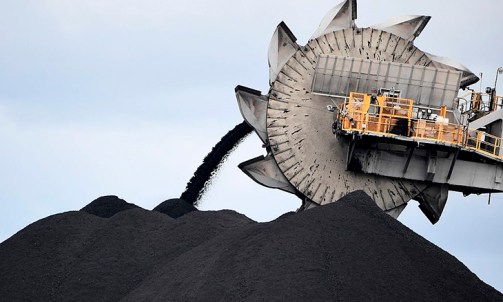
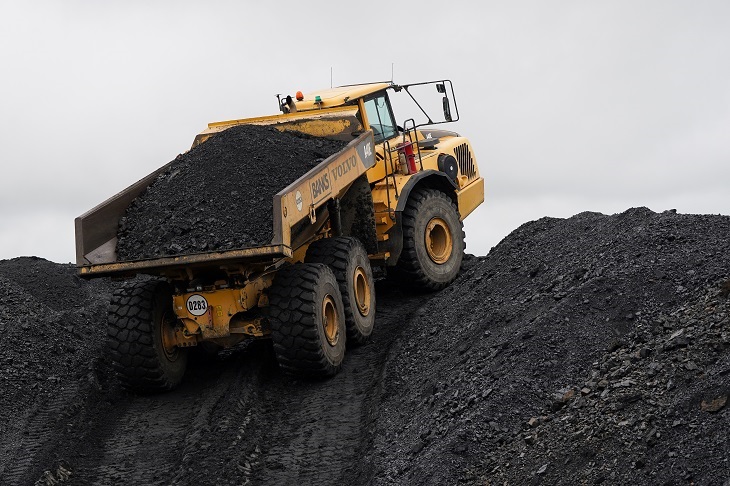
It is nothing short of an epiphany to realise that all fossil fuels are a condensed store of hundreds of millions of years of solar energy. One has only to see a few of the coal exploration drill results to appreciate the enormous amount of fossil fuels readily available to use in our day-to-day comfort and for our very survival. Ninety-metre-thick coal seams are not to be sneezed at, especially when current theories of coal formation are considered. It takes ten meters of foliage to form one meter of peat, and ten meters of peat to make one meter of coal. The swamps of the Carboniferous Age must have been quite deep, and the necks of the dinosaurs extraordinarily long to have lived in those Jurassic swamps!
Well over 100 million years ago, our planet was a largish dynamo of minerals and energy hurtling through space and time in the cosmos as it orbited around the Sun, with the whole caboodle hurtling through the Galaxy.
It was a slowly cooling liquid glob that, as it cooled, formed a lower-density, cooler, condensed skin, the thick continental crust, on which we live, and a thinner seabed crust overlaying the hot magma of the mantle that contains the core that is still as hot as the surface of the Sun, in an atmosphere then rich in the gas of life, a trace gas, carbon dioxide. Through the miracle of photosynthesis, plants, plankton, people, polyps and all forms of life on Earth began extracting carbon dioxide from the atmosphere to sequester the gas back into the planet’s crust to a low-level approaching plant extinction. Yet we now waste time, money and energy to further sequestrate this essential gas from the atmosphere where it does so much to sustain us and the plants on which we rely.
The gods must be crazy – or are we?
The claim that carbon dioxide is the culprit responsible for higher temperatures is scientifically unproven – a myth. This myth is thoroughly demolished in a paper by Sanjeev Sabhlok published on August 5, 2025. His conclusion is worthy of quoting:
‘There is simply no possibility of any runaway greenhouse effect on Earth. Vast numbers of living organisms are constantly feeding on CO2 or storing it in some way. Almost all CO2 generated during the history of Earth has been already sequestered into limestone rocks and other storage. Forces of life prevented runaway greenhouse effect on Earth in the past when CO2 levels were vastly greater than current levels. No amount of CO2 released into the atmosphere from the use of fossil fuels can possibly cause a runaway effect. Even if we manage to release all the CO2 from limestone we will still never get a runaway greenhouse effect – because there was no such effect when all that CO2 was still up there.
‘We should sleep soundly, knowing that no matter how much CO2 mankind emits by burning fossil fuels, our amazing living planet will never go the way of Venus.’
But the demonisation of carbon dioxide is based on, and perpetuated, by a tissue of lies that has been transformed into a tangled web of legislation, vainly attempting to define the undefinable and achieving the unachievable.
The narrow margin of the High Court decision, three judges to two, is an indicator that the judgement is not clear-cut, and neither could it be. Judges are required to adjudicate on points of law, but when scientific evidence emasculates the premises upon which the law is based, there is no value in the resultant adjudication, except to the litigants who necessitated this court action and those working in the background to support this disruptive legal process.
The High Court’s decision was about process. When the New South Wales government approved the project, it had not properly considered whether Scope 3 emissions linked to the mine ’are minimised to the greatest extent practicable’; if it had done so the legal result might have been different. Nevertheless, the rules of statutory interpretation used by the Court cannot hide the severe dissatisfaction and uncertainty created by the Court’s judgment. Even the wisdom of Solomon could not have ruled justly on the weasel words and phrases used in the relevant legislation that required the High Court’s interpretation.
This case represents a landmark precedent in Australian environmental and administrative law. It marks the first time Australia’s highest court has directly ruled on a planning authority’s obligations regarding Scope 3 emissions. There is no doubt that this costly court case will further delay access to, and exportation of, fossil fuels that are essential to the well-being of everyone, including the litigants.
While overseas organisations show a keen interest in this Australian court case to add to their web of legal precedents, there are others motivated by the pursuit of data-based science who have built a formidable case in exposing the futility of such pursuits of Net Zero targets, carbon-capture-and-storage, and decarbonisation.
A paper by Angela Wheeler, Executive Director of the CO2 Coalition, clearly sets out the problem that is mirrored in Australia.
‘The US Supreme Court is considering whether municipalities can set national energy policy by forcing oil and gas companies to pay for weather damages purportedly precipitated by carbon dioxide (CO2) emitted from combustion of their products. While the question before the court hinges on constitutional provisions that reserve such power to the federal government, it is important to note that the premise of the case is scientifically invalid.
‘In Board of County Commissioners of Boulder County and City of Boulder v. Suncor Energy and ExxonMobil – the lead case in nearly three dozen similar suits – the producers of fossil fuels are blamed for the effects of bad weather. The suits are a coordinated effort to bankrupt energy companies and force an economically devastating ‘green’ agenda on the public …
‘We agree that city hall should not be deciding whether the producers of coal, oil, and natural gas are allowed to stay in the businesses that make modern civilisation possible. However, equally important is that the apocalyptic claim of a climate emergency underlying what could become hundreds, or thousands, of lawsuits is fearmongering with no basis in reality.’
The extraordinary number of organisations and government departments thus slavishly adhering to the patently absurd pursuit of ‘clean green energy’ that is cluttering the landscape with subsidised imported glass panels, wind turbines and a network of service roads and transmission cables, is leaving a legacy of debt and rubbish because ‘Australia is on the brink of a great solar panel age-out’.
The High Court’s judgment, rather than solving a dispute, may have created a troubling future for the fossil fuels industry of Australia!