France has long embraced subversion. Its revolutionaries, rebellious students and intellectual provocateurs occupy a cherished place in the national imagination. In May 1968, student protests and mass strikes paralysed the country and shook Charles de Gaulle’s government. Half a century later, the gilets jaunes turned anger over fuel taxes and living costs into a prolonged confrontation with the state. In 2023, raising the retirement age from 62 to 64 brought nationwide strikes, burning barricades and violent clashes with police.
Sadly, it seems that admiration for defiance made the French too accepting of destruction.
I am writing from my living room on the fourth floor of my building in Saint-Germain-des-Prés, Paris. All I can hear are the sirens of fire engines and police cars.
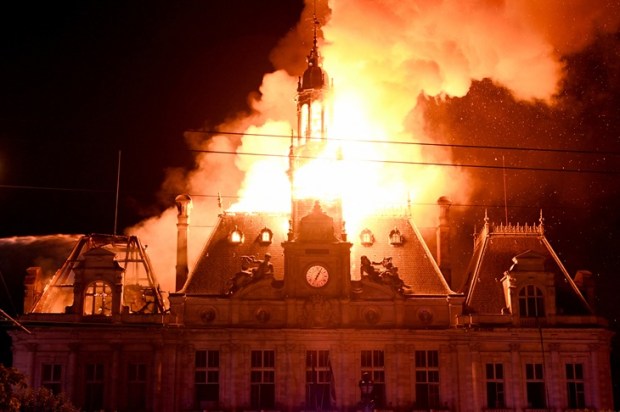
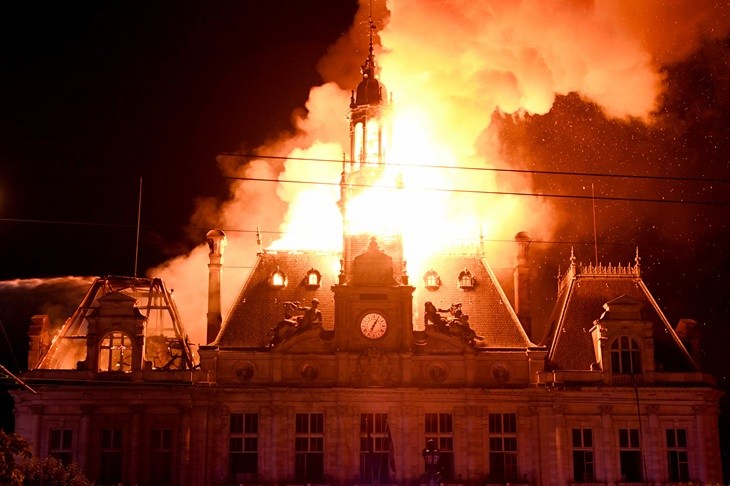
The unrest began with students demanding more teachers and better school conditions. Fair enough. It widened to include unions and protesters concerned about living costs and public services, and today, peaceful demonstrations turned into arson, looting and attacks on public buildings. The French call it la casse. Cars and rubbish bins burned in Paris; shops are being looted as I write. In Marseille, a municipal police station was damaged. In Limoges, the town hall was also set alight, with local reporting describing flames reaching the roof. In Lyon, fire broke out inside a tourism office.
I was in Lyon just weeks ago. Such a magnificent city, with an extraordinary history. Watching this is heartbreaking. This is the destruction of a community’s property, paid for by the very public in whose name protesters claim to act.
My French friends tell me to stop watching television and let it pass. It always has, they say. ‘Il faut avoir une attitude pleine de nonchalance vis-à-vis de ces choses-là. C’est très français.’
Strikes and demonstrations are so familiar in France that disruption is something people organise their lives around. My friends’ response suggests that even violence can become another inconvenience to wait out. Surely a country should expect more.
France has forceful police. Although tear gas and water cannons have been deployed, the police cannot fix the acceptance of declining standards in public behaviour.
When destruction repeatedly accompanies demonstrations, we learn which streets to avoid and wait for the clean-up. Accountability gives way to managing the inconvenience.
Beneath that resignation are fractures that France has allowed to deepen. The Republic promises equal citizenship, but the experience of belonging to it can differ enormously depending on where someone grows up, the school they attend and their prospects of finding work. The OECD has found immigrant students in France more isolated from non-immigrant students than the OECD average, with residential segregation and economic inequality contributing to divisions in schooling. Sharing a nationality does not necessarily mean sharing much of a life.
There is also a failure of reciprocity. A country must offer its citizens a fair chance to belong and contribute. Citizens, in return, owe something to the society that provides their rights: respect for its laws, its public assets and other people’s freedoms. When government fails to deliver, and individuals treat responsibility as optional, that relationship begins to break down.
Governments cannot repeatedly promise better services, fail to deliver them and expect public confidence to survive. Ministers should have to explain what went wrong, account for the money spent and face consequences for persistent failure.
France’s tradition of revolt did not create all these divisions, but romanticising confrontation, then accepting its destruction as inevitable, makes them harder to repair. Anger becomes an excuse for conduct that deserves condemnation. Political failure becomes so familiar that nobody expects consequences. Meanwhile, the people carrying on, paying taxes and keeping businesses open are left to absorb the damage.
That is the French lesson Australia should take seriously. We do not need to face identical circumstances to recognise the danger of allowing disappointment in government, separation between communities and declining expectations of public behaviour to reinforce one another.
Our circumstances differ, but we have housing pressures, financial hardship and distrust in political leadership. Scanlon Foundation research identifies economic pressures, discrimination and prejudice as challenges to cohesion, while finding resilience worth protecting.
As a country shaped by migration, we cannot leave integration to chance. People need opportunities to work, learn English and participate. They also need clear expectations about citizenship, common laws and respect for others.
Governments must match population growth with housing, infrastructure and services. Otherwise, people compete for necessities and blame their neighbours for failures made in political office. Young Australians need a credible prospect of independence, rather than another assurance that their difficulties are understood.
We should demand more of our politicians and ourselves. Political loyalty must not excuse incompetence, as much as sympathy for a cause must not excuse violence. Police must act lawfully, and those who destroy livelihoods must face consequences.
Respect includes the business owner, the employee, the resident and the peaceful protester whose cause is damaged by violence.
My French friends may be right that this will pass. But the victims and taxpayers will still be paying for the destruction when everyone else has moved on.
We should all learn from the French lesson: when we stop demanding accountability from those who govern and those who destroy, we give both permission to carry on.