Just as a person without convictions is easily swayed to differing and conflicting positions, so is a country without convictions. Just as a person without firm principles tolerates damaging behaviour, so does a country without clearly stated principles.
Multiculturalism is what fills the void where strong shared values, principles, and norms are absent – just as a person with no strong values tries to appease all by being over-accommodating, malleable and non-confrontational.
Multiculturalism is a weakness. It is a relativist construct in which all other cultures are placed on an equivalent level, no matter how objectionable they might be. It is a kind of cognitive dissonance in which we are often expected to accept that opposite or even worse things are apparently equal.
At its worst, we are required to tolerate religious beliefs which go against the foundations of Western Civilisation. We compromise freedom of speech to avoid offending Islamic sensibilities; authorities are often hesitant to confront anti-Semitism when it comes from minority communities; and we treat full-face veiling in public as merely another expression of cultural diversity.
This desperate need to not offend other cultures in our own Western countries inevitably leads to host culture capitulation.
This is most evident in Europe where traditional cultures seem to be weakening in the face of diversity pressures – with some very strange outcomes.
In the UK, numerous councils during the World Cup prohibited the flying of English flags on public property with one citing ‘community cohesion’ as a factor. For centuries, rallying around the national flag was unifying; now that same object is maligned as being divisive.
In Brighton, the council cancelled an anti-racist exhibition featuring a reimagined Union flag after its leader said minority communities had expressed fears about displays of national flags in council buildings.
In Whitechapel, a group of men confronted a Christian street preacher and told a police officer that he was preaching in a ‘Muslim area’.
Even some on the Left have softened their approach when progressive values collide with conservative Muslim opinion. During the Birmingham protests over relationships and sex education, Labour MP Shabana Mahmood emphasised in Parliament that pupils’ ‘religious background’ must be taken into account when such material is taught. Indeed, this was already required by legislation.
In a sign that extreme diversity doesn’t in fact end in fair representation, but rather in the dominance and suppression of the host culture, I refer you to the image of Tower Hamlets council in London.
"A viral photograph of the borough’s newly elected council has reignited debate about one of the fastest demographic transformations anywhere in the country."
Read more from @CamillaTominey on Tower Hamlets here ⤵️https://t.co/n9HnoaAlT6 pic.twitter.com/vfb4X3jjr2
— The Telegraph (@Telegraph) May 28, 2026
In Austria, President Alexander Van der Bellen suggested that, if Islamophobia continued to spread, ‘the day will come when we will have to ask all women to wear headscarves’ in solidarity with those who wear them for religious reasons.
In Brussels, authorities repeatedly removed the word ‘Arab’ from an inscription on a monument depicting Belgian forces defeating Arab slave traders in the Congo. The inscription originally read ‘Belgian military heroism annihilates the Arab slave trader’. The monument itself is hardly an uncomplicated object – as it relates to sometimes brutal Belgian colonialism – but literally chiselling the identity of the slave traders out of the record is an unusually crude form of historical editing to avoid offence.
Multiculturalism often means that a host culture bends itself or sacrifices its values in order to accommodate others, whereas other cultures should be bending themselves to the host. It is people arriving from foreign cultures who should be most wary of not offending those in the host culture, rather than the other way round.
And the more ground a host culture cedes, the more it is asked to sacrifice. Look at the new anti-Muslim hostility definition in the UK and the controversy it has already caused over the ability to criticise Islam.
Under multiculturalism, criticism of the host culture becomes the only acceptable form of cultural criticism. And it often seems like all cultures are celebrated except the host culture.
This is an effective way to demoralise a populace and promote shame within the local population.
Multiculturalism works for some people, though. It is particularly beneficial to groups that wish to preserve their own norms instead of adopting those of the host culture. It is also relentlessly promoted by activists in the West who regard their own civilisation principally as a catalogue of crimes and who see cultural dissolution not as a danger but as a form of historical justice.
It is these types who propagate the guilt in our culture which has left us uncertain of who we are, doubting our legitimacy and riddled with shame for a distant colonial or imperial past.
Only a country not confident in itself would tolerate behaviour and attitudes at odds with its own culture.
But if you look at some countries that have drunk down multiculturalism for too long, the host culture has become so diluted by competing cultures that many people don’t even remember the original culture’s flavour. There comes a tipping point where there is so little left of the host culture that there is nothing left to integrate into, even if new arrivals wanted to.
The host culture merely becomes a beguiling whiff you sometimes notice in the air before it is overpowered by the indiscernible aroma of innumerable exotic dishes being cooked in the same kitchen at the same time. The smell that fills the room is now indistinct and carries no unique sense of place, history or identity.
The delicate aroma of the rose can’t be smelt next to the melting pot.
We must realise that all cultures are not equal and Western societies attract huge numbers of migrants from all corners of the world for a reason.
Our foundational Western values of individual liberty, freedom of speech and religion, equality before the law, democratic government, due process and the rule of law have created the world’s greatest societies and helped reshape much of the world for the better.
We need the moral courage to assert this. We need the strength to firmly say that we will not accommodate values that aren’t compatible with ours.
But we won’t do any of this if we are not proud of our culture and confident in ourselves.
We need to firmly say who we are and what we stand for, and what is acceptable and what isn’t.
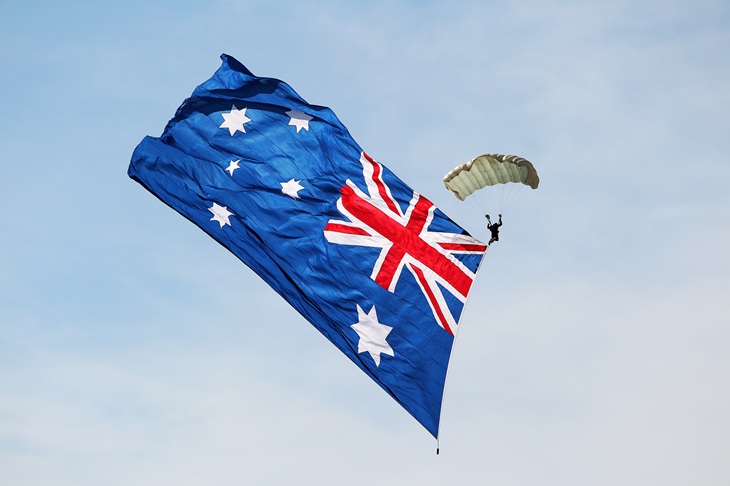
It is time to proudly fly the flag – even if the authorities and the shame peddlers don’t want us to.
Travis Kelly is a Melbourne-based writer who writes about politics, culture and Western society. Substack: Western Drift