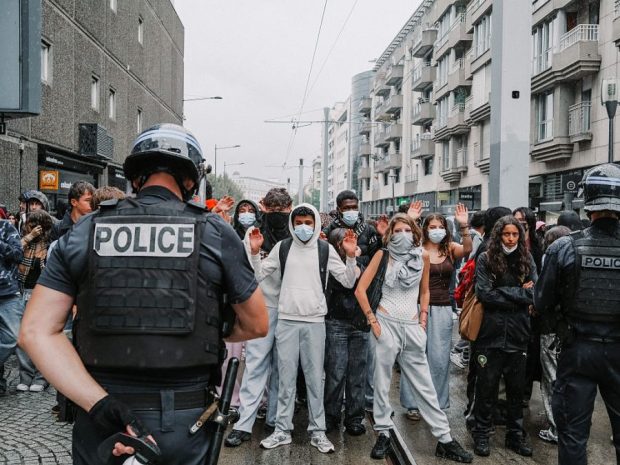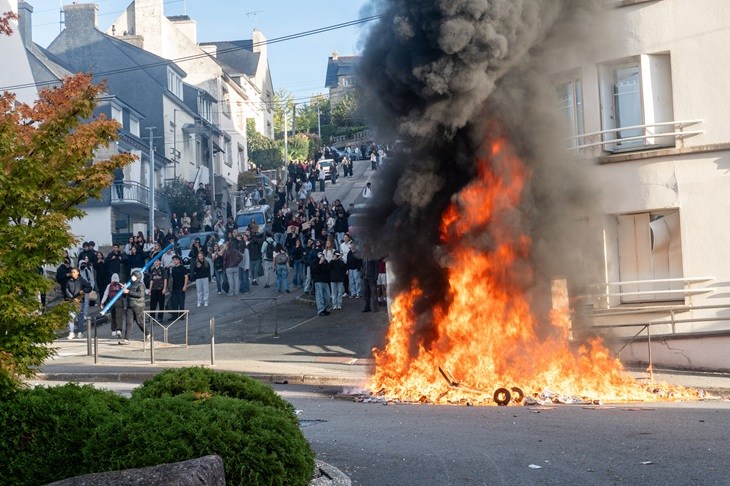
France is once again on the streets. Across the country, students are protesting over overcrowded classrooms and deteriorating educational conditions. Firefighters are demonstrating against chronic underfunding and staffing shortages after an exhausting wildfire season. Trade unions have mobilised public-sector workers against wage stagnation and proposed budget measures.
Yet among these overlapping grievances, another issue has emerged as a particularly emotional flashpoint: the controversial French police law known as Bill 691.
Thousands of people have marched in Paris, Lyon, Toulouse, Marseille, and other cities against the proposal, which opponents have labelled a ‘licence to kill’ for police officers.
The intensity of the reaction tells us something important. This is not merely a technical reform of criminal procedure. It is a law that strikes at the heart of a fundamental democratic question: when the state uses lethal force against a citizen, where should the burden of proof begin?
According to reporting from Reuters, the legislation would establish a presumption that police officers and gendarmes acted lawfully when using firearms, unless evidence proves otherwise. The proposal passed the lower house of parliament and now faces further consideration by the Senate.
The supporters of Bill 691 argue that it is a necessary correction to a system that unfairly places police officers under suspicion whenever they discharge their weapons. Conversely, the critics argue that it would weaken accountability and create a dangerous culture of impunity. Both sides have valid points. Yet after the international reaction and a consideration of comparable systems such as Australia’s, the law ultimately moves France in the wrong direction.
Supporters insist that the proposed law does not create immunity. They are technically correct. The bill would not legalise arbitrary police shootings. It would not permit officers to fire into crowds. It would not prevent investigations. Prosecutors could still bring charges, investigations would still occur, and courts would still have the authority to convict officers who acted unlawfully.
That distinction matters because much of the public debate has become exaggerated. Some opponents speak as if the law would allow police to shoot protesters without consequence. There is no evidence in the text descriptions available that this is what the bill does.
Yet recognising this fact should not lead us to conclude that the criticisms are overblown. The real issue is not whether investigations continue. It is how those investigations begin.
Traditionally, democratic societies start from a position of neutrality. A fatal police shooting occurs. Investigators examine the evidence. Prosecutors determine whether criminal conduct took place. The officer may ultimately be vindicated, but the process starts without a legal presumption in favour of either side.
Bill 691 alters that starting point. Critics argue that by presuming legality, the law shifts the practical burden onto victims, families, prosecutors, and investigators. That concern has been echoed by human rights organisations, French legal bodies and even Morris Tidball-Binz, the United Nations Special Rapporteur on extrajudicial executions. He warned that the proposal could weaken investigations and increase the risk of impunity.
At the same time, dismissing the concerns of police officers would also be a mistake. Police work is not performed in a university seminar room. It is carried out in conditions of uncertainty, confusion and danger. Officers make life-or-death decisions in seconds. A criminal investigation following a shooting can place extraordinary psychological and legal pressure on individuals who may have been acting to protect themselves or others. This is the strongest argument for the law.
Supporters contend that officers deserve the benefit of the doubt when acting under dangerous operational conditions. They argue that police should not automatically be treated as potential criminals for carrying out their duties and that lengthy investigations can ruin careers even when officers are ultimately cleared. Laurent Nuñez, France’s Interior Minister, has defended the proposal on precisely these grounds, emphasising that the presumption would remain rebuttable and could be overturned by evidence.
These arguments should not be dismissed as authoritarian. They reflect a genuine challenge facing every democracy. How can society expect police to confront armed criminals while simultaneously subjecting every split-second decision to years of legal uncertainty? Nevertheless, acknowledging that problem does not mean Bill 691 is the correct solution.
The deeper problem with the proposal is what it signals. Democratic legitimacy does not rest solely on the legality of state power. It rests on public confidence that state power is exercised fairly. When governments appear to give even symbolic legal advantages to officials who use lethal force, public confidence suffers.
The reaction to the bill illustrates this perfectly. A petition against the proposal reportedly attracted hundreds of thousands of signatures. Demonstrations against the legislation have taken place across multiple cities. Human rights organisations, including Amnesty International, have expressed concerns.
Whether one agrees with those critics or not, their response reveals that a substantial portion of French society already lacks confidence in police accountability mechanisms. That is why comparisons with Australia are particularly instructive.
Australia faces many of the same challenges as France. Police officers are armed. Violent crime exists. Terrorism concerns exist. Officers occasionally face situations requiring lethal force. Yet Australia has generally chosen a different legal model.
Under the Crimes Act 1914, police officers may use force that is necessary and reasonable to make an arrest or prevent escape. Force likely to cause death or grievous bodily harm is permitted only where an officer reasonably believes it is necessary to protect life or prevent serious injury. Australian policing guidelines similarly emphasise force that is reasonable, necessary, proportionate and appropriate, while officers remain accountable for justifying their actions. The crucial difference is procedural.
Australia does not generally begin from the assumption that a police shooting was lawful. Nor does it begin from the assumption that the shooting was unlawful. Investigations start from a neutral position and seek to establish whether the force used was justified under the circumstances. Coroners, prosecutors, courts, and oversight bodies then assess the evidence. This approach has significant advantages.
It protects officers because the legal standard recognises the realities of policing. Reasonableness is assessed from the perspective of the situation confronting the officer, not with perfect hindsight. At the same time, the system preserves public confidence because the process remains formally neutral.
Australia’s model is not flawless. Questions about Indigenous deaths in custody and police accountability continue to generate debate. Yet the fundamental framework remains sound because it balances operational necessity with democratic oversight. France should pay attention to that balance.
The strongest police services are not those shielded from scrutiny. They are those trusted by the public. Trust is an operational asset. Officers who enjoy public confidence often face greater cooperation, stronger legitimacy and less social tension.
The irony is that Bill 691 may ultimately undermine the very police officers it seeks to protect. Even if the legal impact proves limited, the symbolic impact could be enormous. Citizens who believe the system is stacked in favour of law enforcement are more likely to view future investigations with suspicion, regardless of the facts.
A better reform would focus on speeding investigations, protecting officers from unnecessary public vilification before facts are known, expanding legal representation, and ensuring transparent oversight. Such measures would address legitimate police concerns without altering the foundational principle that the state must justify lethal force when it takes a life.
The lesson from Australia and other comparable democracies is simple. Grant police broad authority when necessary to protect life. Train them well. Equip them properly. Support them when they act lawfully. But when a shooting occurs, begin from neutrality rather than presumption.
That principle is not anti-police. On the contrary, it is what preserves the legitimacy of policing in a democratic society.
France’s current protests are ultimately about more than wages, schools, firefighters, or even Bill 691. They reflect a wider crisis of trust between citizens and institutions. In that context, legislation that appears to reduce accountability, even in a limited way, risks widening the divide rather than closing it.
For that reason, while the intentions behind Bill 691 may be understandable, the bill is a mistake. Democracies should strengthen confidence in the rule of law, not create new reasons to question it. The best police officers do not need presumptions. They need a system that investigates fairly, judges impartially and commands public trust. France should strive for that balance, not abandon it.
Dejan Hinic is a financial and investment expert operating from Belgrade, Serbia. He received his law degrees from the University of Belgrade and the University of Queensland. He would like to thank Professor Gabriël Moens AM for commenting upon an earlier version of this opinion piece.