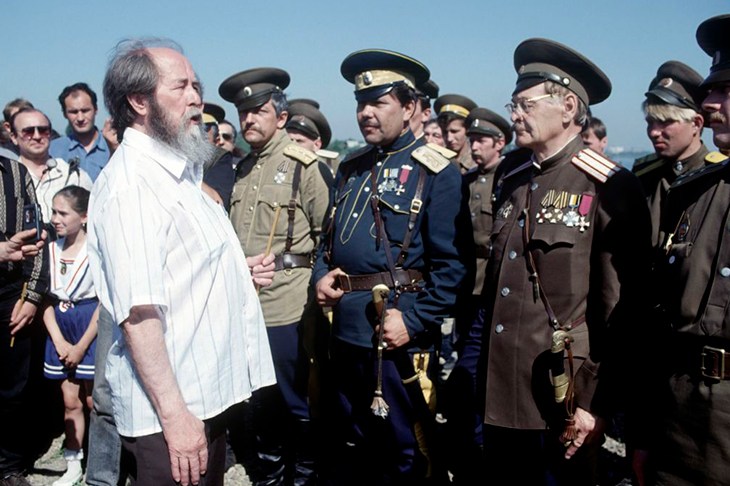
On 12 February 1974, eight Soviet government officials arrested Aleksandr Solzhenitsyn at his Moscow apartment. By evening, he had been charged with treason. The following day, he was stripped of his citizenship and put on a plane to West Germany. That same day, his essay, Live Not by Lies, began circulating in samizdat, i.e. hand-written reproduction.
The essay was short and devastating in its simplicity. Solzhenitsyn did not plead with Soviet citizens to take to the streets. He knew they were frightened, tired and outgunned. He asked for something smaller but harder: that each person refuse to repeat what they knew to be false. To live not by lies.
The Soviet regime, Solzhenitsyn argued, did not survive through guns and fear alone. It survived because millions of decent people mouthed its untruths to get through the day. If citizens withdrew their cooperation, then the façade of legitimacy would begin to crumble.
In the lecture he wrote for his Nobel Prize, Solzhenitsyn articulated his personal doctrine: let the lie come into the world, let it even reign supreme, ‘only not through me’.
Australia is not the Soviet Union, but Solzhenitsyn’s essay travels.
Any political order relies on trust between the rulers and ruled, and that trust rests on words that can be taken at face value. But by this measure, the Albanese years have fallen short.
Before the 2022 election, Labor promised to cut the typical household power bill by $275 a year by 2025. By the opposition’s count, Anthony Albanese repeated the figure 97 times. 2025 came and went, and bills did not fall by $275. They rose by hundreds of dollars.
The government covered over the gap with rebates funded by taxpayers. In other words, the government took money from the people to give it back so to disguise the size of its broken promise. It then blamed foreign wars, gas companies and the previous government for the rest.
Then came the Stage 3 tax cuts. Labor voted for them in opposition and promised, again and again, to deliver them in full if elected. After winning office, the Prime Minister went further, declaring, ‘My word is my bond.’ In January 2024, he broke that bond, re-engineering the tax cuts and unveiling them as a gift. Voters were promised one thing, handed another, and told to be grateful.
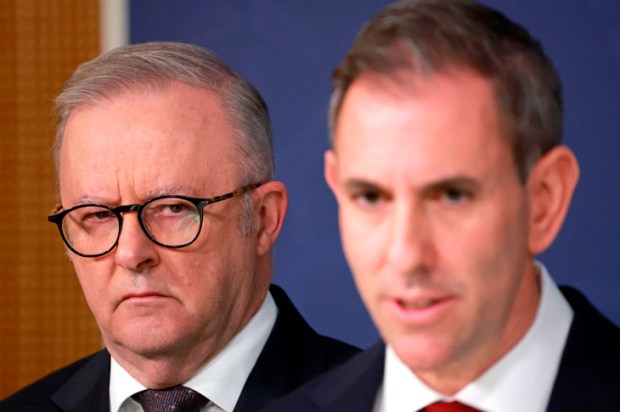
Superannuation followed. During the 2022 election campaign, Albanese told voters, ‘We have said we have no intention of making any super changes’. Within a year, Treasurer Jim Chalmers announced a doubling of the tax rate on earnings for balances above $3 million. The Prime Minister insisted this was not a broken promise because it would start after the next election.
Then while campaigning in April 2025, Albanese was asked to rule out any change to negative gearing or capital gains tax if re-elected. He replied, ‘Yes. How hard is it? For the fiftieth time.’ Later in August, he insisted that the only tax policy his government would implement was the one it took to the election.
Nine months later, the May 2026 budget did precisely what Albanese had ruled out, by his own count, fifty times. The 50-per-cent capital gains discount was to be replaced by indexation and a 30-per-cent minimum tax. Negative gearing for future purchases would be confined to new builds. Discretionary trusts would face a new minimum tax.
These changes resembled the agenda Bill Shorten took to the 2019 election, policies which Australian voters rejected. Asked to explain, Albanese offered five words, ‘We have changed our position.’ His Treasurer claimed the decision was taken only weeks before the budget, as if that made it better.
There are honest arguments for tax increases, but Albanese made none. Instead, he promised the opposite and banked the votes.
Currently, Prime Minister Albanese is fond of urging Australians to ‘turn the temperature down’. He calls for calm, civility, and respect in public life. Yet every government deception turns the heat up. Nothing radicalises a voter faster than discovering their vote was harvested through deception. People who feel lied to do not drift back to the centre. They go looking for anyone who seems to mean what they say.
Consider also the institutional damage caused.
A business that misleads its customers loses them. But a government that misleads is different because it holds a monopoly on the legitimate use of force. Its policies are enforced by law, and its revenue is extracted under threat of penalty.
Australians who have lost confidence in government cannot take their business elsewhere. There is no rival tax office and no competing energy regulator. Australians are captive customers, which is why it is the duty of governments and politicians to tell them the truth.
Every prime minister breaks promises. But Prime Minister Albanese and his government have turned the broken promise from an occasional embarrassment into a governing and electoral philosophy.
The worst part is that the cost of this perfidy is not borne by Labor alone. It is borne by the political system, by the office of Prime Minister, diminished each time its occupant treats a public pledge as an opening bid. It is also borne by every politician of every party who now face voters who assume, justifiably, that nothing said on a campaign trail can be believed.
According to the 2026 McKinnon Index, in just one year, trust in political parties fell 6.8 percentage points and trust in federal politicians fell 5.4 points, even as trust in democracy’s independent institutions held steady.
According to the 2026 McKinnon Index, in just one year, trust in political parties fell 6.8 percentage points and trust in federal politicians fell 5.4 points, even as trust in democracy’s independent institutions held steady.
Solzhenitsyn knew that a lie cannot survive without people willing to repeat it. They need commentators who shrug at them and ministers who repeat them. The answer, he proposed, was not revolution but refusal. Refuse to pretend that ‘We have changed our position’ is an explanation. Refuse to accept that a promise made fifty times was but an aspiration. Refuse to let the lie pass.
In the Soviet Union, refusing to repeat what was known to be false could cost people their livelihoods or their freedom. In Australia, it costs nothing. No one goes to prison for calling a broken promise a broken promise. Yet at least. Thus, there is no excuse for letting it through.
Journalists should continue to question broken promises. Voters should remember on election day. And every politician, of every party, should acknowledge that a promise made fifty times but renounced in five words was never a promise but rather a tactic.
Got something to add? Join the discussion and comment below.
You might disagree with half of it, but you’ll enjoy reading all of it. Try your first month for free, then just $2 a week for the remainder of your first year.