A remarkably candid essay, The dawn of the post-literate society reports that ‘numerous studies show that reading is in free-fall’ and that even ‘the most pessimistic 20th Century critics of the screen-age would have struggled to predict the scale of the present crisis’.
There are undoubtedly many reasons for the decline in society’s reading habits.
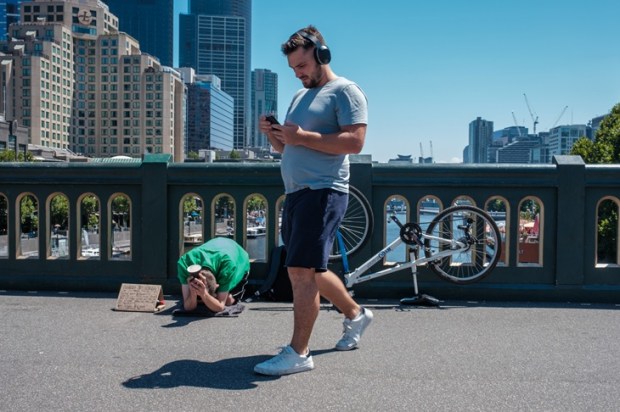
The above essay criticises smartphones for being purposely addictive, drawing users in with constant notifications, trivial videos, and social media outrage.
This represents ‘the greatest theft of knowledge from ordinary people in history’.
According to the essay, the average person spends around seven hours each day staring at, and scrolling on, their phone’s screen – around 25 years of their life. A key concern is that this trend may reduce critical thinking, which is developed by engaging with classic Western works.
Nowhere is this unfortunate trend more pronounced than in the nation’s universities. These days, universities offer many subjects and courses in critical thinking to develop students’ analytical skills and to stimulate them into reading books.
We have always been amused by this because we thought, mistakenly, that students who attend university already possess a modicum of critical thinking which enables them to profit from, and contribute to, the function of universities. This was described beautifully in John Henry Newman’s The Idea of a University as the ‘education of the intellect’.
Statistical evidence, confirmed by anecdotal experience, reveals the extent of the present decline in students’ reading habits. In offering courses on critical thinking, universities have had to conduct remedial training lacking in Australia’s high schools.
The decline in students’ reading ability also affects their ability to write properly. This, in turn, prevents students from reflecting on, analysing, and evaluating social developments. And if university lecturers impose a profound left-wing agenda, students’ critical thinking skills, necessary to hold the government and administrative authorities to account, will inevitably suffer. Without critical thinking skills, people become a docile, sheep-like cohort that will accept any avowed government rhetoric and corruptible spontaneously developed narratives.
What is critical thinking? The National Council for Excellence in Critical Thinking defined ‘critical thinking’ as follows in 1987:
Critical thinking is the intellectually disciplined process of actively and skillfully conceptualising, applying, analysing, synthesising, and/or evaluating information gathered from, or generated by, observation, experience, reflection, reasoning, or communication, as a guide to belief and action. In its exemplary form, it is based on universal intellectual values that transcend subject matter divisions: clarity, accuracy, precision, consistency, relevance, sound evidence, good reasons, depth, breadth, and fairness.
The enrolment of huge numbers of foreign students compromises this ‘intellectually disciplined process’. Some of these students lack the capacity to benefit from, or to contribute to their courses, and instead pay the often-rapacious fees charged by universities. By way of example, commentators have reported that, in 2024, the international cohort at one university represented 51 per cent of the total student population, although the university claims that in 2025 that figure fell to 47.5 per cent.
This high number of foreign students has been criticised on the grounds that universities have effectively become migration agents. Many of these students stay in Australia, legally or illegally, after finishing (and even when not finishing) their studies. Of course, the university sector blames declining domestic enrolments and chronic underfunding of research for this development and therefore, so the argument goes, international students inject much-needed funds into the operational budget of cash-strapped universities.
There is no doubt that a cohort of international students diversifies the student body but, having taught thousands of foreign students, they are noticeably reticent in class. It is not surprising since they may lack the versatility to speak English. However, this observation is not meant to demonise the presence of international students on Australia’s university campuses because limited language skills may indeed be a formidable barrier to participation in class discussions. Also, it does diminish students’ ability to think critically and to read books. This, in turn, may propel students into supporting unpalatable causes, for example, participation in pro-Palestine demonstrations.
Is there any hope to have an informed electorate if students do not read books anymore? Moreover, Woke-infested materials that compound the problem have replaced the classics of Western Civilisation. In this context, Aldous Huxley, the author of Brave New World, feared that there would be no reason to ban books because there would be no one to read them.
There is also an attempt, sometimes less transparent or more disguised, to indoctrinate students. This is caused by an academic environment comprised of passive students devoid of proper critical thinking who, as a result, only absorb the mere opinions of academics committed to leftist agendas advanced by the ruling classes. This phenomenon, observable in all universities across Australia, can be associated with the neo-Stalinist climate of enforced conformity that naturally contributes to the lack of critical thinking.
To promote critical thinking among university students, it behoves academics not to tell them what to think, but to teach them how to think. This would enable them to hone their skills in analysing societal developments. It is necessary to encourage students to carefully study the available information and follow the money to ascertain the beneficiaries of the views pushed by the authorities and elites. And it is always important to grill students on their logic and their choice of the relevant literature relied upon. It is all about pushing students to think deeper.
Unfortunately, a powerful enemy of critical thinking and reading is the obsession in universities of ‘a safe learning environment’ which is a contradiction in terms. This obsession is unfortunate because it overlooks that a student’s mind needs to be challenged to learn and grow. In this context, ‘A degree of discomfort is necessary for mental development. Nothing is learned in a completely safe space, which is of course the point of insisting on it.’ Robust discussion is needed in a university environment and any attempt at stifling free academic speech is problematic.
The need to provide a safe learning environment would offer a good argument in favour of the ban on accessing social media, including YouTube, for under-16 year old people, except that enhancing a person’s reading ability is most certainly not in the minds of politicians and unicrats, and there is neither a guarantee nor evidence that students will use the freed-up time to read books and, hence, improve their critical thinking skills.
In The Cancelling of the American Mind (2023), Greg Lukianoff (an US attorney and First Amendment expert) and Rikki Schlott (a political commentator and columnist at the New York Post) explain that, on university campuses, freedom of speech has been subverted, and younger generations are taught that free speech itself is a problem. To solve this problem, according to them, universities should reemphasise the central purpose of all true education: promoting critical thinking and intellectual exploration. This means to teach students that, to be creative thinkers, they must risk being ‘wrong’. It is therefore necessary to teach critical thinking skills to help guide students through engagement with diverse and provocative viewpoints. Lukianoff and Schlott comment:
Putting the emphasis back on critical thinking will ultimately teach the next generation to argue in a healthy and productive manner – and help them resist falling into the trap of using the unhelpful rhetorical techniques that help propel polarisation and Cancel Culture. Most important of all, fostering intellectual curiosity at a young age sets the stage for a lifetime of learning.
In this context, universities are naturally responsible for the noticeable absence of critical thinking skills. In Cynical Theories: How Universities Made everything about Race, Gender and Identity – and Why This Harms Everybody, Helen Puckrose and James Lindsay comment:
University culture leaks out into the broader culture almost by osmosis. Many people gravitate to the university’s events, productions, and outreach programs, and are thereby influenced by its culture … as a society, we turn to universities to help identify with statements, ideas, and values we can trust. Universities then transmit both information and intellectual culture to students. In this way, these institutions produce the educational and cultural elite, who will later go into the professions, head industries, establish charities, produce media, and shape public policy. Done right, universities are invaluable. Done wrong, they are as means of harmful cultural indoctrination without equal.
Therefore, we believe that it is impossible to understand the state of tertiary education today without an understanding of the growth of the university bureaucracy. Indeed, ongoing calls for censorship on campus often come from university administrators. Students, on the other hand, tended to be the group that most consistently supported freedom of speech. But in recent years, students have increasingly requested the removal of ‘triggering’ materials from courses.
Students should acquire the skills necessary to address a variety of challenges in the world. If they become accustomed to a ‘safe learning environment’, they may become fragile, anxious, and resentful at university.
And yet, there is a push by students and university administrators to disinvite conservative-leaning speakers whose ideas they may consider ‘offensive’. Most universities rarely penalise students who disrupt classes or silence lecturers, even when it breaches conduct codes. Further, students now demand protection from course material that might make them feel ‘unsafe’. In this context, Lukianoff and social psychologist Jonathan Haidt explain:
It becomes difficult to develop a sense of trust between professors and students in such an environment. Students [may] … report a professor for something said or shown even before the lecture has ended. Many professors now say that they are ‘teaching on tenterhooks’ or walking on eggshells’, which means that fewer of them are willing to try anything provocative in the classroom – or cover important but difficult course material.
A society that weakens people’s ability to develop critical thinking denies them what they need to cultivate proper social interactions. The coarsening of social interaction results in the creation of a society prone to conflict and violence, and one whereby the first instinct is to resort to instruments of coercion to solve perceived problems.
The Charlie Kirk assassination has reminded us that a university education is no longer the best preparation for a satisfying life that needs critical thinking, nurtured by reading the great books of Western civilisation, to be productive and successful.