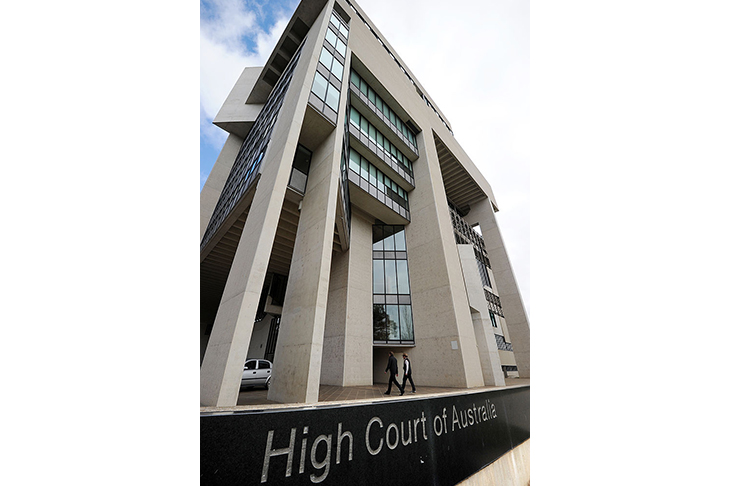
You’ve all seen the story by now. High Court judge Robert Beech-Jones decides to deliver a diatribe up in Townsville at a law association event. He singles out for special attack the Samuel Griffith Society (SGS), including alleging it has abused the legacy of Sir Samuel himself and is intent on trying to stack Australia’s courts with conservative judges. (To lay my cards on the table, readers should know that I have been a board member of the SGS for the last few years.) Beech-Jones also decides to throw judicial comity to the wind and take a run at the conservative judges on the US Supreme Court, going so far as to suggest a certain level of supineness.
But that’s not all folks! Beech-Jones in his talk implicitly criticises one of his fellow judges on our top court. Who? Well, for anyone in the legal fraternity it’s abundantly clear that the Beech-Jones’ ire is unmistakeably directed at Justice Simon Steward. There’s a disgraceful suggestion that law students who attend the SGS yearly conference – or any of its many events during the year – are endangering their future careers. Oh, and Justice B-J seems to think that it’s only conservative judges who speak at the SGS annual conferences. And believe it or not, that is just some of the highlights of the twenty-three-page, 150-footnote address up in Townsville.
The spray was so extraordinary and such a breach of all the usual conventions surrounding extra-judicial conduct by common law judges that it is hard to come up with any sort of comparison. Put it this way. Lionel Murphy would have balked at delivering anything remotely like this Beech-Jones effort. And even in the US, where the judicial world is much more vigorous in terms of top judges critiquing each other’s reasoning in their opinions (called ‘judgments’ in the non-US common law world), the blunt criticisms there are directed at the perceived quality of their colleagues’ reasoning, not at their politics or the conferences at which they choose to speak.
So some pretty remarkable stuff from Labor’s most recent appointee to our top court. Janet Albrechtsen noted in the Australian that she had formally enquired of the Chief Justice whether he had seen a copy of Beech-Jones’ diatribe before it was delivered. Or whether he’d been made aware of the attacks on the US judges prior to the diatribe. This country’s Chief Justice response was to personify that well-known Beatles hit ‘No Reply’.
And not just was it remarkable for the thorough-going way in which it shredded convention and judicial etiquette, it was also just plain out wrong in many of its assertions as well as in its core foundational premises. Start with Australia’s first Chief Justice, Sir Samuel Griffith. One of the biggest themes of the SGS is that our top court has ruined federalism in this country, judicially rewriting our Constitution at virtually every turn since 1920 to take power from the states (who, for instance, are the federal world’s only ones without income tax powers because, after a half century, our High Court rewrote the Constitution to take their income taxing powers away). That pro-federalism view by the SGS in no way abuses the legacy of Sir Samuel Griffith. He retired before the 1920 Engineers’ case that started the massive centralising rewrite. Griffith was a thorough-going federalist. The SGS hasn’t abused the great man’s legacy. It’s been the vast majority of a century of our top court judges, people like Beech-Jones, who have done that.
And if you want to talk about stacking the top court, the party that appointed Beech-Jones has always and virtually without exception only appointed centralisers to the top court. (The Libs have not been much better on the federalism front, also preponderantly appointing centralisers, though with at least a few exceptions to their credit such as Ian Callinan.) That Justice Beech-Jones, from the perspective of our states as they witness the Tasmanian Dam case and WorkChoices and Love, is what court-stacking really looks like. And what delivers world’s worst vertical fiscal imbalance, and mendicant states.
Then there is Beech-Jones’s misconception of who speaks at SGS conferences. High Court Justices Michael Kirby, Patrick Keane and Robert French – all appointed to the court by Labor – have in recent years spoken at our conferences. We even invited Beech-Jones to debate his views at this year’s conference but he declined because he claimed we at the SGS do politics, not law. I don’t think that Keane, French and Kirby thought that they were advancing some US-style right-wing political agenda when they agreed to speak. You? And does Mr Beech-Jones understand the difference between a) conservative political views and b) interpretive conservatism that seeks to leave final social policy decision-making with the elected branches, and is politically neutral? The SGS deals in b), not a).
As for the judge’s implicit threat to young law students in this country, for daring to be exposed to ideas and views outside the bog-standard law school progressive ones in this country, this might be the worst of the litany of his speech’s sins. The man should be ashamed of himself. Think back to the Voice debate. The vast preponderance of the lawyerly caste came out early and hard for Yes. I am speaking not just about the law societies and bar associations and law schools – though they did – but also about some sitting judges. Voices for No were close to non-existent. Think back to our law schools, the places training our future lawyers and judges and whose wall-to-wall progressive, soft-left orthodoxy Beech-Jones laughably treats as some sort of neutral, apolitical baseline. There are some 38 law schools in Australia and so dozens of hundreds of legal academics. Want to know how many came out publicly against the Voice? You could count them all on a machine operator’s right hand. I was one. I knew the other three. The rest of legal academia was apparently all-in on a proposal massively rejected by the voters. Or afraid to voice their views.
And likewise the peer-reviewed law journals were not interested in competing views. No, that was the SGS. We bent over backwards to invite a Yes speaker to that year’s conference. They all said they would not come and debate till we finally found one brave soul who came – and who probably worried that something like the Beech-Jones implicit threat of appearing at one of our conferences might affect his career. Virtually all other legal organisations shunned debating different views on the Voice in favour of virtue-signalling and preening their supposed Yes moral credentials.
My own view is that Beech-Jones (and if he signed off on this speech then also the Chief Justice) has or have opened themselves up to a blunt extra-judicial reply by Justice Steward.
As I said, Lionel Murphy wouldn’t have behaved this way. This, readers, is the lack of trust in the competition of ideas that we find right now on our top court.
Got something to add? Join the discussion and comment below.
You might disagree with half of it, but you’ll enjoy reading all of it. Try your first month for free, then just $2 a week for the remainder of your first year.