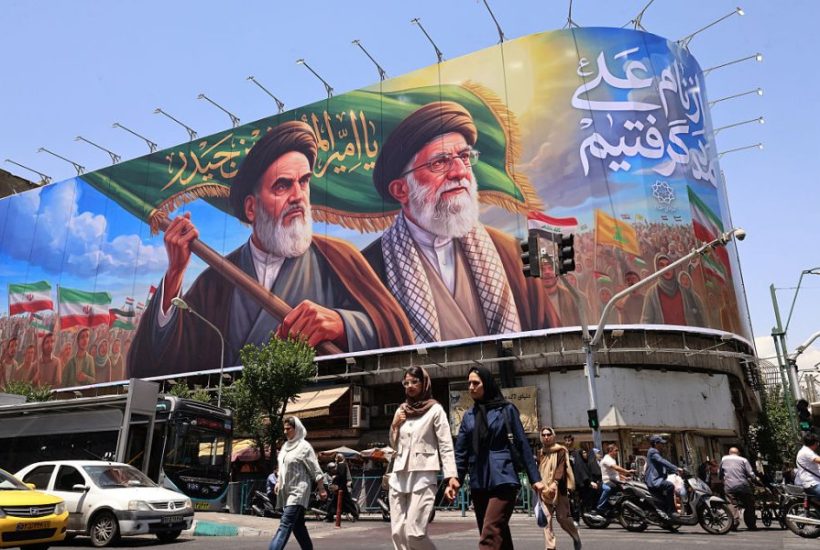
Negotiations between the US and Iran over an end to their conflict are ongoing, accompanied by occasional exchanges of fire. In Lebanon, the Iranian proxy group Hezbollah is engaged in daily clashes with Israeli forces. But whatever the outcome of these negotiations, it is possible to reach a conclusion regarding the war launched by the US and Israel on 28 February of this year: the Iranian regime has survived the attack on it and faces no danger of imminent collapse.
This salient fact means that it is necessary to re-examine the basic building blocks of both US and Israeli policy regarding Tehran. It turns out that the Islamic Republic and its alliance of proxies possess greater durability than had been imagined. What needs to happen now is a concerted strategy of support for both external and internal pressure on the Iranian regime, with the intention of bringing it down.
Israel has been engaged in nearly three years of war against Iran and its proxies. Yet until now, neither the regime nor any of the Islamist political-military groups that it uses as instruments of power projection have been conclusively vanquished. Hamas in Palestine, Hezbollah in Lebanon, the Houthis in Yemen, the Shia militias in Iraq and the Iranian regime itself have all been bloodied, are all weakened, but have all survived.
The Iranian regime has survived but it’s vulnerable
So Iran has survived, and with its proxies, it appears set to continue its disruption and subversion of any chance for normal development and normal life across a broad swathe of the Middle East. Since it has now been established that the regime cannot be aerially bombed into submission, what form might continued effective opposition to its ambitions take?
Recent reporting in American and regional media has revealed the existence of an Israeli plan prior to the war to partner with armed Iranian Kurdish organisations and launch a ground offensive into Iran at the start of the current round of hostilities. The reports claimed that the plan was formulated by Israel’s espionage agency, Mossad. An interview with Mossad director David Barnea in the Jerusalem Post appeared to confirm the existence of the plan, while remaining ambiguous regarding the veracity of its details. My own sources earlier confirmed to me the broad accuracy of the reporting on this matter.
As a reporter, I have been writing about and interacting with the Iranian Kurdish organisations in question for the last 15 years. I have visited their bases on the Iraq-Iran border, witnessed one of them (PAK) dealing with an Iranian ballistic missile attack in 2022, and/or interviewed the leaders of four of the five groups named as part of this plan. (Komala, PDKI, PAK and PJAK – the one I have no familiarity with is Khabat, a Kurdish Islamist militia).
I want to make two apparently (but not substantively) contradictory points regarding the abortive plan to have these forces enter Iran at the start of the war.
The first is that I’m glad the plan for a ground offensive wasn’t carried out. My sources confirm that Israel’s relationship with these organisations is of very recent vintage – a matter of months rather than years.
The combined strength of these organisations is not more than around 8,000 fighters. Claims had apparently been made that tens of thousands of Iranian Kurds would flock to their banners once they entered Iranian territory. Such claims can neither be proved nor disproved. But given what we now know about the failure of the broader Iranian population to rise up in real time and destroy the regime, the likelihood is that these Iranian Kurdish fighters would have been left isolated, eventually defeated and probably slaughtered by a vengeful, damaged but surviving regime. The Israeli air support mentioned in some of the reporting would almost certainly not have been available as a long-term asset.
The Iranian regime would then have exacted a bloody revenge against the country’s Iranian Kurdish population in the event that elements of it did rally to the banners of the organisations. The regime has a track record in that regard. In the period between 1979 and 1982, the regime massacred around 10,000 Kurds in western Iran. On that basis, it’s good that what looks to have been a hasty and ill-prepared incursion did not take place.
The second point, however, is that Israel’s involvement with the Iranian Kurds points the way to the type of activity that now needs to take place to counter Iran – but as part of a properly formulated, long-term strategy.
The Iranian regime has survived but it’s vulnerable. In the course of the war, it has become apparent that Israel has established a kind of counter-encirclement to the regime’s effort to surround Israel with a ‘ring of fire’ of proxy militias. In the UAE, Israel stationed an Iron Dome battery and covert surveillance equipment. In Azerbaijan, Israel stationed commandos and search and rescue personnel in the south of the country and established listening devices and an intelligence-gathering capacity. Last year’s twelve-day war and this recent conflict showed that Israel has its own networks on the ground inside Iran, able to be activated at will.
The missing piece in all this is the Iranian population itself. In the end, the regime will be undermined and destroyed only from within. But assistance from outside, developed and maintained intelligently and consistently, in cooperation with US-aligned regional players, and as part of a long-term goal of toppling the regime, is set to play a vital role.
With Iran set to survive the air war launched against it in February, this concerted campaign of pressure needs to begin. It should end only with the fall of the Islamist regime in Tehran.