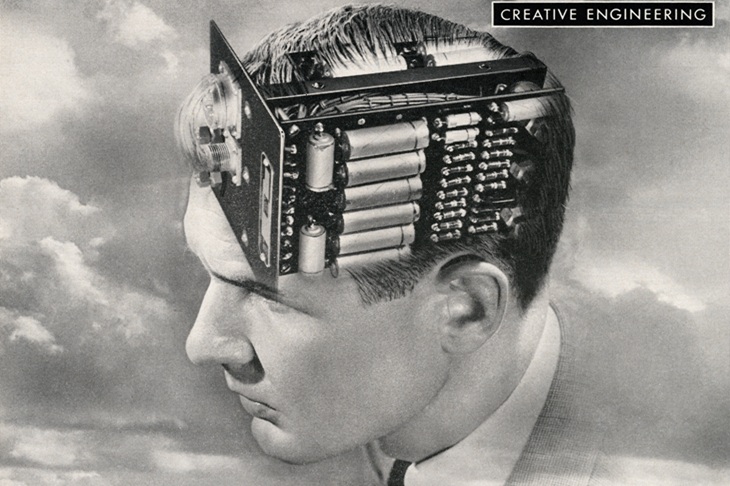
I’ve been thinking. Three words that have, throughout history, inspired hope, fear, or eye rolls when spoken. When I utter them, the immediate response from my wife is the latter, ‘Oh oh!’ And, after she hears the incredibly profound and intelligent results, ‘You think too much.’
The phrase, of course, is redundant as we are thinking all the time. Some people become lost in thought, others, like me, provide a dribbling commentary to anyone who will listen or who is unfortunate enough to be within hearing distance.
To temper this endless stream of consciousness, I do often try to think about nothing, which is difficult because nothing is something, but occasionally I manage to blank everything out briefly, usually in the shower. It’s a practise I call mindlessness – a tiny dose of death without the tragedy.
For the most part, I’ve found that thinking is inescapable and the only hope of avoiding madness is to find some way of controlling it. But given everyone these days appears to be completely insane, this is not as easy as it sounds.
My thoughts – sorry – are that smartphones have sucked the intelligence out of everyone and filled our heads with irrelevance. When all the world’s history, philosophy, experience, and knowledge can be accessed via a small device, why do you actually need to think? Our thought processes have gone from pondering life’s mysteries and solving the problems of the universe to trying to work out where we left our keys. Why generate our own opinions and think for ourselves when we can repeat a snappy social media comment or headline we saw that appears to be virtuous or clever? And, indeed, why question them?
The result is that large swathes of society think their thoughts are thoughtful, but in reality they have given them no thought at all.
Knowledge, wisdom, nuance, and context have all been outsourced so that thought, critical or otherwise, consideration, and problem solving can be flick-passed to a machine. The incredible amount of knowledge in our hands has incredibly reduced the knowledge in our heads. Phones are smart, but we’re not.
The most obvious result of this outsourcing of intelligence, is that people are no longer capable of argument and, by extension, are unable even to agree to disagree. Argument these days has devolved into the famous and prophetic Monty Python sketch. No-it-isn’t-ism.
All of this is currently far more apparent on the left, which via the education system is churning out radical brainwashed anti-West students in their thousands, while older lefties have allowed themselves to be dragged into the Wokesphere without questioning the madness. Bizarre trends and group thinking have taken hold and morphed into a quasi-religious cult in which fixed opinions cannot be challenged lest they inspire condemnation, hysterics and victimhood.
I live in a Sydney suburb which leans so far left it has fallen over and lies sprawled on the ground, unconscious. I used to fit in comfortably, allowing the stream of non-think to carry me down a river of certainty, complacency, and superiority, but since I became a right-wing extremist a few years ago by marching all the way over to the political centre my eyes and mind have been opened.
My group of friends have not abandoned me, much to their credit, and still treat me with kindness, much like someone with a serious physical or mental illness. I assume they believe their support will help me recover one day, though I expect they haven’t really given it any thought.
I think – there I go again – that they have, like many, lost their curiosity.
They watch only the ABC and SBS locally for their news and acquire knowledge of international affairs by watching CNN and Al Jazeera. Their assumption from this consumption is that they have absorbed enough knowledge to achieve balance and now have a fundamental grasp of reality and reason. Nothing more is required and no further investigation is necessary. They are ready to pronounce their truth as though it is the word of God and dismiss the poor deluded naysayers. Like me.
My fellow oldies at least have enough life experience to look sheepish when you call them out or expose their flimsy convictions, but the young provide most cause for concern. Their eyes open wide when they hear about Marxism or communism or socialism or Nazism and they believe those marvellous ideologies are the obvious solutions to society’s ills, which is a logical and natural reaction from people whose brains are not fully formed. But it would not occur to them to ask a basic question: I wonder if these concepts have ever been tried in the real world and what happened?
So, what is the solution to a problem that is causing society to slide into a Dark Age of the Mind? The obvious place to start, even without thinking, is to ban smartphones and fire all the teachers and university professors, but I suspect that quick fix is unlikely. Unfortunately.
Or we could simply hand over the keys to AI and say, here, you have a go. We can’t be bothered.
We are now well into the 21st Century, teetering at the peak of human achievement and advancement directly the result of thinkers thinking, expanding the possible and challenging the impossible, improving life to the extent that the average Westerner today lives like the kings of yesterday. Quite the achievement.
Yet things have now suddenly changed and the importance of thought is slipping away. If thinking was still considered the best way for humans to progress and to solve problems it would not have fallen out of fashion and been abandoned so quickly.
Who’d have thought?
Steve Harrison is a Sydney based writer and author of the novels, TimeStorm and Blurred Vision.