Here are two things worth considering…
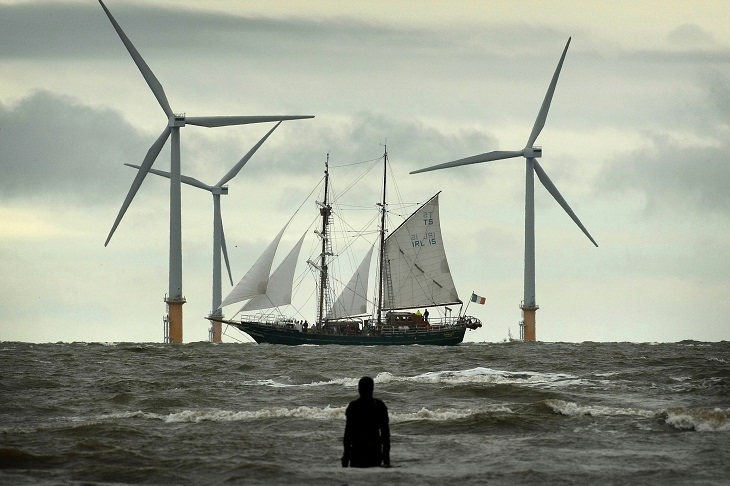
Firstly, green energy projects and state government agendas envision a version of Australia essentially surrounded by offshore wind parks. Bowen’s miraculous superpower by the sea. There are plans to put these things every-bloody-where.
Secondly, governments around the world, including ours, are spending billions on defence in expectation of a Pacific-based hot conflict involving naval fleets, possibly (but not necessarily) triggered by Xi Jinping’s threatened Chinese military action against Taiwan.
These facts seem unrelated; a red army and aquatic green battlefield.
And yet for near-on 30 years, concerns have quietly been raised about the potential negative impacts of offshore wind when it comes to national defence capabilities.
Several years ago, Sweden’s Defence Minister took issue with the nation’s planned offshore windfarms, arguing that the presence of 300m+ turbines with spinning blades may have consequences for both maritime and air surveillance radar systems in sensitive stretches of water.
These comments came in response to a study on proposed Baltic Sea wind farms in which the report alleged these huge machines could create ‘radar echoes’ and reduce missile warning by half.
Sweden is thinking about war more urgently than Australia due to both a culture of military realism and Russia’s invasion of Ukraine. War really is on Sweden’s doorstep. Europe remains one accident or misunderstanding away from a larger conflict. These hostilities are regularly tested with close-encounters involving shadow fleets, damage to undersea cables, and suspicious fishing trawlers dragging their anchors in strange places.
Last week, the veiled threats between Russia and the UK intensified with semi-serious winks and nods toward nuclear war. Switching out Starmer for a harder-red-leaning Prime Minister did little to improve tensions. Defence spending for the UK is expected to be somewhere in the order of £70 billion in 2026, with a distinct pivot toward nuclear as energy-hungry AI datacentres pop up under the guise of saving business money, but really, AI is leading future defence plans with drone war escalating.
For nations that lack billions of people to use as fodder, drone warfare offers a technical solution for an equation that used to depend on humans in uniform. AI is not a full replacement for boots on the ground, but this technology provides a strong-arm (or an annoying threat, if you are opposing it) whose damage levels escalate as the size of the enemy increases. Ukraine and Iran have both shown how this can playout in a real-world situation, and the US has taken significant notes in its preparation for potential hostilities with China. It is not clear if Australia’s Labor government bothered scribbling anything so much as a post-it.
Unsurprisingly, and as warned, this increased reliance on drones and AI for military applications is causing competition for rare-earths favoured by EVs and renewable energy, particularly gallium and germanium. And guess which nation dominates the supply chains?
China essentially tricked the world into pursuing a costly, short-lived, and civilisational-crippling renewable energy empire. Having depleted domestic resources, China’s likely aggressors are now dependent on Chinese supply lines for both critical energy infrastructure and defence weaponry right when the world’s first drone era is about to begin.
When I say our politicians and military strategists are unforgivably dumb, I am being generous. Instead of learning from these mistakes, they are busy making a whole stack of new ones with India off our west coast.
Many of our politicians get on their high horse about free trade and a peace-love-harmony world of infinite commercial enterprise. Meanwhile, China banned the export of gallium and germanium in 2023 to starve its military competitors. Guess what we have… Will we use these rare earths as leverage or to benefit ourselves? Probably not. The universe keeps bestowing natural gifts on this country, but forgot to give us politicians smart enough to make the best of them.
Meanwhile, China is taking its new large, unmanned crafts out for a test run. These are machines capable of carrying troops, armoured vehicles, landing craft, helicopters, and tens of thousands of drones perfect for landing operations.
Any slightly sentient citizen can see where this is headed.
The deeper one digs into this topic, the more obvious the problem becomes, particularly regarding offshore wind. Many other nations have been struggling to find a workable relationship between expanding green energy projects and fundamental military reality.
Finland was raising the alarm in 2013 with similar claims about radar interference.
Our Aukus partners in the UK, as an example, have made public their ‘need to find and implement technical measures to achieve coexistence of radar surveillance systems and wind turbines’ listing this as both ‘important and urgent’. The government admits that the detrimental impact of wind farms on radar surveillance, according to their reports, is ‘worsened by the increased size and scale of future planned wind farm installations’. That was published between 2019-2022. It has been half a decade since then, and the world is only getting more energy-hungry and more geopolitically fraught.
The US has always been one of the stricter nations on this front, and that continues with the Pentagon frequently blocking wind farms on notice of national defence.
While banning offshore wind farms in sensitive military areas, the problem is, I hope, obvious. If wind turbines have the potential to act as camouflage, these areas will become favoured routes by hostile parties. To simplify, they are a forest cover of metallic trees.
One could argue this is a self-inflicted defence headache Australia didn’t need. We have abundant fossil fuel and nuclear resources and yet the green agendas of politicians have been allowed to manifest into real-world national defence concerns.
In a 2025 report cited by the New York Times, the Direction of Natural Resources and Environment at the Government Accountability Office said:
‘The physical properties of the wind farm that can disrupt some radar would be the same … interference from wind farms can cause problems for ground-based radar used to track aircraft, but does not affect radar used by aircraft flying above the turbines.’
Given how tall some of these new turbines are, it would be reasonable to assume some military aircraft can scoot beneath.
There are also reports that offshore wind may have an impact on subsea sensors aimed at detecting submarines. That is a greater threat within the context of Australia. Not only did we have Japanese submarines sniffing around our harbours in the previous world war, there have been reports of unwelcome Chinese submarines getting way too close in recent years. At the very time when we need maximum clarity of our waters and air space, things are getting murky.
Advocates of wind farms insist that we need both wind farms and defence, but that is not strictly true. Wind farms are a completely optional energy choice. They did not exist for most of our civilisation and, with other forms of energy on offer, there is no real argument other than ‘politicians like them’.
The case against offshore wind farms, particularly in Australia, is not limited to radar. Given the size and scope of these installations, they have an impact on low-flight operations, whether those are commercial or military. Visual surveillance, in particular, often uses low-level fight.
We may add that just because the Department of Defence says ‘okay’ to offshore wind farms, it does not make the problems go away.
As written in The Strategist:
‘In Australia’s case, declared offshore wind zones sit close to air force bases, naval aviation corridors, submarine operating and training environments, air-defence and surveillance radar coverage, undersea cable routes, and ports designated as critical national infrastructure.
‘Australia has proposed offshore wind zones adjacent to some of its most critical east-coast infrastructure, including the Port of Newcastle and Wollongong’s Port Kembla, either of which may host a future submarine base. Australia’s largest fighter base is at Newcastle.’
This only covers some of the more obvious potential military issues. There is a whole wide range of other scenarios involving drug smuggling, terror activities, sabotage, and even nations such as Germany raising a flag of concern regarding surveillance and China-made turbines operating around Nato territory.
These are not my assertions, they come from circa 2025 and were reported in many major publications.
‘When using systems or components from Chinese manufacturers … given the political situation, it can even be assumed that such a slowdown or even disruption would be deliberately used by China as a means of political pressure or even as an instrument of economic warfare.’
This claim stems from the German Institute for Defence and Strategic Studies and attracted a stern denial from the Chinese government insisting there was ‘no evidence’ to suggest a security threat from Chinese wind technology constructed in Europe. Politico further ran the headline, China could blackmail Germany via wind turbines, report warns.
This is not the first time Chinese-made tech has been side-eyed, with many nations choosing to keep certain companies and tech out on the grounds of national security or surveillance concerns.
Evidently there is more than one issue of concern at play here, but if we ignore the structural vulnerability of foreign-made and reliant technology from our most likely geopolitical aggressor and instead focus on the problem of physical interference … it is still a conversation that is not conducted in the public sphere.
When was the last time you heard a green-tinged politician have a serious discussion about military implications of wind farms?
Have you heard our Defence Minister address the topic lately?
Any Shadow Ministers?
As far as I recall, the topic did not arise during the two great splits over Net Zero within the Coalition. Those political schisms were about votes, not national security.