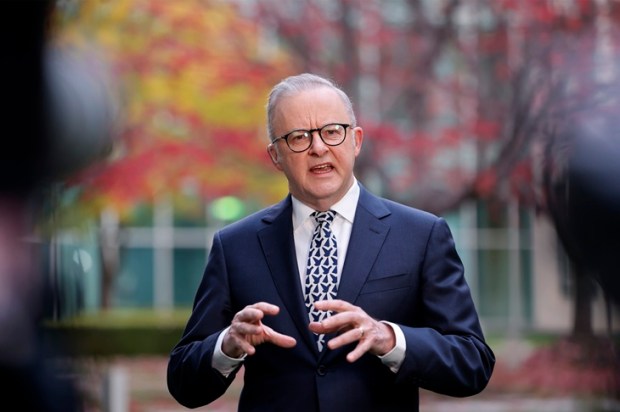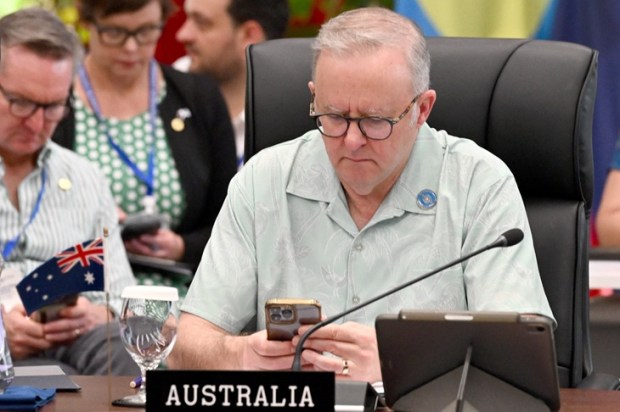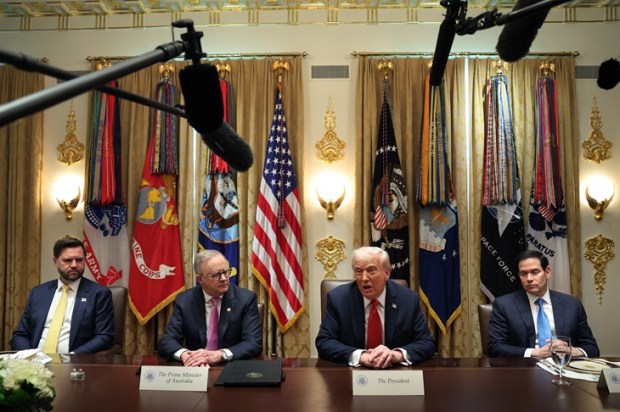
The price of coffee is set to become an election-defining issue after the Prime Minister was ridiculed and community-noted across social media for promising ‘cheaper coffee’.
Or maybe Labor went ahead and launched their original policy thought bubble instead of checking what actually happened in real life.
Perhaps they never properly understood their policy in the first place.
This isn’t clear…
Regardless, if you are buying a cup of coffee after October 1, either nothing changed (except the wording of signage), or the price of coffee went up.
What coffee most certainly did not do is ‘get cheaper’.
Before we get to why Albanese is wrong, let’s go back to March.
On March 31, the Treasury, under Jim Chalmers, put up a self-congratulatory press release titled, Ending card surcharges to help with the cost of living.
Maybe that was their intention. Maybe not…
A voter reading this might assume the concept of card surcharges, in their entirety, were being removed.
This interpretation, which is the ordinary reading of the promise, is where much of the angst comes from. What people did not realise is that businesses were being banned from passing on merchant fees as a separate surcharge. It is a distinction never made clear and never corrected.
Removing the fee sounds good for the economy. Forcing businesses to wear it or hide it sounds bad for the economy.
Having spent hours on the detail, it is still not wholly clear what the intention was, beyond a click-bait headline. Even the wording is misleading, with the Treasury promising Australians will ‘no longer pay $1.6 billion a year in surcharges’ and small businesses ‘save $910 million when credit and debit card surcharging ends in October’. The release went on to say:
‘People shouldn’t be punished for using a credit or debit card. Australians should be able to use debit and credit cards without being penalised, and that’s what this change will help deliver.
‘In late 2024, the Albanese Labor government announced that we were prepared to ban debit card surcharges to help with the cost of living … in response to this, the Reserve Bank will today take steps to end credit and debit card surcharging from 1 October.’
If you go back and check the RBA media release from March 31, it seems to suggest this.
Key decisions of the Payments System Board include:
‘Removing surcharging on debit, prepaid, and credit cards on the designated eftpos, Mastercard, and Visa card networks. The surcharging framework, introduced more than two decades ago, is no longer achieving its intended purpose of steering consumers towards making more efficient payment choices. The increased prevalence of businesses surcharging all cards at the same rate, challenges with enforcing the current surcharging framework, and consumers using less cash have reduced the effectiveness of the surcharging regime. Removing surcharging would make card payments simpler, more transparent, and increase competition among payment service providers. Removing surcharging also aligns with the preference of most consumers for payment costs to be incorporated into advertised prices.’
You have to read that quite carefully to realise that the RBA is not suggesting the removal of surcharges from reality, only from a line-item on the receipt.
This is made slightly clearer in a follow-up recommendation about ‘lowering the caps on interchange fees paid by Australian businesses’.
Which follows with: ‘These changes are expected to lower businesses’ costs when they accept domestic or overseas card payments. Small businesses should benefit the most because they tend to pay fees closer to the existing caps.’
It is implied that the business savings, quoted at $910 million, are coming from the cap, not the removal of surcharges. That is only true if businesses were genuinely absorbing the surcharge rather than restructuring their prices or passing on the surcharge. Considering that businesses do not explain their margin structures, one wonders how this saving was inferred accurately when all they have to go on is businesses who list the surcharge separately. Businesses are complex organisms. Press releases cannot make claims about savings when numbers are interacting in complex ways. $910 million might appear on a spreadsheet, but it is doubtful it will manifest in full.
As for customers, their savings of $1.6 billion could only, theoretically, come from the passing on of the cap. But given surcharging will no longer by displayed as a separate line item, customers have no way to determine what surcharge they were charged. Indeed this has the opposite effect of the report which sought to encourage competition between providers. If customers do not have visibility of a surcharge, and businesses are averaging it out and burying it in the cost, how could competition possibly emerge?
Fast-forward to October.
The final release, as quoted on the Australian Small Business and Family Enterprise Ombudsman, reads:
‘The Reserve Bank of Australia’s card surcharging ban came into effect on 1 October 2026, meaning businesses can no longer add a surcharge when customers pay by eftpos, Mastercard, Visa, or American Express.’
To be clear, the Treasurer, RBA, and the government allowed the public to believe that surcharges would no longer exist.
Yesterday, people realised what was actually going on when cafes and retail stores reprinted their menus or changed the cost of their products.
Businesses are expected to continue restructuring their pricing to cover the surcharge in an aggregated fashion. Very few are able to wear it, and why should they? These nonsense fees add up to employees they cannot hire. Surcharging is one of the thousand invisible threads holding back productivity.
If the videos on social media from the Prime Minister are anything to go by, it seems the government has gotten themselves very confused about how pricing, discounts, and fees work.
One interpretation is that, sometime last year, the Labor government saw a discount offered to cash sales as a punishment for card transactions. Because this is a socialist-y government that views society through the lens of oppression, they misinterpreted what was meant to be an act of fairness as aggression and unfairness toward card payments. Maybe a policy advisor then thought, heck yeah, easy win for votes!
To clarify, if only for the benefit of the Treasury…
The cup of coffee costs $5.00. That is the value a business can sell their coffee and remain in business.
If a customer pays by cash, the business can sell it for $5.00. Awesome.
If the customer wants to pay by card, the business incurs an additional fee thanks to the cards. If they charge the customer $5.00, they are actually selling that coffee for $4.50 and the businesses goes bust. Slowly. In order to ensure the cup of coffee is still being sold at $5.00, the business adds the surcharge to the sale. The cup of coffee is actually the same price.
To illustrate this point, there is a great meme running around of an eftpos machine under a plastic box with a sign reading: ‘50 cents to unlock.’
The surcharging was not a choice businesses made to punish card-paying customers and they do not make money from its existence. Nor are they misleading customers with surcharging at the terminal or in any way discriminating unfairly against customers brandishing different cards. The cards themselves do that.
As someone with over a decade of retail experience (and involved in one of the early software adoptions of terminals with complex surcharging), I have always found the sneering of commentators and, at times, governments at the use of cash as some kind of under-handed exchange to be incredibly distasteful. I am not saying that is what Labor have embarked upon, only that the commentary surrounding this release has dug up this ‘we should just ban cash’ crowd and it is tiresome.
Anyway, businesses were not so much offering a discount for cash payments as they were trying to avoid an argument at the register with customers who don’t understand card fees. It was never really a discount. It is the original price.
Every business person understands this. And, frankly, I think even the Prime Minister and Treasurer do too. Which is what makes their commentary so jarring.
At best, if we accept the surcharge caps, coffees went from $5.00 to $5.25 for everyone (instead of $5.50 for card holders). That is not how the general public imagined the We banned surcharges and made coffee cheaper!!! promise to manifest.
The surcharges are still there.
The coffee is not cheaper.
And this ultimately cost businesses in reprinting, repricing, and technical changes to their POS and reconciliation processes which includes paying staff more hours to work out how the heck to incorporate the change. No doubt those extras will be included in the new prices.
Essentially, the government has forced businesses to hide the surcharge in the price and offer actual discounts to cash purchases.
That will definitely cause arguments at the register.
You can see that this has not made coffee cheaper. Not for the card payer, and not for the cash payer.
This means Albanese’s claim is mostly false in theory and almost certainly false in practice, even if a discount for cash is still applied.
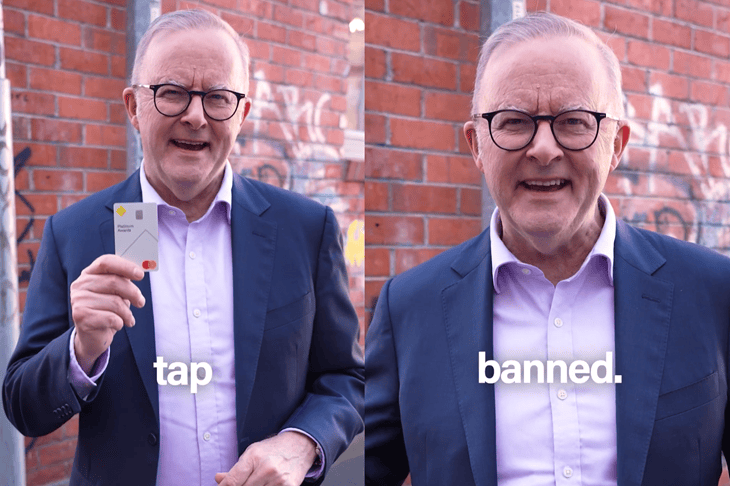
Pay by card? You’ll want to hear this… pic.twitter.com/MKVt1Uhdoo
— Anthony Albanese (@AlboMP) September 30, 2026
None of this stopped Albanese waving his bank card around as if it were his Medicare card, quoting the March release when he said surcharges cost $1.6 billion each year ‘but from today, they’re banned, saving you money every time you tap’.
How are they banned?
They are still being charged to the business. The businesses are still passing them on. They are certainly hidden.
But they are not banned.
The RBA’s release is very clear: ‘The changes apply to card payment surcharges on transactions on designated card networks. A surcharge in the context of card payments is an extra fee charged by the merchant to the customer for using a particular card to pay for a transaction. Payment service providers set their own pricing for the card acquiring services they provide businesses. This may include fees for renting payment terminals, processing transactions, or other payments-related offerings. These are fees for services provided and are not considered payment surcharges. The charges to remove card payment surcharging do not apply to these types of fees.’
And in case Albanese is still confused, ‘Businesses will still incur costs when accepting card payments. Those costs can be reflected in a business’s overall pricing, rather than charged as a separate surcharge.’
If the government cannot keep its story straight on the cost of coffee, how on Earth are we supposed to trust them to manage the nation’s finances?
Our trillion dollars of debt is starting to make sense.
Because a government that can’t work out the cost of coffee sure as shit can’t balance a budget.
Alexandra Marshall is an independent writer. If you would like to support her work, shout her a coffee over at donor-box.