Australia’s establishment, whether it be politicians or journalists, calls the present insurgency a convulsion. It has the diagnosis backwards: the seizure is its own. Australia is one of the clearest places to watch how politics can shift and how incumbent players react to this change.
Anthony Albanese has lost his lead in the polls and his mind is now plagued by uncertainty.
He is handling it the way many people handle a big loss…
Told that One Nation sits ahead of his party on the primary vote, and that Pauline Hanson has passed him as preferred Prime Minister, he did not ponder its significance, reach for a new argument, or look to the future. Instead, he reached for an old trope. People are under pressure, he said; it is easy to identify grievance, the issue is providing solutions; the government would keep reminding voters of what Labor had already done for them.
The response was anything but the enlightened kernel of a constructive strategy. If Labor had done so well, why the electorate response? Instead, Albanese’s reaction symbolised the first stage of grief.
Half a century ago Elisabeth Kübler-Ross set down the sequence the dying and the bereaved tend to move through: denial, anger, bargaining, depression, acceptance. Commentators have borrowed it for politics before, as I am doing now, often as a joke at someone’s expense. But it deserves to be taken more seriously than that – for two reasons that have gone almost entirely unremarked.
The first is that the sequence helps depict what might happen next: tell me which stage of grief a ruling party is in, and I will tell you its next move. It was not hard to foresee Albanese’s response to losing; nor Starmer’s response to his electoral drubbing in May. The second reason for spending more time with this idea of grief is that there is more than one mourner in the room – and they’re not grieving in time with each other, or even in the same way. One mourner is the party; another is the voter.
Denial
Denial says: this is not real; it’s a protest vote; it’s a flame of anger that will flare and fade as quickly as it came. Newspaper headlines have already taken up this idea: ‘Albanese’s plan is to wait out Pauline Hanson’s populist surge.’ The reflexive answer is to restate the old contest as though it were still the only one on offer – Labor or Liberal, left or right, a vote for anyone else is a vote wasted. The establishment files the insurgent – in a phrase that recurs in many countries – as a spasm, an emotion; not a structure, which is more durable.
Denial is the most comfortable stage, because it requires nothing. You need only keep talking, and wait for the electorate to come to its senses. It has served Australia’s government well for more than ten years. Why not anymore? The Labor Party is pushing on the only question it knows how to answer in some form – has this government delivered? – while the electorate has moved on to another question entirely: Does this party still speak for people like me?
Anger
When the increasingly self-righteous prompts of the leadership fail, their tone hardens. The insurgent is no longer a misunderstanding to be corrected but an enemy to be named and trashed. And so we have sneers about competence.
Could she even manage the grown-up business of mature government: policy-building, delivery, alliances, maintenance?
Can she stand up to the press gallery with all its intellectual heft?
Morality is leveraged – these days not the morality of religion, but the morality of the urban intellectual elite, who understand the way the world really works. Labels are applied as load-bearing shorthand – the most reliable of which, worldwide, are the phrases ‘radical right’ or ‘fascism’.
It is worth stopping on those choices, because it is where thinking goes to die and the need for serious analysis is waived. The academic literature has spent two decades testing whether mainstream parties can win voters back by reasonable ‘accommodation’ – by moving right. It keeps finding accommodation doesn’t work. However, the academic researchers and party strategists then reach for the wrong lesson: that voters are beyond reason.
Efforts to accommodate do not fail because of voter derangement; they fail because the inherited axis of political fight is dissolving. The vote is not marching rightward. What is forming is cross-flank – borders and the forgotten worker and the striver, drawn from the right and the left at once. Consider Narungga in South Australia, where One Nation won outright in 2026, and the local elections in Britain last month, where Reform overtook the Conservatives. Sir John Curtice delivered his judgement: Britain ‘has become highly fragmented’. These events are not rightward lurches. The results show the old axis coming apart – disintegrating – not suddenly swinging to one side in a fit of pique.
Which means that a party cannot accommodate the new forces by sliding along the axis – the old line is breaking.
Democrats have tried sliding in America with almost perverse results. The political science that insists on ‘the radical right’ or ‘fascism’ is not standing outside the elite’s anger, diagnosing the cause. It is inside the establishment, supplying a vocabulary it is grasping for – offering validation and propping up the fragile sense of self-worth.
Germany has built the purest example of this predicament, although hints of similar thinking are found in Britain and Australia. German elites have built a cordon sanitaire – in which every legacy party from left to right links arms and adjusts conventions to keep out the Alternative für Deutschland (AfD), as occurred in Thuringia.
Once again, the AfD leads the polls – this time 41 per cent in Saxony-Anhalt. The AfD may come first. Winning the vote, the establishment everywhere used to insist, should mean something. Yet it is a principle that loses friends the moment the wrong side moves ahead. Germany’s elite are yet to find a constructive way forward.
The legacy party’s anger comes from a loss of validation – grief frozen at the second stage, refusing to move.
It reminds me of Emma Thompson at the end of the film, Love Actually. I can see Albanese repeating her sentiment: ‘You’ve made a fool out of me; you’ve made the life I lead foolish too.’ I sympathise. How can he forgive what the electorate is currently doing to him?
Bargaining
Then the bargaining begins. First, the posturing – ‘we hear you’. It has a conciliatory, if artificial, edge, like a real estate salesman recognising the buyer’s worries without changing the price. Then, if the rhetoric fails, out comes the policy switch: adopt the insurgent’s positions and hope the voters come home. It is the stage that looks most like cleverness – hinting at the master strokes of such campaign virtuosos as Rudd. In fact, it is the most futile in the current situation, for two compounding reasons.
The first we have already discussed: the party is bargaining along a dissolving axis. The second is that winning the displaced back requires something the establishment no longer has to hand – a vehicle and a leader. A vehicle that actually fits the abandoned voter, and a leader with, as it has been put in these pages before, the correct biographical signature for the changing electorate.
Abbott had it; Turnbull didn’t. Thatcher had it; Blair had it – the rest, the followers, merely traded on the memories of these leaders, the goodwill they created. I wonder whether recent leaders secretly resent their predecessors’ immense success; whether that may be part of the problem we face.
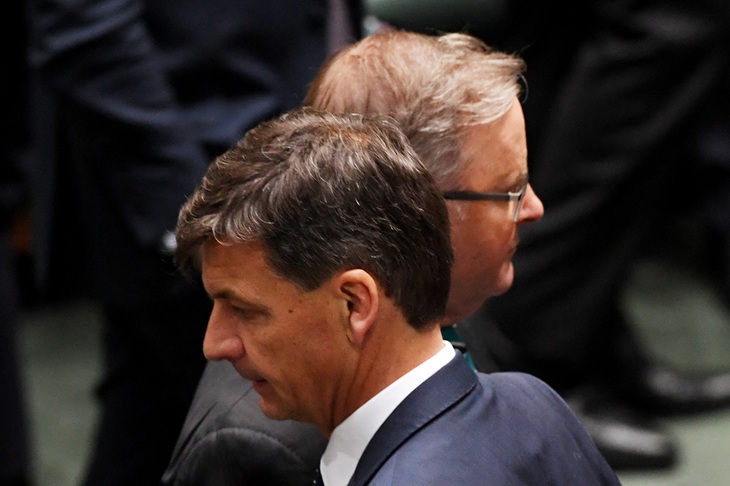
In any case, Angus Taylor does not have the right biographical signature, and no amount of borrowed toughness will lend it to him. Meanwhile, South Australia shows the vehicle problem in its starkest form: the state has had no Nationals since 1932, when they fused into the Liberals. The conservative–rural vote has nowhere to go but out: straight to One Nation, with no buffer in between. It is hard to mimic your way back into a constituency you have left, especially if you have neither a voice to engage it nor a vehicle to carry it.
Depression
Britain is further down the road than we are, and shows what waits at the end of bargaining. After the May rout, a government short of credibility wheeled out the past: Gordon Brown, Harriet Harman – yesterday’s people, because a machine which had spent a decade purging its disruptive talent could no longer manufacture today’s. Sir Keir Starmer gave the speech of a man running through a checklist of tired tells.
Australia as a whole is not there, but the Liberal Party may be. Many of its tactical moves over the last decade or so have resembled Britain’s Labour Party, including now the resort to past luminaries. The Liberals are grieving – not just the rise of a rival but the death of itself, leaking professionals to the teals on one flank and the battler they abandoned to One Nation on the other.
And here is the turn a casual version of the five stages of grief tends to miss. The party is not the only mourner. The voters are grieving too – and they started first. A friend of mine wrote to say that she found my arguments sobering, that she was still processing them, and that nothing so far had proved them terribly wrong. She is close to acceptance. The party I assume she votes for is not.
The gap – between a voter or an electorate which has already reached the stage of acceptance and a political apparatus still reminding the world of its fuel excise genius or foreign policy coups – is not a curiosity. It is the clearest measure we have of how much realignment is still to come, and how long the legacy parties have left to grieve.
Acceptance
Which leaves the last stage, and it has two doors through which legacy parties can seek to pass.
The first is the deal. Accept the insurgency as real – permanent – and come to terms with it. The faster the better. It allows something to be gained. First steps may be preference sharing, an arrangement, in time a coalition. This is the common ending.
The Liberals and the Nationals, in their different positions, are standing in front of that door right now, deciding whether to walk through it, wondering how they can remain key players and avoid being absorbed or reduced to a letterhead.
The second door is the rebuild: actually remaking the party to fit the country. It is almost never opened.
The record of the last century and a half is close to unbroken. Every leader of an established party who sought to recover their voters – an electorate, more often than not, they consciously abandoned rather than accidentally lost – was eventually destroyed by his or her own party machine, from Joseph Chamberlain to Thatcher to Abbott. The institution got precisely what it wanted and lost the war by winning the fight. No one is left to match the times.
The single exception is America, and the exception proves the rule. Donald Trump did not persuade the Republican machine; he bypassed it, walking through the open primaries straight to the voters and capturing the party from the outside. We know this from the howls of the Republican establishment. Westminster has no such option. The preselection room is locked from within, which is why Britain and Australia will chase a deal with increasing energy – not genuinely rebuild.
Australia has an important place in the global argument. Compulsory voting and full preferences among other factors make the subtleties of dissolution more legible here than anywhere else – and in a single month, May 2026, two by-elections ran the experiment side by side. At Farrer, the displaced vote assembled and One Nation took a safe Liberal seat. In suburban Nepean the same energy was stranded – a solid primary, but preferences did not consolidate; the Liberals held on. Same country, same month, opposite endings.
Grief is universal: the process is now grinding through Britain, France, Germany, Italy, and the US. The architecture – the combination of national system and local terrain – decides how it finds expression.
I expect the vocabulary of stage two, anger, to go on for a while yet – Labor railing against the spasms, the convulsions, the derangement, the radical right, the deplorables. It is worth remembering what that language is. Grief that calls the new world mad is simply grief that has a long way to go before reaching acceptance.
The axis is reconstituting whether the political parties can see it or not. Voters have increasingly accepted that the past is gone.
In contrast, Australia’s legacy parties have a long way to go before their grieving is finally played out.