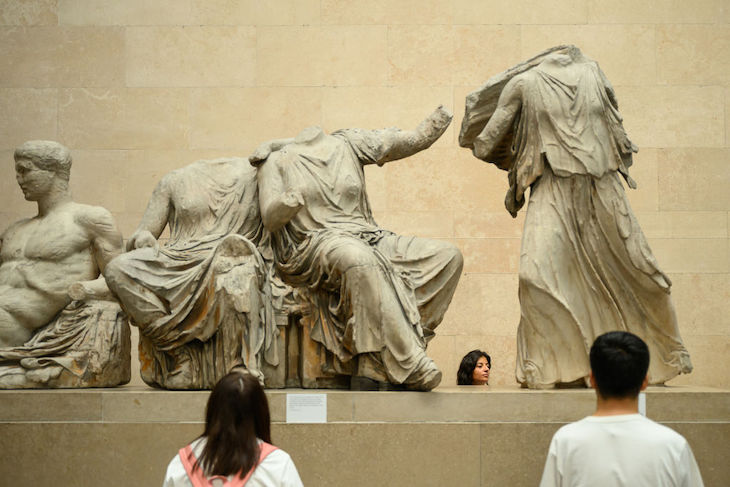
Between 1801 and 1812, more than 100 tonnes of Pentelic marble were hacked away from the walls of the Parthenon in Athens and carried off to London.
A year after operations began, a portion of the collection sank off the Peloponnese Peninsula, close to the island of Kythera, and required a painstaking effort to salvage them.
Today, about half of the marbles remain in Athens, while the other half reside in the British Museum. For Greeks around the world, the debate about who owns the marbles means more than a mere museum collection or legal clause. Instead, it is about identity. For the rest of us, the reunification of the marbles should be seen as one of the most significant opportunities in art history.
The British Museum, along with the British government, has the chance to restore a timeless masterpiece to its original whole.
The marble masterpieces, carved out of the nearby Mount Pentelicus under the celebrated sculptor Phidias’ direction in the 5th Century BC, depict the Trojan War, the Panathenaic Procession in honour of Athena, and the Gigantomachy – the mythical battle fought between the Olympian gods and the Giants for control of the cosmos – among other scenes from Antiquity. They sat atop the Acropolis, that high rocky hill and ancient citadel above Athens, and formed part of the outer walls of the Parthenon’s inner chamber. If ever a building could be the soul of a culture, it is the awe-inspiring Parthenon, which overlooks Athens and has inspired artists and architects for some 2,500 years. The marbles that once adorned this most impressive building formed a frieze, a tapestry of stone, which withstood time and outlasted civilisations.
Leading the mission to remove the marbles at the turn of the 19th Century was Thomas Bruce, the 7th Earl of Elgin, thus known as Lord Elgin. In the summer of 1801, Elgin obtained a firman (an official decree from the Ottoman Empire, having been ambassador since 1798) to remove the stone relics. The decree came from the Sublime Porte, the Ottoman imperial government, which gave Elgin permission to carry away anything from the Temple of the Idols (the Parthenon) which had ‘old inscriptions or figures thereon’. While the Ottomans were largely apathetic to Greek heritage, Elgin’s special permission was catalysed by Great Britain defeating Napoleon in Egypt, restoring an important eyalet to the Sultan. While guilty of disregarding Hellenistic culture, the Sultan cannot be charged for failing to return favours, although Elgin’s heavy financial bribery might have helped fast-track the process. Dubiously, the decree exists only as an Italian translation by the British Embassy in Constantinople, and is held by the British Museum, meanwhile the original Ottoman Turkish copy is unfindable.
The Ottoman Empire ruled Athens from 1458, having absorbed the rest of Greece a short time after the fall of Constantinople (1453). Under their Ottoman overlords, Greek Christians were forced to pay jizya, were classified as second-class dhimmis, and subject to other tribulations, such as the Devshirme, which forced Christian boys to convert to Islam and fight as elite soldiers known as janissaries, who often fought against their own ethnic and religious kin in Greece and across Europe.
After centuries of severe oppression, the Ottoman Empire formally recognised Greece as independent in 1832, but only after Great Britain, France, and Russia completely annihilated the Ottoman-Egyptian navy (in the Battle of Navarino in 1827) and soon after accepting the London Protocol in 1830 and signing the Treaty of Constantinople two years later, marking the liberation of the Hellenes. However, 16 years earlier in 1816, Lord Elgin, who was facing personal bankruptcy, had already sold his half of the marble sculptures to the British Museum for £35,000 (roughly £3.6 million today).
A short time after Greece became independent, the newly established Kingdom of Greece began to make informal appeals for the return of its looted antiquities. In 1834, newly appointed Greek and Bavarian scholars, who were working for the German-born King of Greece, Otto (who reigned from 1832 to 1862), conducted an inventory to tally up what had been taken from the Parthenon and sent informal diplomatic appeals to Britain. These were roundly ignored. In 1841, Lord Elgin died. A century and a half later, give or take, Greece submitted its first diplomatic request in 1983 and, the very next year, brought the issue before UNESCO’s Committee for Promoting the Return of Cultural Property. Greece has continued to raise the point almost every session since 1984. However, the British Museum Act 1963 remains the primary legal barrier preventing the museum’s trustees from deaccessioning items in the collection. Under Section 3 of the Act, the trustees of the British Museum are strictly forbidden by law from removing any item from the museum’s collection on a permanent basis.
One cannot help but think that the legal arguments that have tinged this debate are incredibly insufficient. An artistic matter should ultimately be settled by artistic judgement. This is precisely why the Greek government has never demanded that museums around the world return their Corinthian helmets or Chalcidian vases. Greece’s claim is confined to the sculptures of the Parthenon, for they belong to the monument itself. That is not so much a nationalist argument as an appeal to artistic integrity. Beyond the myopic, legal pettifogging of this matter lies a question of civilisational magnitude. Even the Romantic poet Lord Byron reviled Elgin, the ‘plunderer’, for carrying off the Parthenon marbles and desecrating the British reputation in the eyes of Minerva (Rome’s Athena). Indeed, Byron wrote The Curse of Minerva (1811) and portions of Childe Harold’s Pilgrimage (1812) denouncing Elgin for what he had done. In The Curse of Minerva, Byron compares Elgin to Alaric I, the ancient Visigoth king who famously invaded and sacked the birthplace of Western Civilisation in 396AD:
Lo! here, despite of war and wasting fire,
I saw successive Tyrannies expire;
‘Scaped from the ravage of the Turk and Goth,
Thy country sends a spoiler worse than both.
I find it hard to share in Byron’s scorn for Elgin. Thomas Bruce may have paradoxically preserved half the sculptures. By painstakingly transporting the marbles back to London he ensured at least one half of the sculptures were always preserved. Any reunification of the marbles, therefore, should not be viewed as an act of anti-British justice. It so happens the other half remains still largely intact in Athens. Having survived through the tumultuous centuries and into the 20th, Athens was bombed during the second world war by not only the Germans, but the Italians and the Allied forces, including the British. Fortunately, Athena was watching over the Acropolis, although it may have been slightly chipped and bruised by stray mortar shells during the internal fighting between the British-backed Greek government and communist resistance fighters during the Dekemvriana in 1944.
In fact, one might recall the story in Plato’s Symposium of Zeus splitting the humans to weaken them. Originally, man and woman were bound together as powerful beings with four arms, four legs, and two faces – this ‘androgynous species’ is where we get our concept of the ‘soulmate’. This mythological separation created a lifelong longing, a homesickness felt by the two halves, which one can imagine is not unlike the separation of the Parthenon marbles. Though the sculpture and the first species of human in Greek myth were split under different circumstances, both stories – one true and one myth – exude a melancholy not dissimilar to each other.
For much of the 20th Century, one of the British Museum’s principal arguments for keeping the marbles in London was because Greece lacked the means to properly exhibit them. That all changed with the opening of the Acropolis Museum in 2009. The entire top floor of the museum, designed by architect Bernard Tschumi, is a glass-walled gallery positioned so that the viewer can behold the Parthenon temple while marvelling at the marbles. Yet, like a plastic doll in place of a tender child, the Acropolis Museum has substituted the missing half of the sculptures with plaster casts. To me, this seems unjust, almost eerie, as though the marble figures interact with an artificial twin while their other half lies 2,390 kilometres away, yearning to bask in the Greek sun once again.
Nonetheless, whether you call them the Parthenon or Elgin marbles, those wondrous sculptures of stone remain largely intact. And yet, they remain partitioned, disunited, longing for the other half from other ends of Europe.
The marbles were never meant to be split up and viewed as individual details of a broader picture, not to mention at eye-level, for the sculptures were designed to be gazed up at by Athenians so that they may contemplate their history, culture and shared spirit.
If returning them to Athens corrects a historical dispute, reuniting the two halves of the Parthenon marbles restores aesthetic justice and a masterpiece to the form its creator intended. If their survival through centuries of war, empire, and upheaval is not persuasion enough, perhaps nothing is.