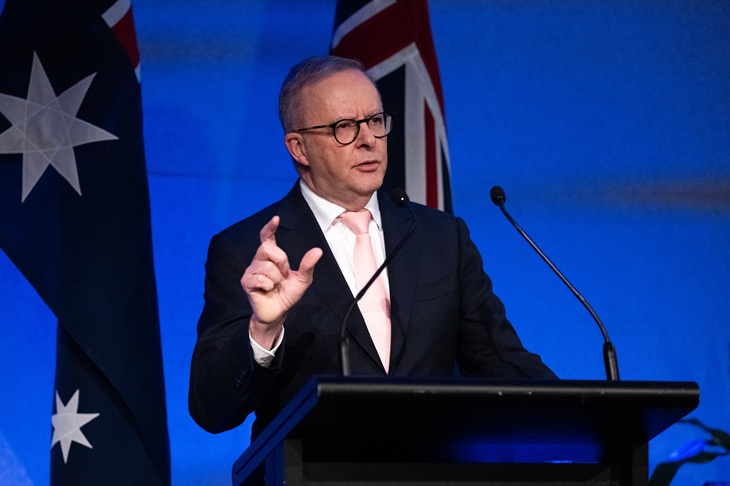
The Albanese government’s housing policies have been sold as the great Australian dream made accessible. Five per cent deposit schemes, government guarantees and shared equity arrangements are presented as helping young Australians achieve home ownership.
However, there is one question that seems to be missing from the sales pitch.
What happens when house prices fall?
For years, governments of all persuasions have built housing policy on the assumption that Australian property values only move in one direction. History suggests otherwise. Markets rise, markets plateau and, sometimes, markets fall.
When buyers enter the market with only a five per cent deposit, it does not take much of a decline to wipe out their equity. A purchaser buying a $900,000 home with a $45,000 deposit needs only a modest fall in prices to owe more than the home is worth.
Negative equity is not just an accounting exercise. It traps families. It limits their ability to refinance, relocate for work or sell without crystallising a substantial loss. Should unemployment rise, relationships break down, or financial hardship strike, many would find themselves carrying debt larger than the value of the asset securing it. Some could face bankruptcy.
This risk is magnified because many recent buyers have already endured one of the sharpest interest-rate tightening cycles in decades. Since the Albanese government came to office, Australian mortgage holders have lived through more than a dozen Reserve Bank cash rate increases, leaving many households paying hundreds or even thousands of dollars more each month than when they first borrowed. For borrowers who entered the market with only a five per cent deposit, there is precious little financial buffer left if property prices begin to fall.
Already there are claims that around 34,000 first-home buyers who entered the market with minimal deposits are at risk of falling into negative equity within just a few months of purchasing. If current trends continue and additional buyers enter these schemes throughout the year, that number could exceed 100,000 by year’s end. Whether those estimates ultimately prove conservative or optimistic, they point to a risk that policymakers should not ignore.
The Budget assumption handed down by Treasurer Jim Chalmers in May was that housing price growth would just slow down, not slump which it has done so four months in a row with no end in sight. The NAB has already slashed forecasted property prices.
The consequences extend well beyond individual homeowners.
If thousands of households fall into negative equity, political pressure for mortgage relief, debt restructuring or taxpayer-funded assistance will become almost irresistible. What begins as a housing correction quickly becomes a budget problem.
There is also a lesson from recent history. Governments have a habit of assuming tomorrow’s taxpayers can absorb the cost of today’s policy decisions.
Following the devastating Queensland floods in 2011, the Gillard government introduced a temporary Flood Levy rather than relying solely on existing budget resources. Australians largely accepted the levy because it followed an extraordinary natural disaster. They also had no choice as it was deducted as part of their Pay As You Go tax. But it also demonstrated how quickly governments can ask taxpayers to shoulder unexpected fiscal burdens.
A housing downturn would be something entirely different. It would not be an act of nature. It would be the foreseeable consequence of policies that encouraged households to take on maximum leverage while assuming house prices would continue climbing indefinitely.
Every dollar committed to supporting distressed borrowers would have to come from somewhere – higher taxes, increased government borrowing, or reduced spending on hospitals, schools, infrastructure, and essential services. Taxpayers who acted prudently, delayed buying, or chose not to stretch themselves financially could ultimately be asked to underwrite the consequences of policies that encouraged others to do exactly that. All this while paying their own mortgages and navigating their own cost of living challenges.
Which raises a broader question about the Albanese government’s philosophy.
The Albanese government has repeatedly argued that increasing housing supply is the long-term solution to affordability. That raises an obvious question: Where are the new homes? Australians have heard ambitious targets and billion-dollar announcements, yet buyers continue to compete for scarce housing while prices remain elevated and renters face record costs. If supply was always the answer, why hasn’t it materialised?
Does it genuinely support aspiration by making housing more affordable through increasing supply, reducing planning barriers and freeing the private sector to build more homes? Or is the instinct always for greater government intervention, greater taxpayer exposure and ever-expanding Canberra involvement in markets?
One could be forgiven for wondering whether the government believes aspiration is something to be encouraged, or something to be managed. Does the Labor government really believe Australians get ahead through enterprise, hard work, and personal responsibility, or is every policy challenge simply another opportunity to expand government? Their supporters would reject the description, but critics are entitled to ask whether these policies reflect support for aspiration or an increasingly socialist instinct that sees the state as the answer to almost every problem.
Helping Australians buy homes is a worthy objective. Helping them borrow more money to buy increasingly expensive homes is something else entirely.
Real affordability comes from increasing supply, improving productivity, and allowing the market to deliver more homes where Australians want to live. It does not come from encouraging families to enter the market with minimal equity and hoping prices never fall.
Hope is not a housing policy.
Nor is it a fiscal strategy.
This is just one piece of the challenges facing Australians.
If today’s housing policies leave tens of thousands of Australians in negative equity tomorrow, taxpayers may once again discover that government optimism has a habit of ending with someone else paying the bill.
This article is opinion only, and not intended as financial advice.