Among the most powerful ideas in the history of politics is that governments derive their powers from the consent of the governed. Legitimacy does not flow down from a crown, a court, or a bureaucracy. It flows up from the people, and only for as long as the people consent. Democracies are built on this principle, and every election is meant to endorse and renew it.
It is a principle to which every Australian politician would happily swear allegiance. It is also a principle that Australian governments, Labor and Coalition, Commonwealth, and state, routinely ignore. Across the policies that matter most to the daily lives of Australians, governments are not seeking the consent of the governed. They are actively avoiding it.
Consider immigration. Australia has run one of the most aggressive population intake programs in the developed world, adding housing demand at a rate supply cannot match. Martin Parkinson, former secretary of the Treasury and of the Department of the Prime Minister and Cabinet, has commented that this is a program he does not believe would receive the consent of the electorate were consent ever sought. You cannot import the population of Canberra each year and then express surprise that housing prices and rents keep rising. Yet the program rolls on with the proposition never put to the people.
It is in energy policy however that the gap between the governed and their governors is particularly wide and where the consequences are most corrosive.
When the history of Australia’s descent from exceptionalism to mediocrity is written, a long and detailed chapter will need to be devoted to the economic carnage caused by the deformation of energy policy and markets at the hands of its own governments. The result has been a policy cocktail of higher prices, inflation, growing fiscal burdens, and deepening friction between metropolitan and regional Australia.
The public has noticed. For all the official insistence that the energy transition is an economic opportunity, ordinary Australians have drawn their own conclusions from their power bills, and the polling now bears this out.
A 2025 Lowy Institute poll asked Australians whether achieving net zero by 2050 would leave the economy better off, worse off, or make no difference. A clear majority, around 60 per cent, thought net zero would either damage the economy or make no difference at all. You would think that people who believe a policy that adds nothing, or actively costs them, would be reluctant to pay for it. And indeed, they are.
Polling commissioned by the Institute of Public Affairs found that, in 2022, 48 per cent of Australians would be prepared to pay nothing and 29 per cent $50 a year for Australia to reach net zero. Not $50 a week or a month. $50 a year. At most.
Set these numbers against recent political history. When 60 per cent of Australians voted No at the Voice referendum, the result was treated as emphatic, a decisive statement of the national will that no government could ignore. Yet numbers equivalent to or higher than that seem to present no barrier whatsoever to Australian governments pressing ahead with net zero.
The electorate has spoken repeatedly and unambiguously rejecting carbon taxes and emissions trading schemes at the ballot box. 60 per cent is a landslide when it suits, and background noise when it does not.
Successive governments have responded to this inconvenient electorate not by listening but by perpetrating a fraud, that the transition to renewables can somehow be costless, or even cheaper than the energy it replaces.
Because voters refused to fund the transition openly, the costs have been buried where voters cannot easily see them. They sit in subsidy schemes and certificate markets, in underwriting agreements and capacity mechanisms, in transmission projects socialised across electricity bills, and on the balance sheets of government-owned corporations. Every jurisdiction and both political persuasions are complicit in the concealment.
The monument to this method is Malcolm Turnbull’s turkey – Snowy 2.0. A project that has earned its place alongside the NBN, the NDIS, and the Suburban Rail Loop in the pantheon of the worst economic decisions in modern Australian history.
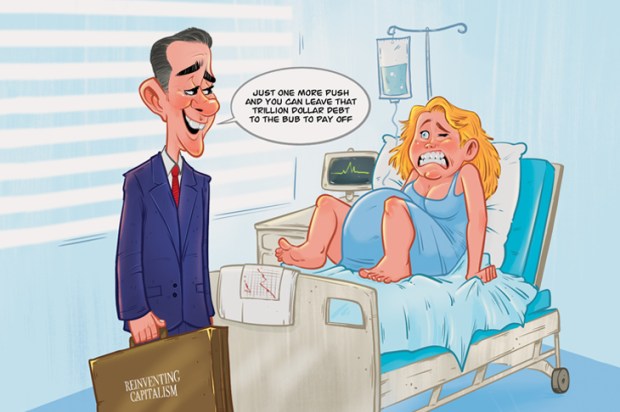
Announced with a $2-billion price tag and a promise of completion by 2021, its true cost is now estimated to be $42 billion while its completion date recedes ever further. No government has ever asked the electorate whether they wished to pay for the damage caused by hundreds of kilometres of power lines across private property or national parkland. But the bill arrives regardless.
The result is that Australians pay for energy policy twice. They pay directly through electricity bills that rank among the highest in the developed world, and indirectly through higher taxes, bigger government, weaker productivity, and slower economic growth.
The unmooring from reality is well captured by Treasurer Jim Chalmers, who recently declared that the aim of government policy is to ‘make Australia indispensable to the world’s new net-zero economy’, a revolutionary transition that will, we are constantly assured, put living standards on a higher trajectory.
But a utopian net zero economy is a delusion, and one that exists only in the dreams of politicians, bureaucrats and activists living off the productivity of others and insulated from commercial and market reality. Living standards, meanwhile, tell their own story with Australians have endured one of the sharpest falls in real household disposable income in the developed world.
If governments genuinely believed the electorate would consent to the full cost of net zero, they would present the costs, all costs, honestly and seek a mandate for it. But they will not because they know what the answer would be. So instead, they proceed by stealth, with piecemeal, poorly considered, and expensive interventions, dressed up with the pretence that something can be delivered for nothing.
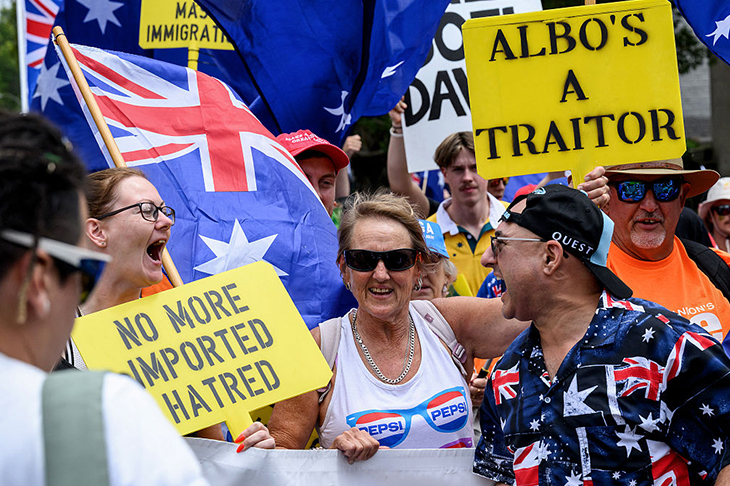
Consent, once treated as an inconvenience rather than a foundation, does not simply evaporate. It ferments. Australians are not yet in revolt against their governments, but they are increasingly, and justifiably, angry.
Our political class would do well to remember where the discontent of the governed, left unanswered for long enough, eventually leads.
Got something to add? Join the discussion and comment below.
You might disagree with half of it, but you’ll enjoy reading all of it. Try your first month for free, then just $2 a week for the remainder of your first year.