‘I wonder how many of you have savings locked away in the banking system where you think it’s safe? Well, under Labor, it would be safer under your bed!’
Prime Minister Malcolm Fraser said this in 1983, shortly before Australians ditched him and elected Bob Hawke and his Treasurer, Paul Keating. Thirteen years of hell later, the Hawke-Keating government gutted the middle-class of its assets in such a way that many never recovered.
Hawke’s smartarse counter comment to Fraser – that you cannot keep the money under the bed because that’s where the commies are – wasn’t very funny, mostly because it was true.
Creeping collectivism and Treasury arrogance regarding other people’s money ensured widespread economic devastation that ended in the election of the Howard-Costello government and their deification in the eyes of the forgotten people.
Many argue, with reasonable success, that part of Howard’s legacy is owed to Keating’s failure as Treasurer and later, Prime Minister.
Hawke pledged that, ‘We set ourselves this first goal: by 1990 no Australian child will be living in poverty.’
Labor did not hear him. According to some statistics, 15.6 per cent of Australian children live in poverty which translates to roughly 950,000. For Aboriginal children, it rises to half despite tens of billions of dollars being poured into remote communities.
The legacy of Labor in the 80s and 90s was more than a temporary economic catastrophe for farmers, business owners, and the middle class in general.
Many dreadful ideas were birthed during that era, almost all of which were left alive by successive Liberal governments, much to their shame.
The worst of these is perhaps compulsory super. It is our dormant economic volcano, yet to rumble. Trillions of dollars in private earnings have been locked away, played with by powerful funds in largely unstable green ventures, the profits of which are eyed off by greedy governments that can’t keep their taxes straight.
Rich people and those in the public service love the bonus of super. The working class in the private sector despise having a chunk of their salary dragged off and ransomed, especially as many will die without seeing it returned. In the poorer sections of the community, super is preventing people from entering the housing market and thus robbing a generation of the means to escape their economic class. Meanwhile, those who don’t die before 60 are getting closer to retiring, and they want those trillions back so they can spend it on evil capitalist things like cruises and cars. This is not ideal for the unstable investment bubble created by super…
The Hawke-Keating period also sparked the Great Lie. That is the assumption that the only way to handle an aging population is with the massive importation of young, foreign workers. What would have been an easily manageable temporary blip in the economic infrastructure turned into the key policy that has destroyed prosperity, hope, and cultural cohesion in this country. A bloated public service and crippling welfare bill are a direct result. And guess what, there’s still no money for pensioners and now there are no houses for young people. The solution to the housing crisis? More foreigners! (And to lean on pensioners to leave their homes.) It is wild that people keep swallowing the economic witchcraft.
By the time it was over, the Hawke-Keating government stood as the longest period of continuous Labor government in history, and it created the deepest economic scars on record.
Fittingly, Labor view it as a success.
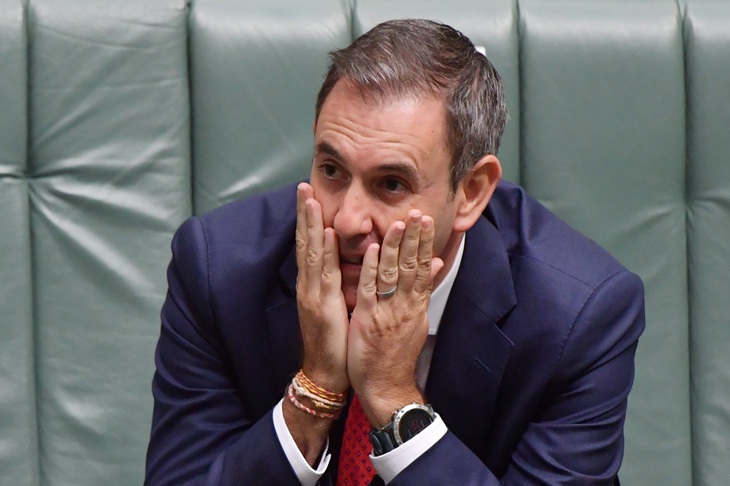
Labor’s next success is obviously Jim Chalmers, whose economic speeches sound as though he used ChatGPT to rephrase chunks of Hawke. Labor never really moved on from this era. Never adapted. Never investigated the unintended consequences of their policies. Never found solutions to the structural failings of their economic outlook. Chalmers is just a loop of Keating’s mistakes spoken through the ghost of Hawke.
Chalmers’ biggest problem is that the Budget claim of intergenerational fairness is a fabrication.
There are no winners. Only losers. Young people have had the door of aspiration slammed in their face. Voters walked away from Tuesday’s Budget knowing only one thing for certain – Labor’s promises are worthless.
When the scare campaign begins, there is nothing the Prime Minister and Treasurer can say to defend themselves.
No promise. No pledge. Nothing.
The worst will be assumed and the voters will take that fear to the ballot box.
Australians have a powerful instinct to work their way out of poverty, but everywhere they move, Chalmers has a tax waiting for them. The government wants a slice of productivity it didn’t earn so it can gift it to a cause that doesn’t deserve it.
The smartest thing a real leader can do is walk up and tear Chalmers’ Budget to pieces, throw it onto the floor of Parliament, and walk away.
Reject the entire narrative of failure.
And offer the public something better.
In the meantime, Australians are starting to wonder if there’s space under the mattress for a bit of cash. You know, just in case.
Flat White is written by Alexandra Marshall. If you would like to support her work, shout her a coffee over at donor-box.