I’m not sure if you’ve noticed, but Australian citizenship – the practice, not the now cheaply won legal status – is undergoing its most profound reformation in more than half a century.
Not since the Whitlamite travails of ’75 so exercised the Left has the Australian polity spontaneously decided to re-arm and reorganise itself around – shock horror! – ideas.
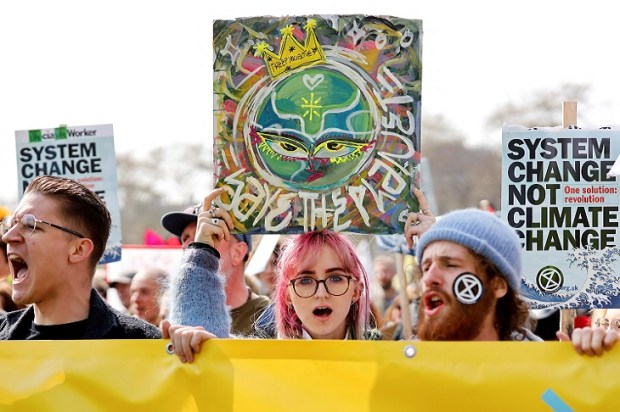
People are marching. Young people are self-organising. Working mums, tradies, and once-recalcitrant boomers are forming new coalitions. Orthodoxies are being slayed.
Some Baby Boomers are even talking openly about lower property prices being a good thing!
Civil society, that indispensable backbone of democratic theory and practice, so recently missing, presumed dead in these antipodes, is gloriously rebooting itself.
And the Left hates it.
In 1538, Thomas Howard, Duke of Norfolk, was said to have remarked that ‘a man could not have his cake and eat his cake’. The Duke’s now-famous phrase illustrates the folly of wanting two mutually incompatible things.
Such is the case for latter-day advocates of Australian democracy, who claim to love the system while deploring its healthy functioning.
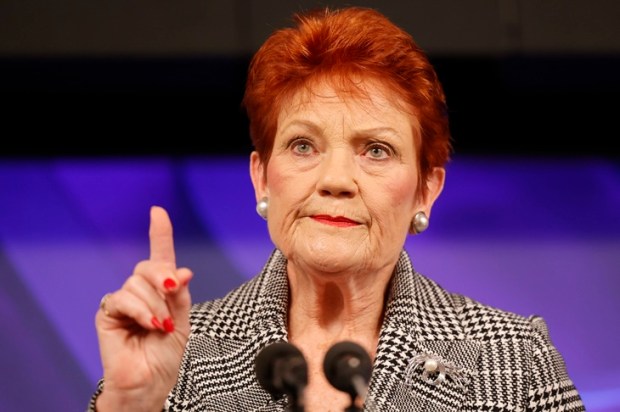
In the aftermath of Western Australia’s Secret Harbour by-election, the ABC again worried aloud that preferencing One Nation could ‘legitimise’ and ‘embolden’ it.
Legitimise?
One Nation voters are Australian citizens. They require no permission from the ABC to make their political choices legitimate. That particular ceremony is conducted at the polling booth.
This is conceit in its purest form. The citizen enters the polling booth sovereign and emerges, having voted ‘incorrectly’, as an idiot patient requiring diagnosis.
One needn’t support Pauline Hanson to recognise the problem.
Democracy is not government by people who have passed a civics examination administered by their betters. It is government by citizens who are allowed to say, do and vote as they please.
This will necessarily involve a grating clash with the views of their self-appointed ‘betters’.
Alexis de Tocqueville understood this nearly two centuries ago. He marvelled that in rising democracies, ‘all ages, all conditions, and all dispositions’ constantly formed new associations. They argued, petitioned, published, worshipped, campaigned, and governed themselves.
The contested opinions of newly mixing classes and social groupings were not an unfortunate side-effect of democracy; they were democracy.
Citizen competence – the capacity of ordinary people to conduct their own affairs rather than surrendering them to an administrative class – is both necessary and necessarily unpolished in a democracy.
How is a new political challenge met, if not through the rough and tumble of new, less-tested voices constantly entering political debate?
Tradies acquire opinions about immigration. Mothers organise school-choice campaigns. Pensioners form Facebook groups. Young men discover politics through podcasts. Cranks run for Parliament. People say stupid things. Policies get confused. People change their minds. Coalitions form that no think tank or consultancy anticipated.
Some will be wrong. Some will be magnificent. Some will need time to figure out issues they have never previously contemplated.
One Nation, an outfit starved of resources by the Prime Minister’s discretion, has recently done much of its ‘figuring out’ on migration policy through messy, public outbursts. It isn’t pretty.
But is Australia really better served by the slick and secretive pre-determined dealings of existing political elites?
For the politically fashionable, a distaste for substantive debate belies a love of superficial messaging.
This is what Australia’s ‘democracy-loving’ elites struggle to stomach. They adore the idea of democracy but become nervous, or outright hostile, when Australians actually practise it.
Political participation is celebrated until the participants reach the wrong conclusions.
You cannot demand that Australians engage with politics while insisting that their engagement terminate within the boundaries of respectable opinion. You cannot celebrate grassroots mobilisation when it serves your causes and diagnose populism, misinformation or voter anger when it doesn’t.
After decades in which Australians were increasingly encouraged to behave as consumers of total-government rather than practitioners of self-government, they are marching, joining, arguing, organising, reading, campaigning – and, yes, voting.
The Australian citizen is making a comeback.
Perhaps they will change their minds. Perhaps One Nation will, too. That uncertainty is not evidence that democracy is malfunctioning.
It is what democracy looks like when nobody knows the result in advance.
It will be loud. It will sometimes be ugly. It will sometimes be wrong, so that it can eventually be right.
Good.
As the late, great Jack Karlson said upon being bundled into a police car after his succulent Chinese meal:
‘This, gentlemen, is democracy manifest!’
Ben Crocker is Deputy Executive Director of the Institute for Public Affairs