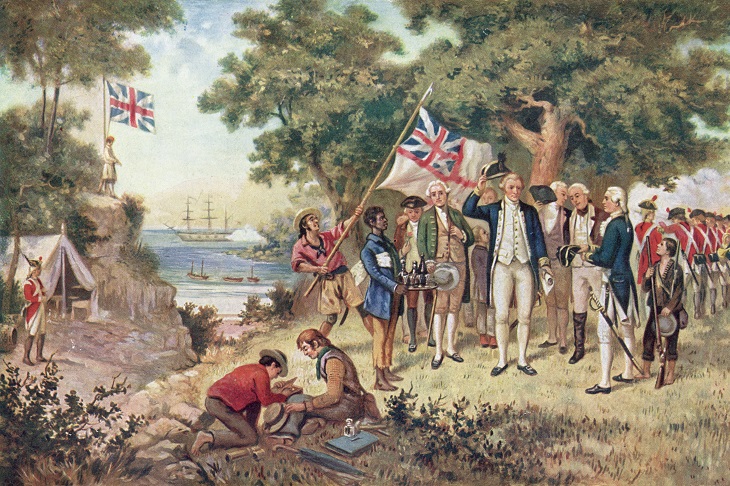
In 2038, Australia will celebrate 250 years since the arrival of the First Fleet. That will be a big deal. It provides an opportunity to recognise the contributions generations before us made to building the nation we have inherited.
There will be official ceremonies, historical exhibitions, grand speeches, and impressive fireworks. All well and good. But perhaps one of the most meaningful ways ordinary Australians can celebrate our nation’s history in the lead-up to 2038 is to learn more about their own family’s role in that history.
Doing this is now easier than ever, and a lot of information is available for free.
However, many records are still quite expensive to access. A different pricing model would not only lower the cost for Australians – it could actually generate more revenue for the agencies that manage those records.
Australia’s Story Is Our Families’ Stories
I speak from experience as an enthusiastic amateur genealogist. What began as curiosity gradually became something deeper. Learning more about those who came before me transformed the abstract idea of nation-building into something personal.
My first-generation Australian ancestors arrived here from England, Ireland, and Scotland during the 19th Century. It is difficult to take your inheritance as an Australian for granted once you have followed a distant forebear sailing south to a fledgling town, the crowded diggings, or a dusty selection. Their hardships, sacrifices, and risks cease to be just someone else’s story. They become part of your own.
Australia was not only built by famous politicians, explorers, and tycoons. It was built by millions of ordinary people whose names appear in no history book – farmers, labourers, domestic servants, miners, shopkeepers, and housewives. Every family tree tells a small part of the larger Australian story.
Of course, not every family’s Australian story begins with the First Fleet or the British settlers who followed. Indigenous people have been here for tens of thousands of years. And Australia is now home to people who trace their ancestry to every corner of the globe. Whatever our background, learning about how our families came here – and the lives they built here – can deepen our understanding of and appreciation for this nation.
This is now very easy to do. Vast quantities of historical records are digitised and available online, including; birth, marriage, and death registers; passenger lists’; census returns’; land records; and newspapers. Records that once required days in an archive can now be accessed from a laptop in minutes.
Much of this information is available for free on official websites. Commercial genealogical websites also have huge collections of records and typically provide some free access and a range of subscription options that make researching family history relatively inexpensive. But many records are still quite costly to access. And that can derail researchers just as they start making progress.
Which John Smith?
State government registries in Australia make the basic details of historical births, marriages, and deaths searchable at no cost. Those details are drawn from a digitised facsimile of the original record. That facsimile is usually behind a paywall.
That facsimile often not only includes additional details, such as occupation, cause of death, or the name of a church where a wedding took place. It also often contains the information that allows you to establish connections between one ancestor and another. It allows you to find extra links in the chain.
Suppose, for example, you have an ancestor named John Smith and you find the death record of a likely John Smith. That’s a promising lead. Except there were a lot of John Smiths…
The searchable record on a registry website will provide a name and year of death, but the paywalled facsimile of the actual death certificate will likely provide his age at death and his place of birth. It might also reveal that his surviving wife was Mary Smith, née Jones.
With that extra information, you can then search for a record of a marriage between John Smith and Mary Jones. And if you get the facsimile of the marriage certificate, you can see whether the groom’s birth year and birthplace match the details of the death certificate. That marriage record will likely, in turn, give you the names of John and Mary’s parents. A link to the preceding generation is thereby established.
That is how genealogy works – one record provides clues that lead to another, and each new record corroborates the last. The value is not simply knowing more about a John Smith – it’s establishing that a particular John Smith was your John Smith.
And, yes, I do have a John Smith in my family tree.
The problem is that it can cost quite a lot to access the full records that make this research possible.
Australian Records Can Be Expensive – the Thrifty Scots Have Another Model
One local family-history society in Queensland regularly tracks what registries charge for a copy of the facsimile of an official birth, death or marriage record. It costs $20 in Victoria, $24 in Western Australia, and $25.55 in Queensland. New South Wales charges $41, though private firms with access to the archive will provide a full transcription for around $20. Tasmania charges $59.21, South Australia $69.50, and the ACT $74.
These prices matter because you often don’t know whether a record is useful until after you have paid to see it. If you are trying to establish whether a particular John Smith is your ancestor, you may need to examine several records before you find the one that provides the crucial link.
At $20 or $40 or $60 each, you obviously are reluctant to follow an uncertain lead. If the price were just a few dollars, the calculation changes completely. You are much more likely to click and see what you can discover.
That is the Scottish model.
On the Scotland’s People website, operated by the National Records of Scotland, users can access the facsimiles of original records by buying credits at 25 pence each. It costs six credits, – just £1.50 – to access facsimiles of birth, marriage and death records.
The low price does more than make genealogy more affordable. It changes how people use the archive. When access to records is cheap, researchers can follow hunches, investigate collateral branches and pursue leads that might otherwise seem too speculative. Many people who would be unwilling to spend £30 on one uncertain record will happily spend £30 investigating twenty records at £1.50 each.
Me included.
Does £1.50 maximise revenue? I don’t know. But Scotland demonstrates that a low-price, high-volume model is capable of generating substantial activity. The annual report for 2024-25 shows that the Scotland’s People website had 795,000 active users and 65.5 million page views. It generated around £5.3 million in income from its range of services, including more than 112,000 birth, death, and marriage certificate orders.
How many certificates would customers have accessed if they had to pay something like £30?
This Could be a Win-Win
This suggests that Australian registries may be leaving money on the table. If lower prices were to result in a sufficiently large increase in volumes, revenue would increase.
Registries have already invested heavily in preserving, indexing, and digitising their historical collections. And when a record has already been digitised, allowing one more person to view the same digital image costs virtually nothing.
So, when the price of accessing a single image often costs more than $50 in Australia, that prompts an obvious question – are registries maximising the revenue they can earn from these digital assets, or are they simply maximising the amount they collect from each individual transaction?
Why not follow Scotland’s example and see what happens?
The basic details are already provided free of charge. Let’s cut the cost of digital facsimiles and let Australians explore. If the resulting increase in demand is large enough, agencies could potentially collect more revenue while simultaneously making their archives vastly more accessible. Win-win.
This would not be a subsidy for amateur genealogists. It would be applying the economics of the digital age to public records.
When you read about the lives of previous generations of Australians in a history book, you learn something about the past. When you learn about you own Australian ancestors, you experience that history differently. It becomes personal.
That is a powerful form of historical education – and one that the 250th anniversary provides an ideal opportunity to encourage. As 2038 approaches, we should make it easier for millions of ordinary Australians to do this.
The records are already there. Most of the work in making them available has already been done.
We just need to make it cheap enough for people to look.