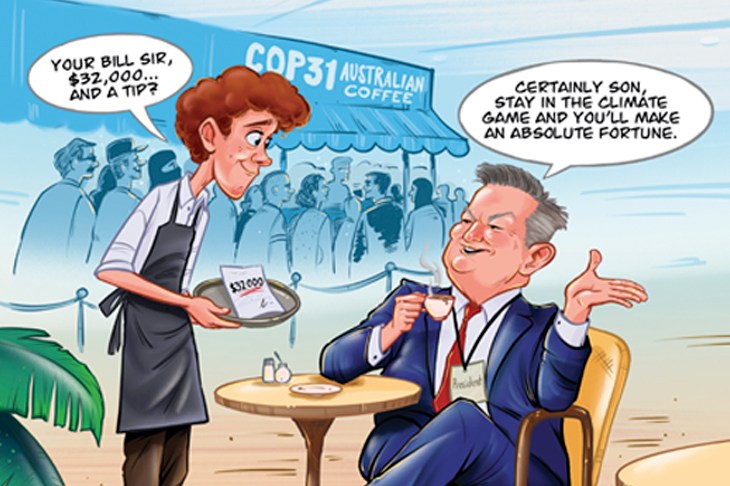
Minister for Climate Change and Energy Chris Bowen demonstrated his formidable negotiating skills even before he landed at COP31 this week, securing a coffee contract for the Australian pavilion at the bargain price of $32,000.
In the home of Turkish coffee, the beverage is traditionally served strong, black and for less than the price of a medium-sized car.
Bowen’s deal has been a delight for the Turkish coffee industry and a hit with delegates. Just not with Australian taxpayers.
The coffee has proved more popular than Bowen, the COPulator-in-chief, whom many delegates reportedly failed to recognise.
Yet the $32,000 coffee contract is a mere bagatelle compared with Bowen’s pre-COP Fijian foreplay, which racked up $34.6 million in contracted commitments. Even that pales beside the $147.8 million allocated to COP-related activities overall. And all of it is small change compared with the cost of making Australia’s electricity supply increasingly expensive, unreliable and weather-dependent.
In Senate estimates on 26 May 2026, Senator Tim Ayres boasted that the government had committed to $78 billion worth of new net zero energy and climate-related spending since October 2022.
New modelling released this week suggests wholesale electricity prices could almost double by 2029. In a country sitting on some of the world’s largest reserves of coal, gas and uranium, blessed with sunshine and wind, the only thing we’re short of is affordable electricity.
But that won’t stop Bowen, Albanese, the Europeans and the rest of the West, barring the US, from rehearsing the familiar themes of ambition, leadership and the urgent need to do more.
The delegates will applaud, the communiqués will be issued and the main agreement will be on the urgent need to reconvene somewhere suitably salubrious next year.
This is the 31st Conference of the Parties. We’ve had COP-outs, COP flops and enough COPaganda to last a lifetime. And after thirty-one conferences, what has the world got to show for all this COPulation?
Global emissions of carbon dioxide continue to set records, as do global crop yields. Cyclones are down. Polar bears are thriving. Snow continues to fall, including in NSW, Victoria and Tasmania in November, with Sydney colder than London and New York.
Delegates have succeeded in reducing the size of their carbon footprint in their communiqués, rather than the atmosphere. The Europeans are world leaders in this arcane art. They claim to have reduced their greenhouse gas emissions by around 40 per cent since 1990, but that conveniently chosen baseline captures the collapse of heavy industry under the weight of communist central planning.
It took another thirty years for European heavy industry to succumb to a different form of central planning, this time administered by the watermelons — green on the outside, red on the inside. European governments became adept at exporting factories to developing countries, importing the same goods and congratulating themselves on reducing emissions. The carbon dioxide hadn’t disappeared. It had merely acquired a new postcode.
Then there is the miracle of biomass. Europe discovered that the quickest way to reduce carbon emissions is to stop counting them. Cut down a tree, turn it into pellets, ship it across the Atlantic and burn it in a power station. Britain’s Drax power station, once a mighty coal-fired generator, now burns imported wood pellets.
The European Environment Agency’s latest figures confirm that biomass combustion emissions have continued rising. In 2024, they were approximately 368 million tonnes higher than in 1990, yet they are excluded from the EU’s headline greenhouse gas totals. The carbon dioxide is still pumped out of the chimney, but thanks to the magic of climate accounting, it disappears before it reaches the spreadsheet.
According to Chatham House, Europe’s reported 26 per cent reduction in energy-related CO2 emissions between 1990 and 2019 shrinks to just 15 per cent when emissions from burning biomass are added to the combustion figures.
Wood smoke has brought the charm of Dickensian pea-soup smog back to European cities, replete with all the old toxic particulates and carcinogens.
Germany performed an even more remarkable feat of circular environmental ingenuity. Alarmed by the Fukushima disaster, it closed its nuclear power stations, which generated genuinely low-emissions electricity. When Putin’s invasion of Ukraine created an energy crisis, it brought coal-fired generation back online. Now, it relies on importing French nuclear energy.
As for the Paris Agreement, the reason why 194 parties have signed up to it is that all they are legally obliged to do is to set targets and report on them; they are not legally obliged to achieve those targets, and there are no treaty-imposed fines or sanctions for missing them.
At least not until now. The European Union wants Australia to make its Paris commitments legally enforceable as part of a so-called free trade agreement. But it has made no such demand on China.
Why Australian businesses should face additional constraints compared with Chinese competitors in their trade relationship with Europe is not something Bowen, Albanese or Ursula von der Leyen has explained.
The point of climate policy seems to be to punish the West by rearranging the geographical distribution of smokestacks out of Western jurisdictions without reducing what they emit.
Moreover, there is a huge difference in the targets they have set themselves. Labor has pledged to cut emissions by 43 per cent below 2005 levels by 2030, a target that, thankfully, it will not meet. China, on the other hand, the world’s largest annual emitter, has promised to peak its carbon dioxide emissions by 2030 and reduce its net greenhouse gas emissions by a modest 7 to 10 per cent below its peak by 2035. What is that peak? Nobody knows. If Bowen could negotiate terms like that for Australia, the $32,000 coffee bill would be worth it.
Some have complained about the PM jetting off to Turkey this week to help Bowen save the planet, but that seems shortsighted. Perhaps the only way to bring down Australian electricity prices is by keeping Albanese and Bowen out of the country. Could Tony Burke be persuaded to refuse them re-entry? If we make them climate refugees, could the Turks offer them permanent asylum in Antalya? Indeed, doesn’t the whole COP circus belong in an asylum? With Bowen in charge, Australians will COP it now and COP it later.
Got something to add? Join the discussion and comment below.
You might disagree with half of it, but you’ll enjoy reading all of it. Try your first month for free, then just $2 a week for the remainder of your first year.