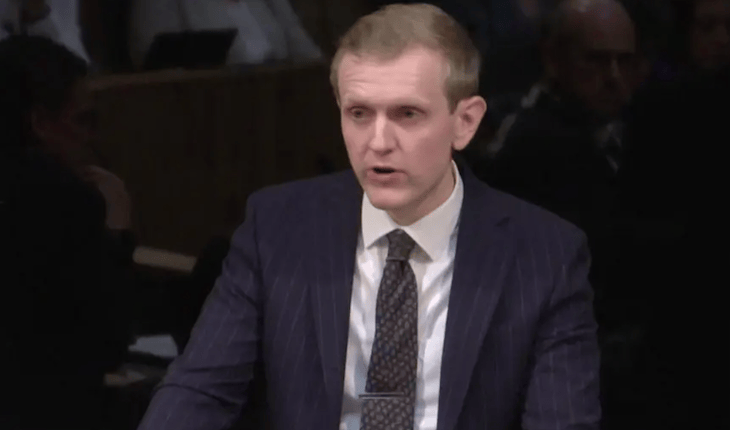
Joe Martin is a member of the Welsh Parliament who finds himself in a pickle: he’s been banned from speaking in the Welsh Parliament. The Senedd’s presiding officer Huw Irranca-Davies handed down the ban after the Reform MS asked the Welsh Government to address ‘demographic replacement of white British people’. Minister Heledd Fychan objected to the premise, telling the chair: ‘We cannot differentiate between people of different religions, different sexuality, different skin colour. We are a government for everyone here in Wales.’
Multiculturalism is a false dogma, but multiracialism – better still, post-racialism – is where Britain’s future lies
Irranca-Davies, elected for the Labour party, generously allowed that ‘it is always possible to raise legitimate policy matters in relation to immigration’, but said Martin’s question had been ‘unnecessarily provocative and deliberately offensive’ and had ‘detracted from the dignity of the Senedd’. That the Senedd considers itself to be adorned with dignity is arguably a more newsworthy headline than the gagging order.
Martin will be allowed to speak again only after he apologises for ‘discriminatory’ and ‘offensive’ comments. He has been in trouble before for what his opponents characterise as derogatory remarks about Sudanese asylum seekers and Indian nurses taking jobs in the Welsh NHS.
Martin is on the right of Reform and I doubt we would agree on much. I state this not to inoculate myself from the charge of siding with the hard right, but because establishing my differences with Martin is important for another reason. Everyone believes their allies should be allowed to speak freely; the only defence of free speech that matters is a defence of your enemies.
BBC News says that Martin’s question ‘echoed a far-right conspiracy theory that the white population was being deliberately replaced by the immigration of other ethnic groups’. If Martin does indeed believe in the great replacement, by which I mean the proposition that a coordinated cabal of powerful actors is plotting to deracinate white Britons, then he’s plainly a conspiracy theorist. No credible evidence of such a scheme has been offered by Martin or anyone else and the themes – shadowy elites, secret agendas, globalist threats to natives – are familiar from conspiracist literature.
Equally, Martin might have been referring to the demographic process by which a homogenous ethnic group because smaller, or less homogenous, as a result of migration. It is hardly inflammatory to suggest that, through a combination of mass migration (legal and illegal) and higher birth rates among some migrant cohorts, the percentage of Britain that identifies as ‘white British’ on the census will decline. To what extent and within what timescale is open to debate. However, should demographic trends continue to a point at which ‘white British’ becomes a minority across the UK, as it already has in London, it will be a simple statistical fact that the hitherto dominant group has been displaced into one of an array of minority groups.
The proper liberal response to Martin’s question would be to say that, yes, immigration changes nations, which is why borders must be managed, democratic consent obtained, and divisive racial narratives confronted. Sustained immigration is likely to contribute, along with falling birth rates and emigration, to a reduction in the share of the population that is ‘white British’. The racial composition of a nation does not matter and should not matter. Individuals, customs, and culture shape societies; skin colour does not.
Unfortunately, in-group racial preferences are a fact of life and progressives, having elevated and pandered to ethnic identity politics among other groups, can hardly reach for the smelling salts when whites rock up late to the racial grievance party. Instead of imposing an omerta on the subject, liberals would do well to challenge it head on. Demographic change has tangible impacts; these impacts can be negative as well as positive; but race is immaterial to considerations of Britishness. Multiculturalism is a false dogma, but multiracialism – better still, post-racialism – is where Britain’s future lies.
Whatever Martin thinks about race and immigration, he is an elected member and should be allowed to speak his mind. If the voters approve, they will likely vote for him again next time. If they find his views abhorrent, they might chuck him out come the next election. Let him speak, and if he is spreading falsehoods, debunk him. That is how we do things in a free and pluralistic nation. What is truly alien to the British political mind is the progressive authoritarianism that hides behind buzzwords like ‘disinformation’, ‘safety’, ‘divisiveness’, and other urgent-sounding temptations to squelch speech and debate. Parliamentary questions do not harm human beings, and where anyone uses them as a pretext to do so, the law should be clear where actual culpability lies, and punish appropriately.
Whatever we might make of Joe Martin or his politics, censoring him is an authoritarian outrage. A parliament that only allows members to speak when they agree to speak as they are told has ceased to be a parliament. It has become a mouthpiece of political orthodoxy, an echo of establishment groupthink. When a parliament feels entitled to shut down an elected member, perhaps it is the parliament itself which ought to be shut down.