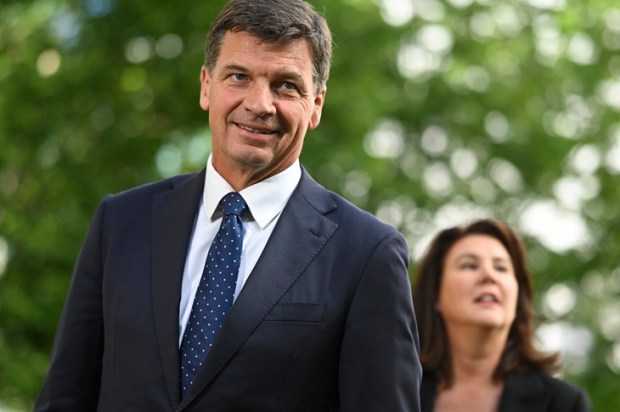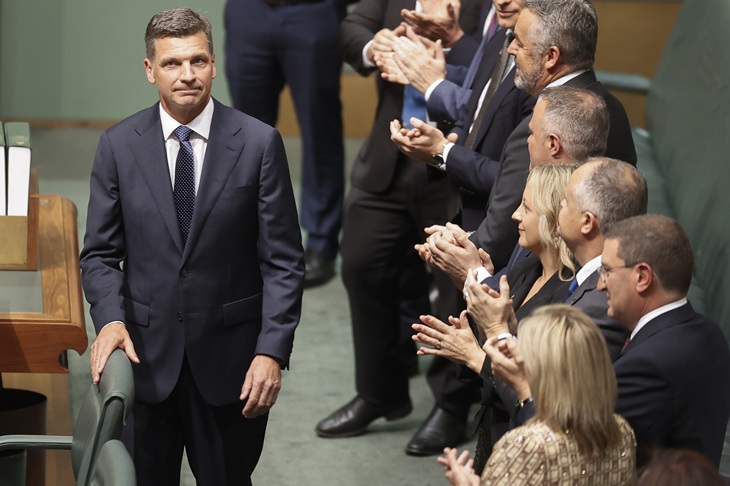
Last week I went to an LNP event for small business with Angus Taylor as the guest speaker. It’s my first LNP event ever, and it was also the first time for a significant proportion of the audience.
Three-hundred people turned-up. That’s a significant number. It was a free breakfast, but still it’s a large enough number to say that while the Liberal Party might look dead, it is not buried yet.
People were there to check out Taylor, and from the questions they asked they were there because they were angry with the federal budget.
Anger is one of the most effective motivators in politics because more people know what they are against than what they are for. It is the most valuable coinage for opposition parties because it can unite supporters around you and against the government.
At least it can when you have more or less a duopoly. But what about a three, four or even five-party system?
If you count the Coalition as one party, the last time we really had a duopoly was in 2010 when the two majors shared 81.61 per cent of the vote between them. It slipped below 80 per cent in 2013 (although the Coalition share of the vote was well over 40 per cent) and has been slipping ever since.
At the moment, according to the latest Newspoll, the split is One Nation 31 per cent, Labor 30 per cent, Coalition 18 per cent, Greens 11 per cent, and others 10 per cent, with each of those blocs holding at least one seat in the House of Representatives, and more than that in the Senate.
Now anger against the government can translate into votes not just for the official opposition, but for any in the ‘not the government’ pile.
I don’t think either of the major parties has adjusted to this reality, and from what I saw on Friday, that definitely applies to the Coalition.
Part of the fracture in Australian politics, and the reason Pauline Hanson is riding so high, is that voters have lost faith in the political class.
This is particularly significant for the Coalition. Literally half the 40 per cent or so of the electorate that used to vote for them has moved to One Nation.
Taylor wants those voters back. He has no alternative. How do you move from 18 per cent and second place ,13 percentage points behind One Nation, to top place?
The Coalition cannot make up a 13-point gap by nibbling at the centre. There simply are not enough movable votes there. Its missing vote is sitting in plain sight: with One Nation.
But if you can convince just 20 per cent of Hanson’s voters to come back, then you are tied around 24 per cent each and back in the game.
As an aside the current state of first preferences is that according to Newspoll the Coalition plus One Nation vote adds up to 49 per cent, but after preferences Newspoll still has Labor on the 55 per cent of the vote it won last election.
So, Hanson is redistributing votes within the anti-Labor bloc but at this stage doesn’t actually seem to be adding to them. That is a problem she and Taylor have to overcome. If they both try to run to the exact same place on the ideological spectrum they’ll trip over each other and lose the election. They need to expand their support.
At the breakfast Taylor impressively covered a lot of the policies that make voters angry, but that is not going to be enough – Pauline can recite the same grievance list.
It’s not policies that have lost the Coalition voters, it’s their failure to deliver, and the fracturing of trust that lack of delivery has caused.
They’re in the middle of a marriage breakdown. Half of Coalition voters have left.
They’ve heard all the promises before, they like the sound of them, but they know they will never be delivered. They’re still invested in the kids and the house, but they’ve no trust in the ex.
They’ve got nothing to lose and maybe everything to gain by having a fling with a new partner.
At this stage the worst thing the ex could do is to slag-off the new partner. Taylor didn’t make that mistake, although there were members of his team in the room who have been doing just that.
Which is his central problem. When the Coalition has broken promises it’s not that the leaders making them weren’t necessarily sincere, but that they didn’t have control over delivery, or bargained them away.
The Coalition talks a good game on climate change, but John Howard signed Kyoto. It promised to reform Section 18C and then baulked, then doubled-down in January this year supporting the government’s antisemitism bill which extended the criminal law into free speech.
There are some members of the Coalition who have trouble saying what a woman is. There are others who will happily tell you that current immigration levels are just fine.
The Coalition used to be the party of good economic management but during Covid it couldn’t stop spending and borrowing. It said it was against mandates and lockdowns, but then did nothing when the states imposed them.
How do you cure this trust deficit? Even the most heartfelt apology won’t be enough. You need to demonstrate real change, and that can only mean removing the cause of offence – those members who undermine the mainstream centre and right position.
There’s talk of making Liberal Party preselections more open. That would be significant, but not sufficient. Unless there is large turnover of representatives it will be the much same old cast, just season next.
Which explains the position of many One Nation supporters. They’re not voting for a One Nation government so much as they’re voting for a complete demolition and rebuild of the conservative side of government.
If the Liberals and Nationals can’t select good candidates, then they will do the job for them through One Nation. And if replacement is their aim, then some Liberals will survive, but only by having a strong personal brand.
Do One Nation voters care if Labor wins another term in government because of the chaos on the right? Probably not. For many of them, another Labor term may be a price worth paying if it burns away the old centre-right and makes room for an alternative whose word can be trusted.