The following is a transcript for the speech given at the Alliance for Responsible Citizenship (ARC) conference, held in London, 2026. Over three days, the conference explores The Pathway to Deconstruction, Mindset Shift, and The Age of Reconstruction.
Last month I attended the 125th anniversary of Australia’s first Federal Parliament, held at Melbourne’s Royal Exhibition Building – the very site where it first met in 1901.
A lonely conservative in the crowd, I felt like Hiroo Onoda – the Japanese soldier who kept fighting the second world war in the Philippines into the 1970s.
It was an elites-only event which oozed remorse for our colonial past.
There were no Australian flags, no mention of the Constitution or our British heritage, a passing nod to the King in the Governor-General’s speech – but heaps on how Australia had changed for the better into the diverse, inclusive, tolerant nation it is today.
‘There was certainly no one in the House of Representatives with a surname like Albanese,’ Mr Albanese the Prime Minister crowed. ‘There were no Senators back then called Wong … no MPs called Abdo, or Khalil, Fernando or Ng.’
What the Prime Minister chose to overlook was that Australia’s great success as a democratic experiment came from the very institutions we inherited from Britain, and from the best features we borrowed from the British and American constitutions.
Yes, it is easy to parody the self-loathing of the left.
Much harder to examine our own side’s conscience and ask: Where have we gone wrong?
It is fantasy to think the powerful ideas born 200 years ago implemented by the left, can be reversed at a general election.
But we do have one natural advantage – our faith in the family.
Let me offer a practitioner’s view of three policy areas: education, migration, and family.
On Education
In the government I served, four Education Ministers met their match in the powerful higher education lobby.
One genuinely tried to deregulate the sector, but he was up against a machine, and the Senate blocked the reforms, twice.
The left has sought through the universities to groom the elites to a certain worldview – the future judges, politicians, decision-makers – but they’ve also focused on educating the educators to indoctrinate the masses.
This is a picture of some two-year-olds at an Australian childcare centre signing a sorry log for what they have done to the Indigenous people.
Learning shame at their most innocent.
Before becoming a Senator, I was a lecturer in the Faculty of Education and sceptical about our government’s enthusiasm about rewriting the national curriculum as a solve-all.
If a student teacher spends four years being grounded in white guilt, victimhood, climate catastrophism or even antisemitism, that is what gets passed on behind the closed doors of a classroom.
But Australia’s literacy and numeracy scores have been sliding for years, and the education industry responds by questioning whether the OECD has got its methodology right.
Even this week, in another first, teachers have publicly raised their concerns that educating students about the Holocaust will upset Muslim kids.
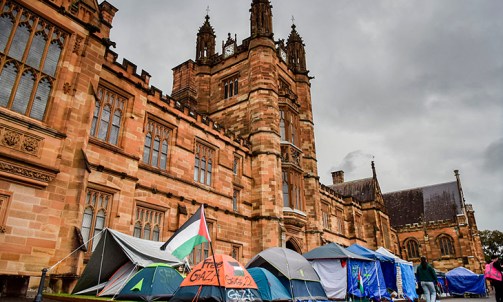
Our supposedly best universities allowed antisemitism to run unchecked with permanent camps like this at Sydney University.
Jewish lecturers’ offices were urinated on, Jewish students harassed and intimated, and research careers cancelled.
Higher education is Australia’s fourth largest export industry, after iron ore, coal, and natural gas.
High-paying international students comprised 3.5 per cent of the Australian population, the highest per capita in the world.
We have to ask a difficult question – is it any longer worth preserving institutions that cannot be reformed?
My firm belief now is that the only way to fix higher education is to break it.
On Migration
Nothing changes a nation more quickly, for better or worse, than rapid immigration.
Successive centre-right governments in Australia achieved something genuinely remarkable: stopping illegal immigration.
Deluged by a flotilla of rickety boats – 50,000 desperate souls who’d paid their life savings to people smugglers arrived.
Stopping the boats was difficult – the attacks from the left (and our own side) were relentless.
But Australians supported our actions and we stopped the boats and the drownings.
But…
Centre-right governments shut the back door to illegals, but we kept the front door wide open.
The Labor Party has since pushed high immigration to warp speed.
Australia operates a non-discriminatory immigration policy and takes in more migrants per head than any other Western country.
Our economy has become addicted to it.
It appeals to big business, big property developers, big universities, and big, lazy government.
Conservatives around our Cabinet table were meek when they should have been strong, accepting the economic imperative for higher migration over the genuine concerns of Australian citizens.
But the social cost to Australian families is incalculable.
Increasing national GDP makes Prime Ministers and big business happy, but it is not a measure of the health of society if GDP per household is getting poorer.
Houses are now unaffordable for young people well into their 30s, putting pressure on them to delay having children.
If you love your country, and respect your past, you shouldn’t apologise for discriminating over who comes to live in it – not on race, but on values.
If you believe Sharia law is superior to the laws we inherited from Britain, I’m afraid Australia is not for you.
On The Family
Defence of the homeland should be the number one priority of government, but surely defence of the family must be a close second?
If we really believe this, our policy focus should be family housing, supportive tax structures, and support parents’ choice about care for their young children – not universal industrial care that is supervised by the state.
On the calamity of the falling birth rate, we blame affluence, birth control, climate fears, or the entitled attitudes of our children.
But are these symptoms, or are they causes?
The most natural thing in the world is to make babies, but there is no escaping that modern life is becoming more incompatible with biology.
Politics is downstream of culture, not upstream.
Parliaments can pass laws, set priorities – but only two people can find each other, commit, and get on with it.
Young men are going to have to start ponying up.
Young women are going to have to accept that biology is a thing and that the runway is short.
And we, all of us, have to recognise that children are a social good.
How do we reconcile a modern life that’s affluent, full of material things, yet laced with anxiety, exhaustion and broken relationships?
The Conservative Challenge
Perhaps the fall of the Berlin Wall bred a complacency that Western Civilisation had triumphed.
In fact, our enemies had merely regrouped to take full control of the civil service, the corporates, the police, even the sporting codes.
Removing the powerful ideological incumbents from their citadels is akin to urban warfare.
The left targeted the family because they understood what conservatives have always known: the family is the one social institution the state cannot fully capture.
So, if the family is their problem, it must be our solution.
The market exists for humans to express their autonomy and agency, to build wealth, for people to chart their own course, provide for their families and build for the future.
But there must be limits, limits on power, elected and unelected, and on the excesses of human appetite and behaviour.
‘My truth, my morality, my choice,’ assumes we all live in our own atomised moral and social universes.
Where everyone is their own Pope – including the protestants.
In 2025, the centre-right in Australia suffered our worst election loss – it was not just because we were outcampaigned.
We had breached trust with the Australian people.
Our task is to reflect that Australians are in their heart natural conservatives – protectors of their family, their communities, and their country.
But we’re not going back to homogeneous, faith-filled societies any time soon, so our long march begins.
In Conclusion
The lonely conservative in that Melbourne crowd last month, it turns out, is not so alone.
Edmund Burke published Reflections in 1790 when enthusiasm for the French Revolution was at its peak and found no support even among his own party.
Yet within a decade, history had shifted.
The conservative tradition has always been the minority position in moments of radical enthusiasm.
It is a tradition of great hope and faith and love for the family.
As St Paul wrote: ‘If God is for us, who can be against us?’
The Hon Bridget McKenzie, Leader of the Nationals in the Australian Senate
Shadow Minister for Infrastructure, Transport and Regional Development, Shadow Minister for Local Government and the Territories, Senator for Victoria