Western nations are experiencing a rising interest in revolution. Not the over-the-top French-style guillotine variety or a Maoist starvation leap into the grave. Our revolutionary allure is more civilised. A revolution fought on the scaffold of social media by charismatic politicians ducking around mysterious poll results which swing close to their necks like sharpened blades…
Underpinning this desire for change is a generational divide that has emerged following the development of social media, or more correctly, instantaneous global communication intertwined with a culture of renting rather than owning.
We experienced hyper-low-cost consumerism that trained people to seek new things over nest-building. Everything from entertainment to software is drip-fed to us via subscription where the days of collecting possessions seems antiquated.
Generations are separated by how they learn, play, and view their world. There is perhaps even a bit of regret from the subscription generation who have reached adulthood without anything to show for it. Why do you think identity politics has such a powerful sway over the young? Their identity is very nearly the only possession they have. They view criticism about their gender identity as you view an interest rate hike against your mortgage.
Millennials sit on the boundary line of this revolution – half-in, half-out.
They were teenagers in the year 2000 when the West was at its peak and have memories of life in the late 80s and 90s. They have shelves full of CDs and DVDs but reluctantly stream duplicates of their entertainment on streaming services. Now, they fear for the future as they attain leadership positions and see, firsthand, the collapsing state of the world being handed to them. This makes Millennials uniquely positioned to understand the full scale of the disaster.
The older generations above them are complacent and satisfied with their life. Those beneath them, such as Gen Z, are restless beyond negotiation.
As a member of Gen Y/Millennials, I have had so many letters, articles, and phone calls from my peers in the media and politics who feel terribly let down. They cannot understand why those who they looked up to in their industry refuse to act or even adapt to the changing world. They feel adrift. Uninvited. Looked down on. Locked out of the room. And unable to break through the cliques of power that are happy to wine-and-dine while the West burns. They don’t even get invited to the party and are instead expected to stay home and do the grunt work for a dollar that is increasingly worthless. Those with the most energy and ability to fix this situation are prevented from doing so. Politics is the worst example. Thank god Millennials are workers rather than revolutionaries.
Knowing that your future is being wrecked by indifference and greed creates generational friction.
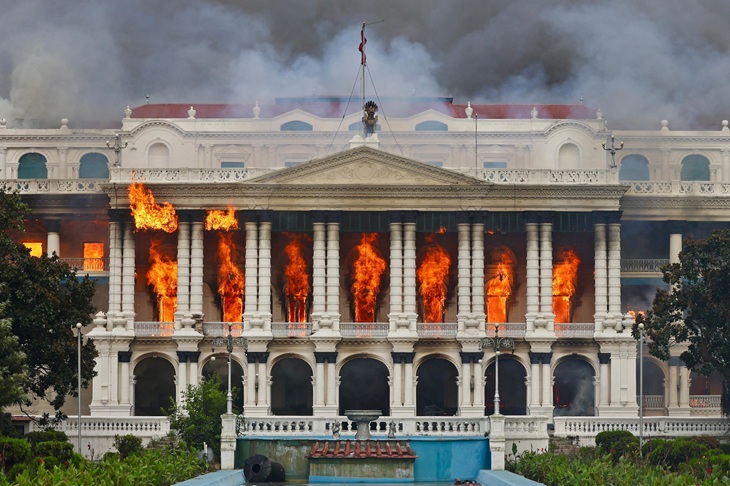
This ignited in Nepal where the younger Gen Z, rightly furious over the corruption and failure of their hardcore communist government, rose up and burned their city to the ground.
In September of 2025, Nepal’s government and legal buildings were left aflame after social media bans sent young people over the edge. Their communist regime enacted digital censorship to combat misinformation and disinformation … which sounds strangely familiar. Old politicians thought they could control the election with digital censorship.
The world called the resulting uprising a Gen Z Revolution against political corruption and a far-left regime that had no interest in the wellbeing of its people.
At the time, it was hard to criticise these 20-somethings for the obvious destruction, but did their anarchy achieve anything productive? Or, like so many failed attempts at freedom, do they face more of the same oppression re-branded and re-born?
These Gen Z revolutionaries had been locked out of power, just like us, and although their rage was destructive, it did not destroy the corrupt bedrock sitting beneath the ashes.
People died. Party leaders fled. 2,500 buildings were burned or looted. Government leaders fled in helicopters. Revolutionaries celebrated their victory in the streets. And then silence.
The Gen Z Revolution story vanished from the news cycle while Parliament and the courts were still burning. There were other wars. Other domestic troubles. And a Christmas period to enjoy.
It’s the familiar silence that always falls after people insist they will never allow their voices to be lost. The problem with revolutions is that individual people are fragile, they get tired, and they suffer serious consequences from their victory against the government. No matter how oppressive and cruel a regime is, it is still the scaffolding of the country and without a solid plan to pass power on, things can go from bad to worse.
The first act of the state has been to rebuild its destroyed services. Crowdfunding and foreign aid from interested neighbours has steadily rebuilt security forces after 465 police buildings were attacked with 100 sacked and ruined.
Gen Z revolutionaries targeted police as a representation of state power. This has backfired on protesters, with ordinary people desperate to see their police force rebuilt when thousands of criminals walked free during the revolution. The general collapse of society has left people vulnerable to crime and re-establishing law has become a major occupation following the protests.
Another reason for the urgency regarding the repair of the police force are the approaching elections.
‘Despite some resource and mobility limitation, our operations have returned to normal. We are prepared for maintaining peace and security for the elections,’ said the police force.
Nepal is currently under the care of an interim government and the military. Until elections are held in early March, Sushila Karki, the former Chief Justice, is in charge.
India has been helping Nepal in the lead-up to the elections. This generosity has included vehicles and urgent supplies. Before the collapse of the Sharma Oli Communist government (and his Unified Marxist-Leninist party), elections were scheduled for 2027. These elections will be an enormous endeavour. As reported in Pressenza:
‘The Hindu majority nation of over 29 million people will witness over 3,400 (including 390 women) electoral candidates representing 68 political parties as well as independents vying for 165 seats in the 275-member House of Representatives.’
They add that the election race will contain four former Prime Ministers and three mayors.
The old communist parties, which were thrown out of power in the Gen Z Revolution, will be back running against a 35-year-old anti-government protester.
It is also worth noting some soft similarities between the situation in Nepal to Iran, at least in regard to rising left-wing radical groups displacing the monarchy. Pressenza also writes:
‘It may be mentioned that Ms Renu is the daughter of Prachanda, who led the decade-long Maoist movement in Nepal. In reality, the hardline communist leader was instrumental in abolishing the Nepalese Hindu monarchy in 2008. Nepal’s last king, Gyanendra Shah, who lives a common citizen’s life, but with visible support bases across the country, recently made a public comment criticising the Nepali political leaders for adopting an increasingly imbalanced foreign policy and conduct against national interests.’
And critically:
‘…hardcore supporters of the deposed king are demanding restoration of the monarchy, arguing that selfish politicians had failed the citizens, precisely the young generation, and the return of King Gyanendra emerges as the only alternative to save Nepal and its nations.’
It is very likely that the communist thugs who ruled Nepal will be back in power and the whole thing was for nothing. Gen Z may remain trapped by the deeply misguided activism of their parents.
Nepal remains an eerie glimpse at our possible future, and also demonstrates how difficult it will be for Iran to dismantle the Islamic Republic. For some reason, democracies and monarchies are easy to destroy, but communist and Islamic governments have proven resilient in their tyranny.
The lesson for Australia and our parent nation in the United Kingdom, is to have the soft revolution inside the protective ecosystem of democracy. Make the necessary changes to cut-out the poison of creeping socialism and modernise while bringing forth the best parts of the last age.
We can’t go backwards, we can’t stand still, but we don’t have to trip over and fall on our faces either.
Flat White is written by Alexandra Marshall. If you would like to support her work, shout her a coffee over at donor-box.