There is a lot more depending on the necessity for newly minted opposition leader Angus Taylor’s restoration of traditional Liberal principles to succeed than winning the 2028 election. Those principles, mouthed but not observed over a decade of Liberal party decline into Labor-lite, mirror the basic precepts of a democratic Western world that is, itself, also increasingly under attack – and showing a widespread reluctance (the US and Argentina excepted) to defend its values.
The main risk, including in Australia, to the future of Western democracy, with its free-enterprise capitalism, its basis in individual freedom, protection of its citizens, reward for effort, the right to vote and the rule of law, comes not from hostile authoritarian regimes but from within. The destructive ideology-based government programs like net zero and the mounting failures of traditional political parties to deliver as promised (Albanese government election promises can now be accurately redefined as lies), has led to voters in the Anglosphere expressing their disillusion both in opinion polls and the ballot box by favouring untested ‘protest’ groups that have never faced the discipline of being in power. Hello Britain, France, Germany – and Australia’s Pauline Hanson and her new-found friends.
This disenchantment with the traditional players in the political system is compounded by the stated lack of support for Western democracy by younger Australians evident in recent opinion polls (for which a left-dominated education system can claim the credit). Add to this the corrosive influence of the high-powered World Economic Forum (WEF) in seeking, with increasing success, to impose a Davos-based supranational ruling elite over the democratic decision-making capacity of nation states – including via undemocratic alliance with the United Nations secretariat on health.
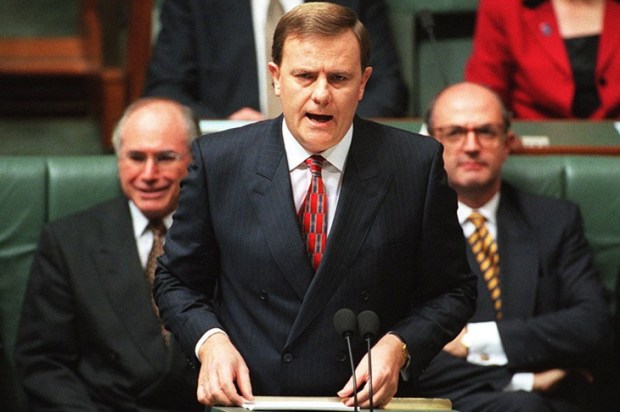
The Coalition’s welcome rediscovery of its principles was in Taylor’s impressive speech in response to the Albanese government’s old-fashioned left-Labor semi-socialist May budget that focussed on redistributing Australia’s diminishing per-capita wealth rather than Taylor’s pro-growth agenda. It was not so much about wealth redistribution as wealth destruction in a war against aspiration.
So for Angus Taylor, now comes the really hard part – making these principles (indeed democracy itself) meaningful to an electorate that has increasingly welcomed Labor’s deliberate policy of increasing voter dependence on governmental handouts (by universal, not means-tested safety net payments) as the solution to every economic problem affecting them – electricity prices, cost-of-living, petrol and so on.
Taylor’s totally contradictory policy is to resolve these problems with incentives rather than softening their impact with handouts. This creates a clear distinction in political approach with the potential for electoral support – particularly among the increasing proportion of self-employed and tradies. But there is also the political risk that Taylor’s policy determination to reward enterprise and encourage real private sector growth to reverse Labor’s years of falling living standards means cutting the taxes that fund the handouts; something has to give as the road to smaller and more efficient government brings losers as well as winners. So convincing voters that the Liberal principles he has restored are in their best interests requires a greater capacity to sell a message than the Liberals and Nationals have shown for some time – with the notable exception of the Voice referendum.
But the crisis facing both the Coalition and Labor in One Nation’s spectacular rise in the polls and remarkable win in Farrer (mirroring Farage’s Reform in Britain) cannot be isolated from the disenchantment that has prompted concerns about political instability in the Anglosphere and Europe, much of it caused, as in Australia, by the self-induced economic pain of industry-crippling energy prices due to governmental net zero over-reactions to a (now admitted) overstated UN-backed climate scare campaign. And now being exacerbated by the Hormuz chaos.
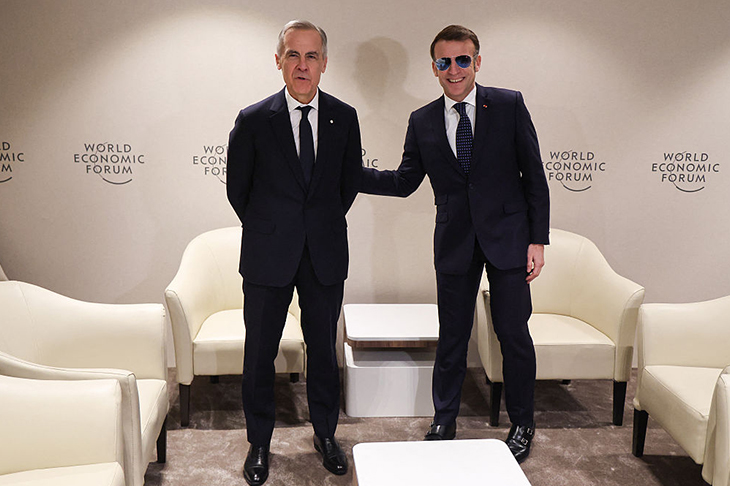
Playing a key role in this climate catastrophism, along with other actions to the detriment of Western democracy, is the self-appointed WEF, with its annual gathering of world leaders in government and business (with the usual Australian corporate suspects such as ‘Twiggy’ Forrest) in Davos – and its effective Young Leaders program which boasts that its indoctrinated alumni have ‘penetrated the cabinets’ of much of the Western world.
The most significant critics of the WEF’s centrist, supranationalist and climate-obsessed version of elites-controlled capitalism (with its Diversity Equity and Inclusion and Environment, Social and Governance agendas) have been Presidents Trump and Javier Milei. In calling for minimal government intervention and championing the marketplace as the driving force behind progress, Milei instituted a verbal assault directed at his Davos audience, declaring, ‘The Western world is in danger because those who are supposed to defend the values of the West are co-opted by a vision [the WEF agenda] that inexorably leads to socialism and thereby to poverty.’ He lamented the influence of collectivism, radical feminism, a cruel environmental agenda and ‘the mental virus of woke ideology’.
This month, in a new extensive critique of the WEF, controversial American biochemist, anti-vaccine physician notoriously critical of the US Covid response and a ‘non-political conservative’, Dr Robert W. Malone, says the WEF is best understood not as a conspiracy, not as a mere networking club, and not as the sinister cabal its loudest critics claim. ‘It is something more interesting and more worrying. It is an institution that has spent five decades cultivating, networking, and ideologically shaping the international class of people who staff the senior reaches of Western governments, multilateral institutions, and large corporations. It has used that influence to advance a coherent project built around stakeholder capitalism [in contrast to accountability to shareholder owners], technocratic global governance, and the steady transfer of decisions from local and national levels upward to international bodies’.
The WEF is dangerous, he argues, regardless of the intentions of its participants, because of its very nature in being an institution composed of the world’s largest corporations and most powerful officials, operating without democratic accountability, cultivating the leadership class of multiple democracies (including Australia), formalising its partnership with the UN, and shaping the response to global health emergencies.
‘The cumulative effect of the project has been to suppress economic dynamism in Europe, to corrode political legitimacy across the West, to push Western governance into structural convergence with authoritarian alternatives, to reorient the United Nations away from intergovernmental multilateralism and toward corporate-influenced multistakeholderism, and to expand the WHO’s authority in ways that lack any meaningful democratic check displacing it.’
So just as Dr Malone argues for Western capitalism, including Australia, to replace its WEF agendas with the classical liberal alternative of an insistence on dispersed power, clear accountability, market discipline, and the rule of law, as the only model under which modern prosperity has actually been produced and sustained, so Angus Taylor seeks a similar return to the Liberal principles of free enterprise democracy that have served Australia so well in the past – and are needed for the future.
Got something to add? Join the discussion and comment below.
You might disagree with half of it, but you’ll enjoy reading all of it. Try your first month for free, then just $2 a week for the remainder of your first year.