Before entering a village in Afghanistan or any other uncertain, complex and ambiguous environment I have worked in across Africa, the Middle East and elsewhere, it was good to know two things, if nothing else. Those villages who liked you and those who hated you. Knowing where you stand is reassuring. It is never pleasant being in a village where you have no idea how the leaders of that village feel. They are probably the ones where the village leaders will make you tea in the day and slit your throats at night. Judgement under uncertainty is one of humanity’s greatest heuristic challenges in relation to risk. That’s where a good Human Terrain assessment helps. This was the framework used by Western forces in Afghanistan and Iraq to understand local power structures, nodes of influence and population dynamics. When applied to Victoria, it exposes a state providing a permissive sanctuary for the global Islamist insurgency. And this has enabled the Islamist extremist networks to secure significant sway over key political, security and religious nodes across Melbourne and its suburbs.
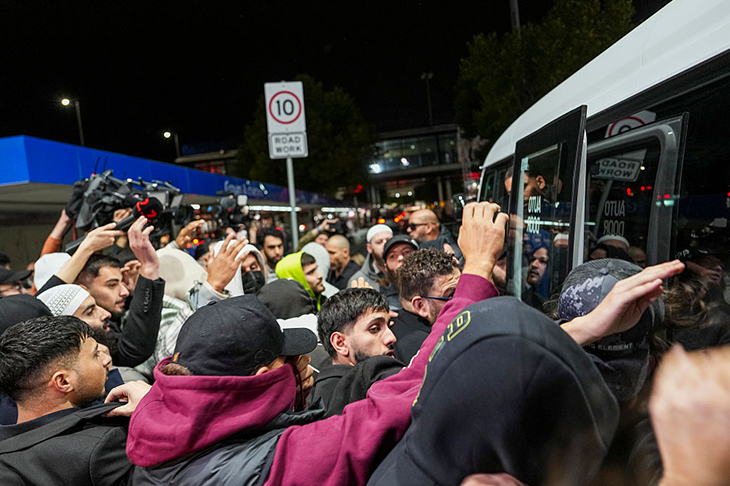
The arrival of Isis brides and their families to Melbourne in early May underscores the problem. These women were not innocent bystanders but willing participants in a barbaric regime responsible for slavery, beheadings and unimaginable cruelty; the same mindset that committed the 7 October 2023 massacre in Israel. Met at the airport by committed Islamist supporters, their return reveals how deeply entrenched the network has become in parts of Victoria. And it was evident this Islamist leadership and their network have zero to fear in the state of Victoria. It’s why you can call Victoria a permissive environment.
In Victoria, Islamist groups have mastered modern irregular low-intensity conflict by increasingly dominating the human terrain. As Thomas X. Hammes explained in The Sling and the Stone, fourth-generation conflict leverages all available political, social, economic and military networks to convince decision-makers that continued resistance is too costly. Far better to cultivate networks within your enemy’s system.
This is precisely what we see playing out now. Political nodes have been effectively captured. Organisations such as the Muslim Vote celebrate their ability to decide outcomes in marginal seats and pressure governments into adopting positions aligned with Islamist priorities, while ministers actively conform to the Islamists’ position. Federal and Victorian authorities, in turn, direct taxpayer funds toward institutions and community bodies, often labelled ‘social cohesion’ and ‘multicultural’ projects while avoiding scrutiny of the ideologies being promoted.
Fear of being labelled Islamophobic has paralysed political resolve, turning feeble, acquiescence into standard practice. This is infiltration dressed up as diversity. In 2014 the UAE Foreign Minister, Abdullah bin Zayed bin Sultan Al Nahyan, warned in future there would be far more Islamist radicals and terrorists coming from the West than from anywhere else.
Security institutions find themselves in an increasingly difficult position. Earlier operations exposed radicalisation networks in Melbourne, yet many of the same environments continue to operate with limited interference. Authorities devote substantial resources to watching returnees, yet broader patterns of radical preaching, foreign funding and community pressure receive softer treatment. The state is no longer shaping the human environment – the insurgents are shaping the state’s behaviour through persistent advocacy, education, street mobilisations and legal pressure.
The religious nodes lie at the centre of this sanctuary. A network of influential imams, Islamic associations and educational programmes exerts commanding authority over a rapidly expanding and geographically concentrated population. In too many cases, these institutions advance messages of Western hostility, historical grievance and solidarity with designated terrorist organisations. This decentralised approach aligns with the strategy once outlined by al-Qaeda theorist Abu Musab al-Suri – spreading the ideology like a virus through everyday community structures. These religious and cultural centres function as the decisive terrain where loyalty to Australian values is contested and often eroded. No physical caliphate is required when one can be constructed suburb by suburb through influence and indoctrination.
Decades of lax immigration screening, generous refugee policies, chain migration and elevated birth rates have altered the demographic balance in key Victorian areas. The result is the emergence of parallel societies where sharia-influenced norms coexist uneasily with Australian law, antisemitism has been normalised, and there is no allegiance to the host nation. The open celebration of returning Isis associates demonstrates how confident these networks have grown.
The lessons of counterinsurgency are unambiguous: conceding the human terrain to determined insurgents leads to permanent instability. Australian leaders must now commission their own unflinching Human Terrain-style review of Victoria and other hotspots. Real solutions demand more than rhetoric. They require complete reform of immigration prioritising cultural compatibility, and an immediate end to foreign funding of religious institutions, as well as the dismantling of parallel authority structures. Where deradicalisation fails – and evidence shows it usually does – exclusion must be the default. Yet, we all know none of that will take place. One side creates and promotes the conditions for the insurgency to thrive while the other just talks tough. Plus, the political influence and control is now too strong and too well resourced with foreign support. And significantly, almost no elected representative is as committed as the Islamists. Just think about how committed you need to be.
Without a dramatic shift in policy and political courage, governments will face unending friction and recurring security crises. The ideology that drove fighters to Syria has returned with the Isis wives and possibly even their children – strengthened by the knowledge that Australia’s doors remain open and its resolve weak.
Afghanistan is littered with villages and valleys no foreign force has ever held. In villages where they hate you, without kinetic action, then the best that can be accomplished is negotiating to be left alone. This is the potential human terrain facing Victoria.
Got something to add? Join the discussion and comment below.
You might disagree with half of it, but you’ll enjoy reading all of it. Try your first month for free, then just $2 a week for the remainder of your first year.