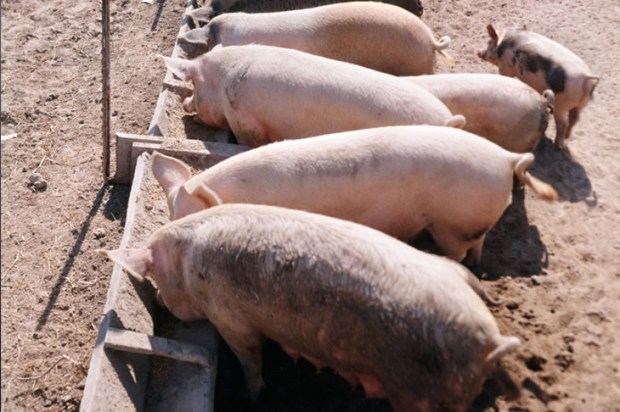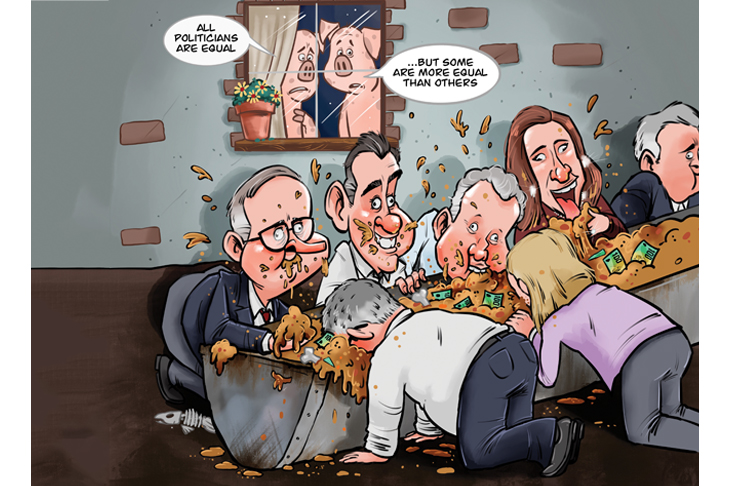
When Animal Farm was published in 1945, George Orwell had a particular grievance in mind. He had watched, over a quarter of a century, the spectacle of men who denounced the privileges of the old order on a Monday and, given the opportunity, arranged to inherit those same privileges by Friday. He thought the process worth recording carefully, because he suspected, correctly as it turned out, that every generation would have to learn the lesson afresh. Eight decades later, the book reads less like satire than like cabinet briefing material for the Albanese government’s housing policy.
The plot is familiar enough. Old Major gives his speech. The animals overthrow their human masters. Seven Commandments are painted on the side of the barn in thick white letters, the chief of which declares that all animals are equal. Then the pigs discover that the farmhouse is rather comfortable, the beds surprisingly agreeable, and the cellar not without its attractions. One by one, the commandments are revised in the night. No animal shall sleep in a bed acquires the amendment with sheets. No animal shall drink alcohol acquires the qualification to excess. The sheep, who were never strong on textual interpretation, bleat encouragement throughout. By the end, the seven commandments have been reduced to one: All animals are equal, but some animals are more equal than others.
Consider this alongside the Commonwealth budget delivered on 12 May 2026.
Negative gearing on established residential property is to be abolished, but only for the wrong category of investor. From 1 July 2027, the concession will disappear for purchases made after 7.30 p.m. on budget night.
Anyone who already owns an investment property, or who exchanged contracts before that hour, may continue exactly as before. Their arrangements are, in the soothing language now preferred in Canberra, to be grandfathered.
What a reassuring word is ‘grandfathered’. It evokes an elderly gentleman in a cardigan dispensing practical wisdom beside a fireplace. It does not quite evoke a sitting parliamentarian with three negatively geared investment properties whose own tax arrangements have just been hermetically sealed against reform, while a 28-year-old in a rented townhouse is informed that access to the same arrangement would now be economically irresponsible.
The register of members’ interests suggests that many of the politicians proposing these changes have themselves prospered under the rules they now seek to amend. The Prime Minister, whose modest upbringing is invoked with regularity, apparently owns negatively geared property. So do several ministers and caucus colleagues. So, indeed, do a number of Greens parliamentarians whose votes may be required to pass the legislation.
The revised commandment, freshly applied to the caucus wall, now reads: All investors are equal, but those who bought before 12 May 2026 are more equal than others. Squealer, readers will remember, was the pig assigned the task of explaining why each fresh inequality was, properly understood, a triumph of fairness. He possessed a twitching tail and a particular talent for phrases that dissolved upon inspection.
His modern equivalent, with a preference for managerial abstraction, explains that the government is ‘taking pressure off the established market while incentivising new supply’. The sentence has the curious quality of sounding highly technical while conveying almost nothing at all. But, of course, that is the point. Squealer’s role was never to clarify. It was to sedate.
The negatively geared investor of 2024 was a useful provider of rental accommodation. The negatively geared investor of 2027 becomes a speculative distortion. Yet the investor has not changed. The property and economics have not changed. Only the date on the contract has changed, and whether the signature occurred before or after those in the farmhouse had completed their own paperwork. But housing is merely the entrée. The main course is retirement. Members of Parliament elected before 2004 remain entitled to membership of the Parliamentary Contributory Superannuation Scheme, a defined-benefit pension arrangement now extinct almost everywhere else in Australian economic life. The scheme guarantees former parliamentarians a retirement income linked not to market performance, nor to ordinary wage growth, but to parliamentary salaries themselves.
Twelve years of parliamentary service secures a pension for life; eight years, or three terms, may suffice if departure is involuntary. According to the Department of Finance, the maximum annual benefit now exceeds $337,000.
The Prime Minister entered parliament in 1996. Several senior ministers are of similar vintage. In due course, they will retire on lifetime indexed pensions tied directly to whichever parliamentarians happen to occupy Canberra at the time. Every increase granted by the Remuneration Tribunal automatically lifts the pensions of former members as well. It is an admirably efficient circular arrangement. The pensioner on the aged pension is invited to manage rising living costs through resilience and civic spirit. The parliamentary pensioner manages them through automatic indexation.
Two systems then. Negative gearing, grandfathered for contracts signed before 7.30 p.m. on 12 May 2026. Parliamentary pensions preserved for members elected before October 2004.
There is also dessert, a third commandment hanging quietly beside the first two. The abolition of the 50-per-cent capital gains tax ‘discount’ is, we are told, prospective. Gains accrued before 1 July 2027 keep the old discount; only gains accruing after that date fall under the new regime. Every dollar of growth already banked by existing investors is thus sealed off behind the old commandment, while younger investors begin accumulating under the new one. Politicians who have benefited from both negative gearing and the 50-per-cent discount keep their accrued gains intact and their negative gearing arrangements untouched.
Boxer, had he been an Australian taxpayer rather than a hard-working cart-horse, might have noticed that the farmhouse never abolishes a privilege before securing its own exemption from the consequences.
Younger Australians, informed that fairness requires the abolition of advantages they themselves never had the opportunity to enjoy, may notice a recurring pattern. The line is invariably drawn just behind the people holding the pen.
At the conclusion of Animal Farm, the animals peer through the farmhouse window and watch the pigs playing cards with the men they once denounced. They look from pig to man, and from man to pig, and from pig to man again, and eventually discover they can no longer tell the difference.
On the evening of 12 May 2026, many Australians may have experienced a similar moment of failed recognition.
Got something to add? Join the discussion and comment below.
You might disagree with half of it, but you’ll enjoy reading all of it. Try your first month for free, then just $2 a week for the remainder of your first year.