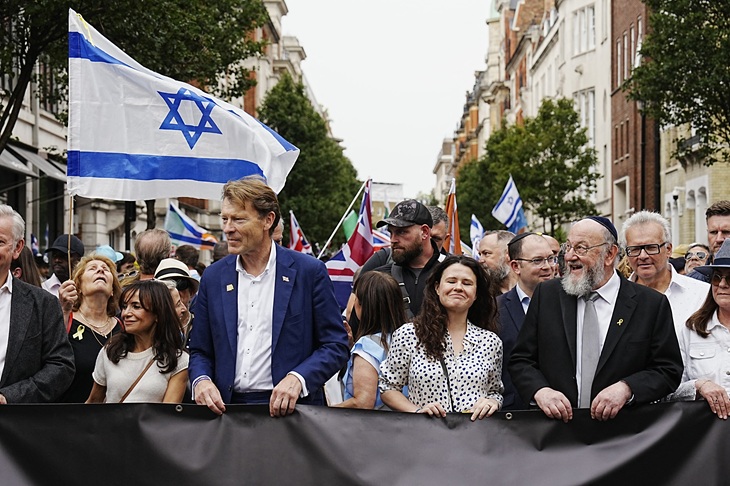
Of the many shortcomings of this government, a casual indifference to the terrifying rise of antisemitism in this country is among the most shameful. It is no exaggeration to say that our Jewish friends and allies feel totally betrayed and abandoned. With public support for Hamas terrorists scarcely concealed on our streets, they also feel frightened.
It is now tragically clear that their fears of physical attack have been more than justified. Since Labour ministers and MPs, from the Prime Minister down, have made their pro-Palestinian allegiances very clear, it is left to others in Parliament to stand by our friends. This is how, just a few days ago, I found myself at an Israeli border crossing into Gaza. I stood among hundreds of pallets of fresh avocados, onions and bananas, along with more flour, sugar and tins than I had ever seen. This was not a supermarket logistics centre, but the very edge of a war zone. I watched as great convoys of lorries were loaded up with this vital aid and pressed their way forward into the war zone.
Earlier, I had visited a kibbutz that was devastated in the October 7 attacks and left feeling sickened. Though it seems hard to believe, two years since those horrors, the smell of burning still lingers. This was the scene of house-to-house slaughter of 85-year-old grandparents, uncles, mothers and fathers gunned down alongside their children. Even pet dogs were not spared.
A woman in her early 20s walked me through this village, and with extraordinary courage, showed me the exact spot where her grandmother was murdered on the front porch. Then she showed me the wooden lamp post where her uncle was executed. Next was the burnt-out husk of a small bungalow. It was here that her brother was blown to smithereens by a grenade. He had thrown himself on it to protect his terrified fiancée, who was hiding under the bed. In the next house, three young people had been kidnapped. Random choices between life and death. Further down the street, I heard how a woman was dragged from a hiding place in her bedroom and forced to strip naked in front of six terrorists. Had any of this happened to me, my family, my community, I would be utterly determined to ensure that it could never happen again. That is why the Israeli government feels an overwhelming burden of responsibility to root out such evil.
Experiences on the ground are so often different from what we hear and read. It felt important to see evidence of aid going into Gaza, and so I went to Kerem Shalom, one of the most dangerous controversial and dangerous border crossings in the world. Because it is yet another target for Hamas, it is surrounded by huge concrete walls.
What kind of monsters would try to kill those bringing in aid? I think we know.
Gingerly, I climbed some steps to a platform from where I was able to peer over the concrete top towards no man’s land. In the distance were numerous Palestinian trucks moving from the distribution area into Gaza itself. I saw dozens more pallets in open-sided sheds, ready to be loaded onto the trucks.
I was able to speak to some of the most senior people involved in this humanitarian aid logistics program. The food comes from numerous charities, the best known being the United Nations humanitarian organisation UNRWA. They are not responsible for the majority of supplies. With terrorists stealing stuff, and infiltrating these agencies, the Israelis try to minimise the risk by knowing who is working in Gaza for these charities. This is where the real difficulties emerge. I was told that certain organisations simply refuse to put forward names for vetting, then unreasonably complain that they cannot get aid through. Some of the charities that trumpet fundraising efforts around the world turn out to deliver very little in the way of actual supplies to Gaza. It sounds very much as if donations simply prop up their sprawling bureaucracies and operations elsewhere.
Of course, mistakes happen in war zones, and there is no doubt that numerous innocent aid workers have tragically been killed by Israeli forces. However, certain globally renowned charities need to be honest that some of those who have lost their lives were in fact Hamas operatives stealing supplies.
It is well known that there is a huge black market in food and supplies controlled by the terrorists and other gangs. I am sorry to say that they have close links to certain charities. Profits from their illegal activities fund more war. Their cynical modus operandi involves deliberately restricting the supply of food, making it impossibly expensive for the poor. The result? Hunger and even starvation. Why is UNRWA the slowest to move aid on, often leaving it sitting on pallets for weeks? Surely, as the longest-serving charity in Gaza, with the most people, it would be the most organised and efficient? This is what the Gaza Humanitarian Foundation was set up to counter. It is all considerably more nuanced than the BBC, Sky and other mainstream news outlets that carry breathless reports about starving children seek to imply.
My own view is that senior figures from the UN who spout blatant lies about the reality on the ground need to be held to account for the failures of their own operations. They have received hundreds of millions of pounds from the UK taxpayer, much of it essentially funding Hamas. Did they properly explain why the British hostage Emily Damari was held in UNRWA facilities? Instead, the UN convince gullible diplomats and leaders that there is a real famine in Gaza. I have seen enough with my own eyes, and heard enough from credible top people, to be convinced that this is simply untrue. This is a world away from real famine conditions in parts of Africa. Having spoken recently to a number of Palestinians living in Gaza, they reaffirm the food position.
Why are we still funding the UN, and other organisations that fail and lie?
As I headed back north along a pothole-free highway, I stopped at a service station. Joining a queue for coffee with young female soldiers carrying semi-automatic machine guns was novel. As I stepped outside, the Gaza border fence was just a few hundred yards in front of me. I heard the unmistakable sound of gunfire and shelling. A couple of kilometres away was Gaza City.
My final stop was the most tragic music venue in the world. The Nova site makes one weep. It is now a memorial, with hundreds of beautiful young faces smiling from their individual posts: young lives, brutally cut short. I sat quietly with a survivor who choked as she recalled her horrific story on that fateful day. She had smothered herself in blood and dead bodies to avoid detection.
A Muslim police officer then described how he ferried carloads of Jewish festival-goers away from the carnage, returning seven times to save even more. Somehow, he survived the bullets. What extraordinary courage.
It was all too much; I had to leave. A little further up the road, I stopped to visit a vehicle graveyard: what remains of more than 1,000 cars, hundreds burnt out, others riddled with bullet holes, from the Nova site. It was hard to process it all.
What I felt like was a stiff drink. Instead, I changed into a jacket and tie and was driven to meet the Foreign Minister in Jerusalem to talk politics.
Without doubt, this was the longest day of my life.
Richard Tice, Reform UK
This article was first published in www.conservativewoman.co.uk