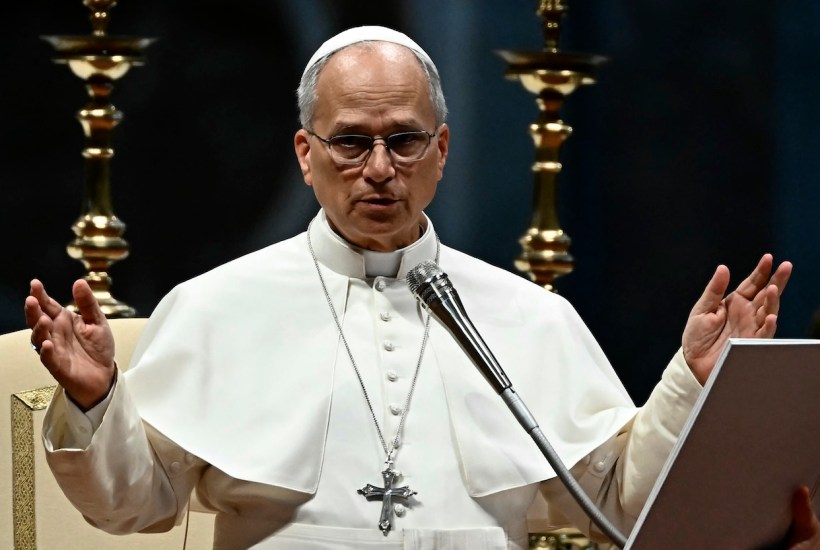
The Pope is arriving in Paris like a rock star next month, taking centre stage at a mass rally of French youth in the Stade de France. The stadium’s 80,000 seats were quickly snapped up online for Leo XIV’s evening prayer vigil on 25 September.
The following day, the Pope will celebrate an open-air mass in Place de la Concorde. More than 200,000 worshippers have already reserved places and a sea of 300,000 faithful are expected to congregate in the nearby Champs-Élysées.
The stage is also set for delicate diplomatic tensions when the Pope meets with French president Emmanuel Macron at the Élysée Palace. Macron’s government just adopted a law permitting assisted suicide. The Pope has publicly expressed his opposition to legalised euthanasia. It is believed Macron hastily promulgated the law last month so the issue will not be hanging in the air during the Pope’s official visit to France.
The Pope’s arrival in France has also rekindled deep divisions within the Church between progressive and ultra-conservative Catholics. Ahead of the Pope’s scheduled visit to Lourdes, the Church recently banned the ultra-traditionalist Society of Saint Pius X from celebrating mass at the town’s famous Marian shrine dedicated to the Virgin Mary. Last month, the Society of Saint Pius X provoked a schism with the Vatican by defiantly ordaining four bishops without papal consent. The Pope responded by excommunicating the ultra-conservative Catholic sect’s followers. Last week, Bishop Jean-Marc Micas of Tarbes-Lourdes also said that mosaics designed by Fr Marko Rupnik at the Lourdes shrine will be covered during the Pope’s visit – Rupnik is facing an ongoing canonical trial over allegations of sexual abuse.
These tensions and dramas demonstrate that, even in the fiercely secular French Republic, the country’s profoundly Catholic identity persists. Some even claim that Catholicism in France is making a comeback. For many, witnessing the destruction of Notre Dame cathedral in a conflagration was a traumatic blow to the country’s deep connection to the Catholic Church and its symbols. On the first day of his visit to Paris, the Pope will celebrate Vespers at Notre Dame.
France’s national narrative has been shaped for centuries by the nation’s connection to the Catholic Church. The country was traditionally known as fille aînée de l’Église – the eldest daughter of the Church. Generations of schoolchildren learned that France was born with the baptism of Frankish King Clovis at Reims, circa 500 AD. Divine-right monarchs were anointed at Reims cathedral to consecrate the connection to Clovis.
The French Revolution toppled the Bourbon monarchy, suppressed religion, expropriated Church property, and converted cathedrals into secular Temples of Reason. Napoleon made a conciliatory gesture towards the papacy with the Concordat, but tensions between secular republicans and Catholic royalists persisted well into the nineteenth century. The result was a rivalry between ‘two Frances’ – one profoundly Catholic, the other resolutely secular.
Following the collapse of Napoleon III’s Second Empire, political Catholics were a powerful force determined to bring back the monarchy. In 1873, George Sand confided in a letter to Gustave Flaubert her fear that Catholic monarchists would take control of the country: ‘I smell a rising scent of sacristy creeping in.’ In the end, republicans squeaked through and prevailed. It marked a historic defeat for traditional Catholics, though the construction of the Sacré Coeur basilica in Paris was a symbolic gesture of defiance towards the secular Third Republic.
In 1905, the famous ‘laïcité’ law separating church and state was another triumph for anti-clerical republicans. With the Dreyfus Affair as a backdrop, Catholic nationalists grew more extremist through movements such as Action Française, whose rhetoric was royalist, anti-parliamentary, and virulently anti-Semitic. They finally triumphed in 1940 with the collaborationist Vichy regime. Crucifixes returned to classrooms in state schools.
The national shame of the Vichy interregnum marginalised Catholic nationalists in the post-war years as France became increasingly secularised. That trend accelerated after the 1960s with the counter-culture movement, rise of feminism, and legalisation of abortion. Traditional Catholics rallied in opposition around specific issues, notably against abortion and gay marriage. In the early 1980s, a mass demonstration of Catholics in the streets of Paris forced François Mitterrand’s government to back down on a law that would have folded ‘private’ schools (mostly Catholic) into a unified state system.
Today less than half of the French population (roughly 46 per cent) identifies as Catholic. Only a fraction – about 5 per cent – attend mass at least once a month. Yet signs of the country’s Catholic identity are etched into many aspects of daily life. The calendar rhythm, for example, still observes Catholic fêtes. On 15 August, the French take a bank holiday in the name of the Assumption of Mary, celebrating the Virgin’s bodily ascent to heaven. This date was once France’s national holiday, stretching back to King Louis XIII who in 1638 declared the nation’s devotion to the Virgin. Napoleon Bonaparte appropriated the Virgin’s fête because it conveniently fell on 15 August – Napoleon’s own birthday. The new ‘Saint Napoleon’ holiday – also celebrated during the Second Empire – mixed religious and imperial veneration. Contrary to the widespread belief that the Bastille Day national holiday on 14 July began during the French Revolution, it was not in fact proclaimed France’s fête nationale until 1880 under the Third Republic.
Many French Catholics will expect the Holy Father to make forthright pronouncements during his visit to France
If there is a Catholic revival in France today, it is being driven by French youth. At a time of moral chaos and general uncertainty, many young people seeking transcendence are finding it in Catholicism. The Church also offers networks and a sense of belonging. This may explain why many young people are drawn to religious pilgrimages. This year, some 20,000 young traditionalist Catholics took part in the annual Pentecost pilgrimage from Paris to Chartres. The number of adult baptisms is also up. At Easter this year, 13,000 adults and more than 8,000 adolescents were baptised in France. That’s an increase of 28 per cent over last year. The total number of adult baptisms this year is expected to exceed 20,000.
Catholicism has also received a boost from France’s conservative media, especially newspapers, radio stations and television channels owned by the country’s most powerful media baron, Vincent Bolloré. A traditionalist Catholic who takes a hands-on approach to his media empire, Bolloré has recruited high-profile ultra-Catholics as commentators on his radio and television channels. One of them is Philippe de Villiers, an aristocrat and ex-politician well-known in France for his invectives against Islam and its threat to France’s Christian civilisation. Unlike Catholic nationalists a century ago who vociferated against Jews, Protestants and freemasons as enemies of the French nation, today Catholic nationalists such as de Villiers regard Islam as the main threat to French society.
Pope Leo XIV may be too progressive for the ultra-conservatives. In his encyclical Magnifica humanitas, he emphasised the duty of humanity and dignity towards migrants. On other issues such as assisted suicide, however, the Pope’s views are aligned with conservative Catholics who strongly oppose legalised euthanasia. Many French Catholics will be expecting the Holy Father to make forthright pronouncements on that and other issues during his visit to France. Their expectations reveal that, in a nation long divided into ‘two Frances’, conservative Catholics still have a powerful voice.