While Hollywood races to make movies cheaper with AI, Christopher Nolan remains deeply sceptical of the technology, and younger audiences increasingly agree.
One of the reasons The Odyssey has been so successful is that it feels so very real in an age where everything we watch is synthetic.
According to Netflix, more than 300 of its films this year used generative AI in post-production.
Nolan’s dedication to analogue goes way beyond the use of his trademark 70mm film.
Many of The Odyssey’s key scenes were created using practical effects, in keeping with Nolan’s belief that giving actors something real to respond to produces better performances.
Odysseus’s encounter with the cyclops, the giants in silver armour, and the pig transfiguration scene were all made using a combination of puppetry, animatronics, and visual perspective trickery.
here you can see the height difference between the 7~ foot actors who played the Laestrygonians and the stunt actors who doubled for the crew of Odysseus in The Odyssey. photos posted by stunt actor Devyn Dalton https://t.co/52LCOr679q pic.twitter.com/bT5ERbEVNO
— Jeremiah Warren ◡̈ (@jeremiahjw) July 20, 2026
In the case of the encounter with the whirlpool Charybdis, a squadron of jet skis did doughnuts to create choppy waters.
Nolan also built multiple 35-foot Trojan horses, which he buried in the beaches of Morocco and hauled to the gates of Troy, where he built a life-size Temple of Athena.
Matt Damon reveals how they filmed the insane Scylla scene in The Odyssey
“we took the boat through that passageway, and chris had on one side jet skis doing donuts in the water”
“this is true, to really create a small whirlpool that the visual effects could use the actual… pic.twitter.com/1KnV4hJLv3
— chris (@tookyospot_) July 20, 2026
‘After years of driving towards heavily virtual environments, we’re seeing a renewed interest in more tactile, more real forms of storytelling,’ said Nolan, in a recent interview.
None of this should surprise anyone familiar with Nolan, a director who has built his career around old-fashioned movie magic.
The train barrelling down a Los Angeles street in Inception and the mid-air plane hijack in The Dark Knight Rises were practical effects. He even grew 500 acres of real corn for Cooper to drive his pickup through in the opening scenes of Interstellar.
In the 2023 blockbuster Oppenheimer, he recreated the Trinity atomic bomb test using practical effects, camera angles, and miniatures, rather than with CGI.
The appetite for old-fashioned movie magic may be strongest among audiences who have never known a world without CGI.
Across culture, young people are increasingly drawn to what feels tangible: vinyl records, printed books, and meeting in person instead of swiping.
It’s known as ‘anemoia’: a longing for a past you’ve never experienced. No prompt can manufacture that longing, only satisfy it.
A recent YouGov survey found almost half of 18 to 24-year-olds believe films using AI should not be eligible for awards such as the Oscars or BAFTAs, compared with just under one-third of those aged over 65.
In many ways, The Odyssey is this generation’s Jurassic Park, and their first taste of the types of movies, Star Wars, Jaws, Alien franchise, and Blade Runner, aka films that made my generation fall in love with cinema.
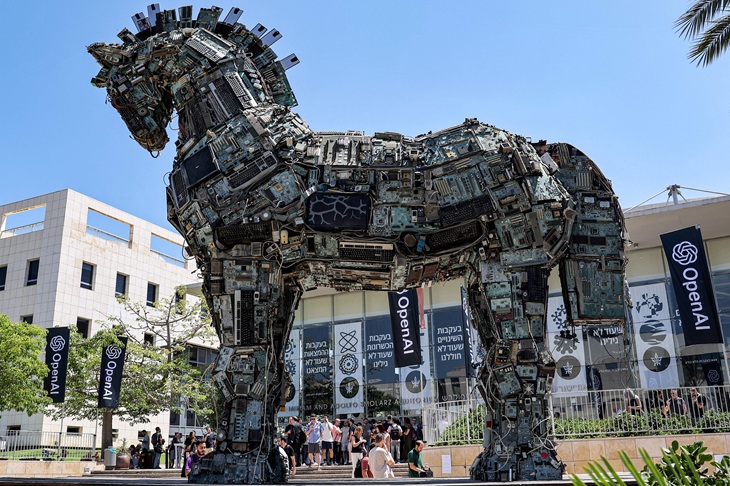
Nolan, who refuses to own a smartphone, has compared AI to a Trojan horse but one where ‘everyone knows the Greeks are inside’.
AI arrives promising effortless productivity and a more convenient life, but many suspect what’s hidden inside that gift is a hollowed-out job market, a world where human creativity rendered redundant, and wealth is concentrated among an elite few.
Nolan has drawn parallels between Oppenheimer and the threat of artificial intelligence, which he has suggested poses a similar moral threat to humanity as nuclear weapons.
‘I have never seen a technology [AI] advancing so rapidly, so completely rejected by the public, particularly by younger people,’ he said, in a recent interview.
Broader research confirms that young people are consistently more opposed to AI than older generations.
This scepticism is not confined to audiences; it’s also coming from young filmmakers.
Kane Parsons, the 20-year-old director whose recent horror film Backrooms became a cultish success, has been outspoken in his opposition to generative AI.
‘If I could snap my fingers and make AI disappear forever I probably would,’ Parsons said. ‘It defeats the purpose of filmmaking entirely.’
Nolan’s dedication to authenticity has been rewarded at the box office, with The Odyssey recouping its entire production budget in its opening weekend.
In many ways it’s a self-fulfilling prophecy: his insistence on filming in real locations, indeed across seven countries, became part of the story audiences were sold before the film even released.
I could make my own version of The Odyssey with a series of carefully crafted prompts from the comfort of my room; indeed people are already doing just that. But I doubt anyone would line up at a cinema to watch it.
The siren song of artificial intelligence is powerful, and hard to resist. Like Calypso’s island it offers a paradise of abundance and luxury. But Nolan, like Homer, understands that the easiest path is not always the one worth taking.