Young women have never had more freedom, more education or more money. So why are so many of them so miserable – and so hostile to men?
Everyone has a theory.
Jonathan Haidt blames the smartphone: girls’ anxiety and depression began soaring around 2012, just as Instagram took hold. Others point to the pandemic, to economic gloom, to universities steeping students in grievance politics, to years of #MeToo messaging teaching girls to see menace in ordinary male behaviour.
The toll is plain to see. Here in Australia, almost half (45.5 per cent) of women aged 16-24 had a mental disorder in the past year – mostly anxiety – compared with a third of young men.
All of these explanations play a part. But I think we’ve missed something vital – something that set the stage long before the first iPhone.
It began 50 years ago. Inspired by feminists like Betty Friedan, who preached work as women’s salvation. Young women were encouraged to put marriage on hold: get the degree, build the career, see the world, settle down later. And so they did.
What nobody anticipated was that this would open up an entirely new stage of life: a decade of dating that now consumes most of early adulthood. It’s a change almost no one talks about, yet it has profoundly shaped young people’s chances of finding love, marriage, kids – the whole shebang. And once the smartphone and the dating apps arrived, that decade turned brutal – an endless marketplace of seeking and rejecting, of dates that go nowhere and breakups that leave scars.
That decade has proved enormously costly. Marriage – for generations the cornerstone of adult life – is in free fall. The Australian marriage rate more than halved in 50 years. Our birth rate has sunk to 1.48 babies per woman – the lowest ever recorded and far below the 2.1 needed simply to replace ourselves. In the United States, demographer Lyman Stone projects that one in four women now in their 30s and 40s will never have children – most of them not by choice. Growing numbers of women will face old age alone – often lonely, many of them poor. And, as I have discussed before, the men, freed from the yoke of marriage that for centuries harnessed their ambition and their labour, are walking away from work as well as from women.
This is not a private sorrow for a few unlucky individuals. It is the slow unravelling of the bargain upon which families, communities, and economies have always depended.
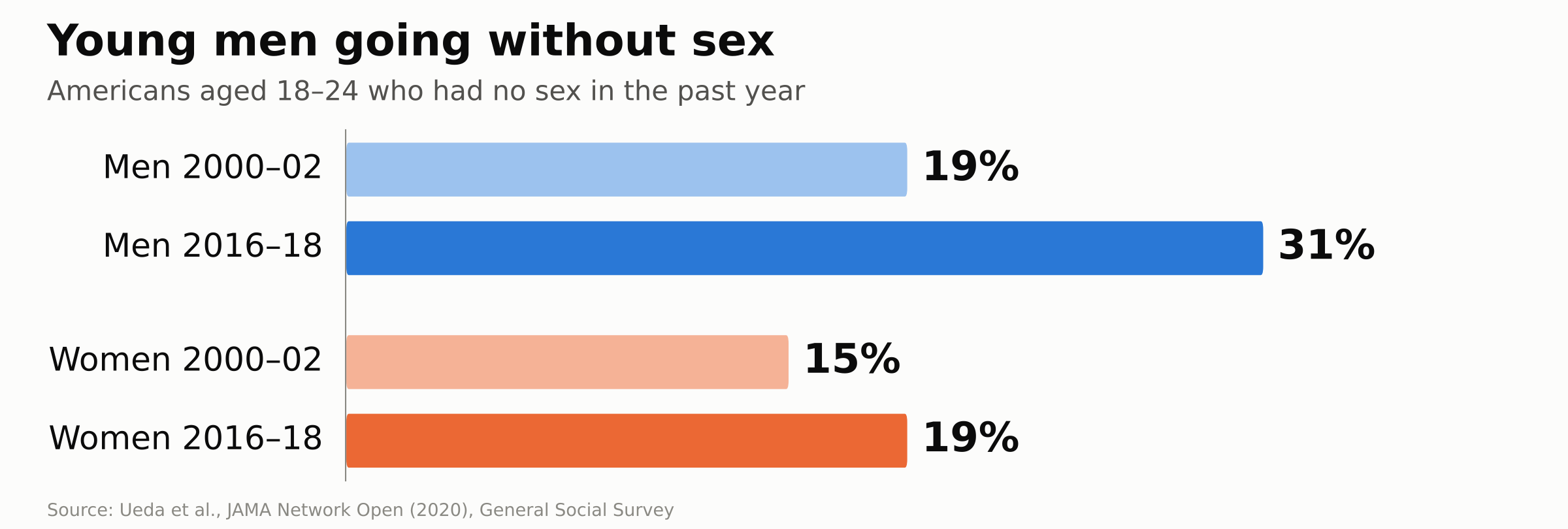
Here’s a statistic that might stop you in your tracks. Women in Australia and New Zealand are freezing their eggs at record rates – more than double the number of four years ago, according to ANZARD, the register that tracks every IVF cycle in both countries. Ask the fertility doctors why, and they don’t talk about glittering careers. The answer is much more basic: there’s no man.
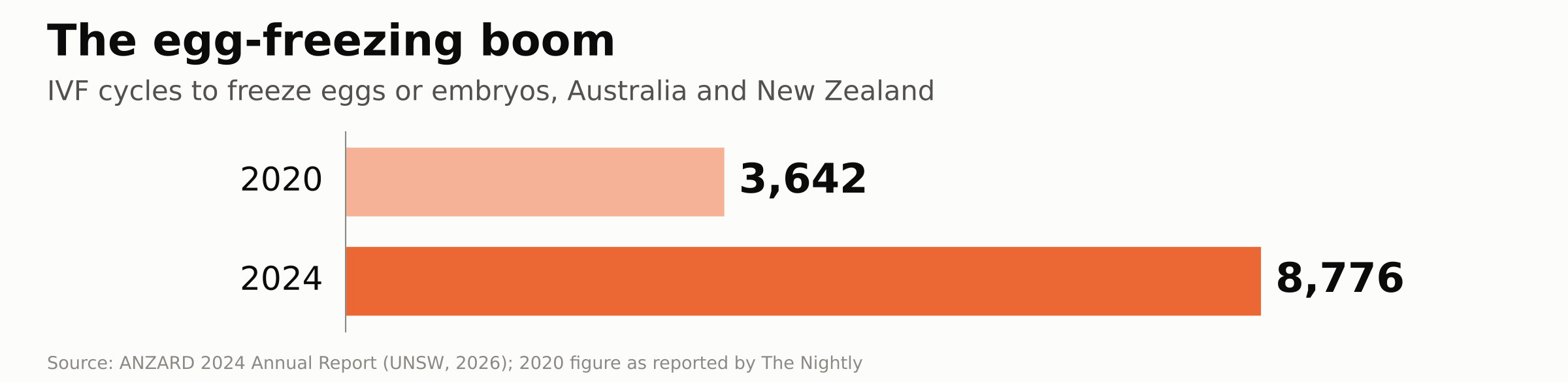
So where are all the men? A lot of them are home alone. Much of the best data on this comes from America, where a 2022 Pew survey found 63 per cent of men under thirty were single – up from 51 per cent just three years earlier. Only a third (34 per cent) of their female contemporaries were in the same boat.
(You’ll notice those figures are American. Much of the best research on young people’s love lives comes from the US, because Australia simply doesn’t collect it – there’s no national survey tracking how many young Australians are single or going without sex. But where we do have local figures, on marriage, partnering and births, they point in the same direction.)
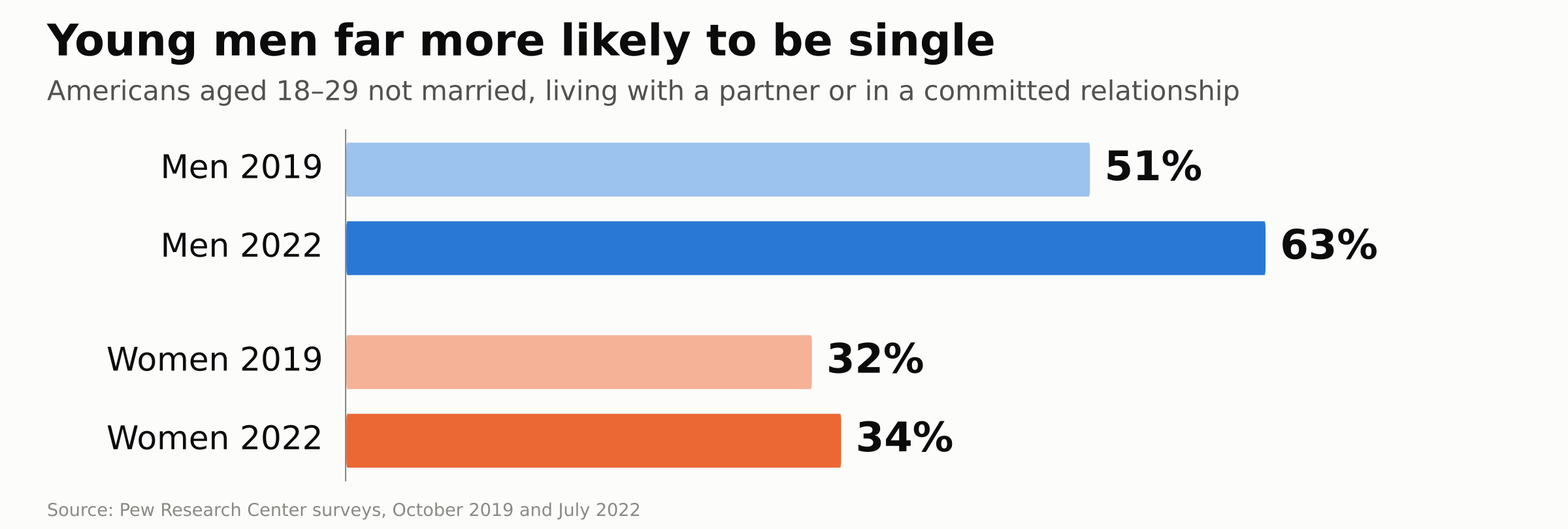
And forget the image of the swinging bachelor. Nearly one in three American men aged 18-24 had no sex in the previous year, up from one in five in the early 2000s. Among young women, the rise was far smaller – from 15 per cent to 19 per cent. So much for the sexual revolution.
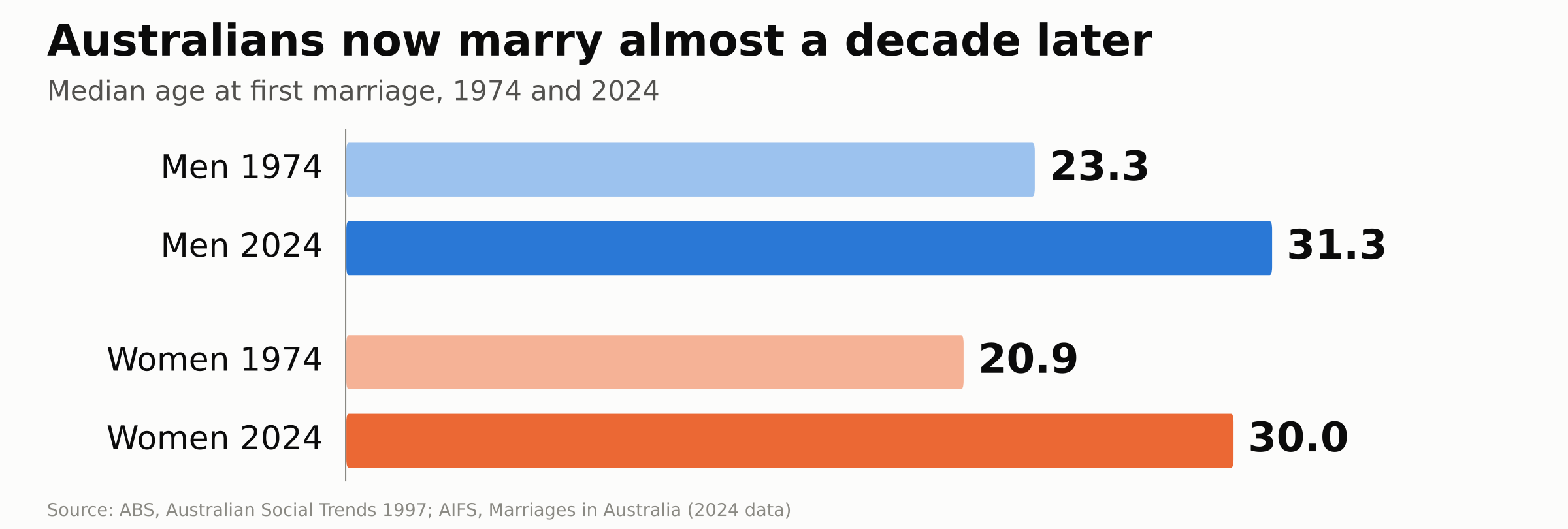
Remember that decade of dating? Here it is in black and white. In 1974, the typical Australian bride was 20.9 – barely out of her teens. Today she’s 30. Her groom has gone from 23 to 31. Even the Australian Bureau of Statistics, looking back in 1997, put the delay down largely to women’s rising participation in education and work: ‘The extra time it took to achieve these goals was probably a major factor leading to the postponement of marriage.’
So, who actually ends up living with a partner – and when? The 2021 Census tells a striking story. In their late 20s and early 30s, women are well ahead: 61 per cent of those aged 25-34 live with a partner, compared with just 52 per cent of men. But then comes the great reversal. By 35-44, just as the fertility window is closing, one in four women isn’t living with a partner. From there the lines cross. Men hold steady, while women slowly slide. It looks like the nice guys that women passed over at 25 have found their feet, built their careers – and many of them now have options. Including younger women.
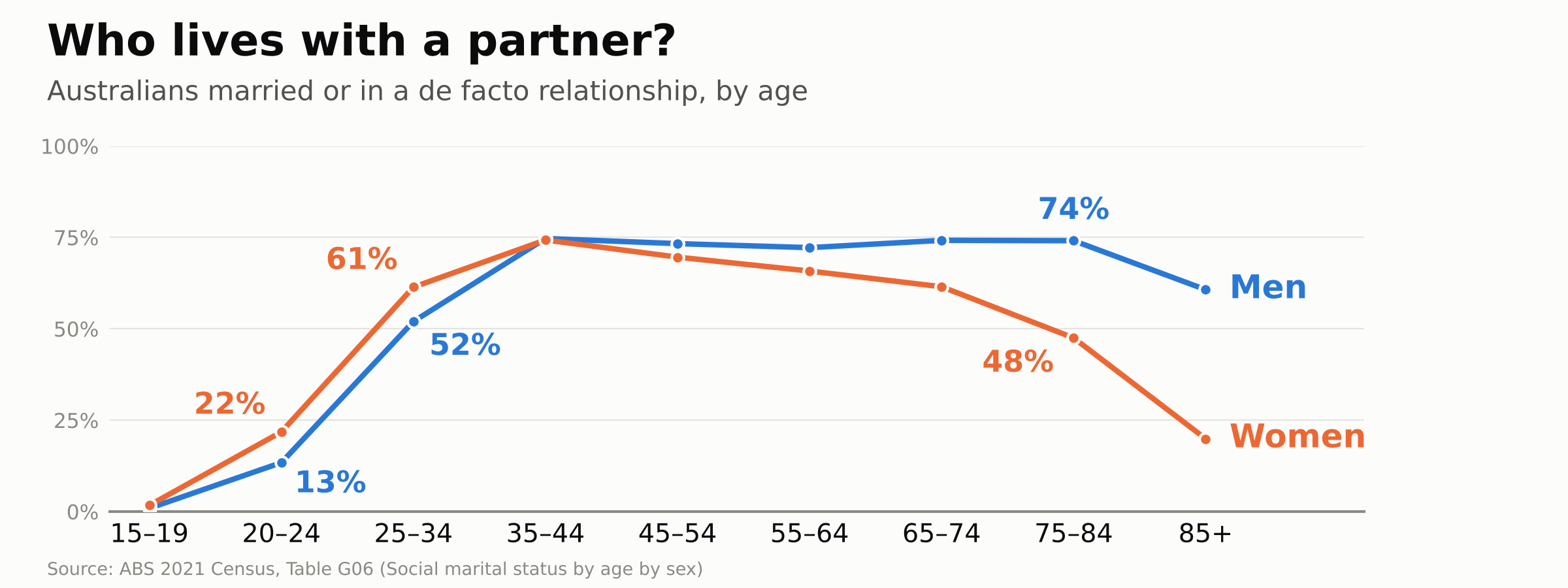
Some will say young people haven’t stopped partnering – they’re just living together instead of marrying. And for many, particularly in less well-off communities, living together has indeed replaced marriage – though these relationships are far more likely to break up. But even counting de facto couples, the decline is dramatic: in 1976, 59 per cent of women aged 20-24 lived with a partner; by 2021 it was just 22 per cent. For young men, it fell from 32 per cent to 13 per cent. Cohabitation hasn’t filled the gap.
Some of this I saw coming. Fourteen years ago, in my Sydney Morning Herald article called Why Women Lose the Dating Game, I quoted an American blogger, Dalrock, who summed it up perfectly: ‘Today’s unmarried twenty-something women have given men an ultimatum: I’ll marry when I’m ready, take it or leave it.’
Even then, plenty of men had decided to leave it. I wrote about the astonishment of successful career women who finally felt ready to settle down, only to look around and find the men had gone. The newspapers were full of anguished essays from thirty-something women stranded on the shelf, wondering where all the good men were. My question was simple: Had this female-led decade of dating been a strategic blunder?
Fourteen years on, the answer is in – and it’s worse than I thought. The cost hasn’t just fallen on women left high and dry in their thirties. Men and women alike emerge from a decade of seeking and rejecting partners battered, bruised, and wary. And a growing number simply give up – spending some of the best years of their lives alone.
Which is where Ali Mahmoudiyan comes in. I’ve had a YouTube conversation about all this with Ali, a 27-year-old sociology student at the University of Leipzig who is writing a book, Modern Intimacy, on the hidden costs of today’s dating market.
He brings something rare to this debate: a young man willing to speak openly about his own relationships, and an outsider who grew up in a devout Shia family in Tehran, in a world where dating didn’t exist, now looking at ours with fresh eyes. In Germany, he was shocked to find that most young people seemed ‘to suffer more from dating than they benefit from it’.
Ali pulls no punches. ‘For young men, the dating market is psychologically violent,’ he writes, ‘and those wounds often shape their entire adult lives.’
Part of the problem is simple arithmetic. The dating apps are flooded with young men – on Tinder, they often outnumber young women two to one. ‘The average woman on a dating app receives maybe 10 to 50 likes per day,’ Ali writes. ‘What most women don’t realise is what the average young man experiences. It’s … crickets.’ The typical young man, he says, ‘would be lucky to get one match per week’.
That puts enormous power in women’s hands – what Ali calls #FemaleChoice.
‘For women … the challenge is deciding. For men … the challenge is waiting.’
And because so many men have nowhere else to find emotional intimacy, finding a partner isn’t just nice to have – it’s emotional survival. That hands women all the bargaining power.
Ali’s most important insight is about what that decade does to young men. Years of invisibility and rejection leave scars that don’t simply vanish when their fortunes turn in their thirties. Imagine finally meeting ‘a wonderful woman who might never have paid attention to you ten years ago’ Ali says. ‘But if you are still bringing all the bitterness, the invisibility, the rejection and the painful experiences of your 20s into that relationship, it’s not a recipe for a healthy relationship either. It’s simply a lose-lose situation.’
And the consequences reach further than we think. Writing recently in The Weekend Australian, Louise Perry points to what’s been called a ‘relationship recession’, with young men and women living ever lonelier lives. She suggests it may also explain why the sexes are pulling apart politically: they no longer ‘deradicalise each other through sustained, loving relationships’.
What’s extraordinary is how little attention we have paid to all this. We’ve rewritten the timetable of young adults’ lives and barely anyone has stopped to ask the cost. We fret endlessly about falling birth rates, male disengagement, the epidemic of loneliness and the growing political divide between young men and women, yet rarely connect the dots. One of the biggest social experiments of our time is unfolding in plain sight – and we’ve hardly noticed.
You can read more from Bettina Arndt at her Substack