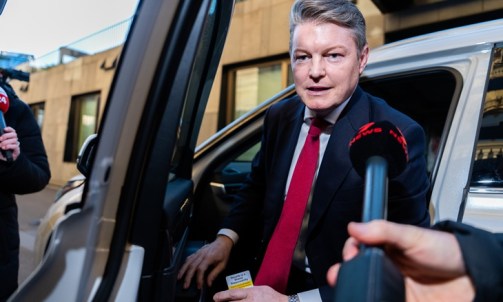
On the table in the House of Commons today is a curious ten-minute rule motion introduced by Josh Babarinde, the Lib Dem MP for Eastbourne. The English Ethnic Identity (Census Particulars) Bill would change the census legislation by adding to the question on ethnicity the option to identify as, for example, ‘Black English’, ‘Asian English’, or ‘Mixed English.’
Englishness as a culture is attractive precisely because of its indifference to skin colour, origins or other arbitrary factors
You can see the thinking. Babarinde’s family on his father’s side is from Nigeria, but he justifiably regards himself as being as English as any white person whose family has been here for generations. What’s wrong, therefore, with getting rid of the idea that Englishness implies whiteness by allowing it to be combined with other ethnicities? Actually, quite a lot.
For one thing, in the context of ethnicity this proposal makes no sense. Currently the census ethnicity question is just that. It asks not about culture but, to put it bluntly, racial ancestry. Everyone has to classify themselves as white, black, Asian, mixed-race, or something else, and then add a more detailed description, such as black African, black Caribbean or Asian Chinese. Only one choice is allowed, and the answer is fairly mechanical.
Unfortunately, Englishness as a culture – your attitudes, outlook, and the place you regard as home – does not fit here. Consider, say, a Jamaican happily settled here, with citizenship, and wanting to be more English than the English. If this bill passes, what are they: black Caribbean or black English? In a sense both are right. But they can’t be both. The question is simply unanswerable.
There is more to this, however, than simple incoherence. Englishness as a culture is attractive precisely because of its indifference to skin colour, origins or other arbitrary factors. If someone is a UK citizen, clearly committed to England, its society and its way of doing things, we rightly see them as just that: an Englishman who happens to be black, Irish, Asian or whatever. We do not make a habit of classifying our neighbours as black English, Asian English, and so on, for the very good reason that there is no material difference between them.
Yet that is exactly what Babarinde’s bill would encourage us to do: to point at, rather than ignore, racial differences between English people. If we must have questions on ethnicity at all in the census – and there is a strong argument that we should show our commitment to anti-racism by pointedly omitting them – let them relate purely to racial features, as at present. That’s all we need to deal with issues such as discrimination and prejudice, which is why they were put there in the first place.
Indeed, it’s hard to avoid suspecting that this proposal is an attempt, among other things, to undermine the idea of Englishness as a unique culture worth preserving. This would certainly reflect the left-liberal cosmopolitan view of the world held by most Lib Dems and, one suspects, Josh Babarinde. Ask any politician of this stripe about their own culture, and the answer is invariably the same. They will start, loyally enough, with a description of that culture as precious and unique. Ask what this unique advantage is, and the answer is equally predictable: you will be told that it consists not in any national idiosyncrasy (heaven forbid), but in committed multiculturalism, together with some fairly bland posturing about human rights. Of course, if this is correct, it follows that there is really nothing special at all about any particular culture, and there really shouldn’t be much difference between the way they do things in London, Paris, or Pretoria. But hey-ho: that’s progressivism for you.
This bill plays precisely into that world view. By reducing Englishness to just another arbitrary classification, split into white, black, Asian and other varieties, it declines to see it as a powerful and beneficent factor uniting people despite their different origins. On the contrary, it turns this view on its head. What really matters, it subliminally tells us, is that a person is black, or Asian, or mixed race. Of secondary importance is the fact that they happen to have an English national identity. This is not a message anyone concerned about promoting racial harmony should be supporting.
But perhaps things aren’t all bad. There is one ray of light. The current census question on ethnicity is confusing enough. Adding Asian English or mixed-race English into the mixture might, ironically, do some good by making the whole thing a complete shambles, the answers to it almost meaningless, and its weaponisation for identity politics extremely difficult. That’s obviously not what this proposal envisages: but if it passes (which it won’t) it might be what we get. Josh Babarinde, like any other politician, needs to be careful what he wishes for.