The Productivity Commission’s Quarterly Productivity Bulletin for June 2026 notes that labour productivity growth is going from bad to worse.
The Bulletin highlights the utilities sector as having the worst sectoral productivity performance in the economy. The electricity industry produces almost 60 per cent of the value added in that sector. A 126 per cent increase in the capital stock used to produce electricity since 2001-02 has increased electricity output by only 14 per cent. Productivity has fallen by 32 per cent. (pp 6-7 of the Bulletin)
Is this the first official acknowledgement by the Canberra policy clerisy of an obvious truth, that using multiple intermittent generating systems to supply the same demand for electricity is destroying productivity?
Not quite. According to the Commission, all is not lost in the electricity industry: ‘Productivity is not as bad as it appears.’
The Commission offers three mitigating explanations of the damage shown by its measured productivity decline from investment in renewables. (Embellishments are mine.)
- First, new investment will take time to increase output.
- Second, we are allegedly enjoying unvalued (and invisible) quality improvements in the electricity grid.
- Thirdly, we no longer expect the electricity sector just to provide reliable, affordable electricity: we now expect it to reduce CO2 emissions, so that reduction should be somehow valued in the output of the investments in renewables and associated infrastructure.
I examine these arguments in turn to conclude that Net Zero policy choices in honour of the Paris Agreement have unleashed powerful forces of productivity destruction. They are likely to grow with future wasted large investments (already above budget and lagging long behind schedule), rather than diminish. No industry is more ubiquitous than electricity in dragging back high productivity sectors through its own productivity destruction. Resources wasted by productivity destruction in generating electricity at needlessly high prices are not available for use in other industries whose productivity is increasing. Real living standards are driven backwards.
The Commission’s analysis regrettably shows it has joined the CSIRO, the AEMO, and Treasury in proffering implausible rationalisations of arbitrary and uncosted government policy targets, rather than evidence-based policy analysis.
Productivity in concept and approximate measurement
Measuring concepts can be tricky.
The late, internationally renowned Australian Statistician Ian Castles (1935-2010) cautioned to avoid the statistician’s version of the ‘reification fallacy’: the fallacy of misplaced concreteness.
Most measurement challenges start with a concept, an idea that we would like a quantitative handle on, such as growth in potential living standards. Then we develop one or more statistical approximations to the concept (such as growth in GDP per person, or real wages), which are invariably imperfect measures. We should take care to avoid mistaking the measurement for the concept, by keeping a perspective on all related evidence to arrive at a realistic picture of what is actually happening with the concept we are trying to enumerate.
Productivity, in concept, is the value to people of what is produced, per unit of the inputs consumed to produce it. Productivity growth in the market sector as approximated in statistical measures is usually either labour productivity (growth in the gross value added of a factory’s output per hour of labour input); or growth in multifactor productivity (the growth in the index of gross value added per increase in an index of the value of inputs of labour and capital).
The key conceptual point to retain in sharp focus is that the numerator of any productivity measure in the market sector is the value of the industry’s output to its consumers. It would make little sense to talk of productivity in producing something no one experiences, wants, or values.
Accepting as a starting point that the measured productivity trend in the electricity sector is appalling, let’s look at each of the Commission’s three mitigating arguments in turn, with regard to all the evidence.
Waiting for the benefits?
The Commission offers a mining analogy for Australia’s massive investment in renewables. A mining company expanding a capital-intensive mining project with heavy investment to increase output might cause initially weak productivity measurements. Productivity however turns strongly positive as the mine’s output from the new capital ultimately comes on line.
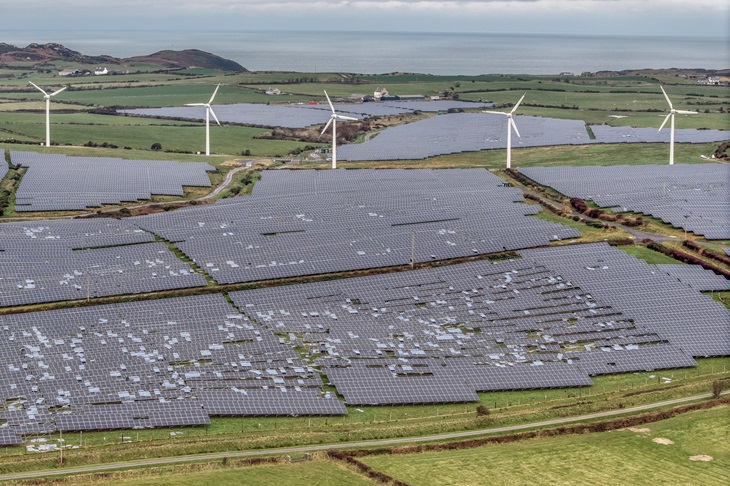
However, the Commission’s analogy is, in my view, misleading. Criticisms of the Commission’s work by Stephen Anthony of Macroeconomics Advisory get to the nub of the issue. A wind and solar system ‘requires three to four times over build for reliability, vast tracts of land, long distance transmission (with losses) and a parallel life-support system to achieve grid stability.’ (emphasis added)
Australia’s electricity market is heavily corrupted by mandates, subsidies and taxes to induce renewables investment, estimated to cost some $16 billion a year. But market forces still have some impact. One would expect investors in solar and wind farms to pick the best sites first. ‘Best’ means sites with most solar and wind exposure, closest to demand centres and existing grid connections. Such sites maximise subsidy payoff per dollar invested with minimised delays for new grid connections to be built. Just from first principles, we must expect tomorrow’s addition of a kW to solar and wind capacity will have higher costs and lower payoffs than yesterday’s.
Moreover, it is a virtue of wind turbines and solar panels that they can be installed incrementally and brought online quickly, relative to replacing a large, ageing sub-critical coal-fired generator with a new super-critical plant or a modern gas-fired plant, much less a nuclear plant. Aidan Morrison of the Centre for Independent Studies has emphasised that the original surge of solar and wind investment has been progressing since about 2008 and is already in extensive production, sometimes (wind and solar conditions permitting) contributing 40 per cent or more of electricity supply.
However, overall electricity consumption in the National Electricity Market has not grown. The proportion of electricity supply being met by renewables is already well up in the range which international experience teaches creates mounting grid stability problems. Indeed, ‘curtailment’ of unusably high renewable electricity production is a growing issue.
So far, we have been waiting almost 20 years for the dividends from renewables investment and output. How much longer does the Commission expect us to wait for a promised future pay-off in productivity?
All that has happened is that investments in wind, solar, batteries, transmission links, and grid stability investments have already displaced the available output of electricity and grid stability services from the traditional large coal- and gas-fired generators, whose presence will nevertheless still be required.
These traditional generators are what electrical engineers class as large synchronous rotating machinery. Their turbines and generators weigh many tonnes, and are spun at 3,000 rpm to produce the stable 50-cycle, 240-volt alternating current whose pulses are, almost unbelievably, synchronised over the entire electrical grid. As Kathryn Porter well explains drawing on the experience of UK electricity system stresses and the recent Iberian blackout, they also provide ‘essentially free’ grid stability services from their inertia and load-following adjustment to demand fluctuations. (Hydro and potential nuclear generation provide the same grid features – it doesn’t matter whether water or steam spins the turbines, or what generates the steam.)
Net Zero targetry has taken this greatest engineering achievement of the 20th Century and replaced it with a Heath Robinson grid. Solar replaces old, retiring coal and gas plants for when the wind doesn’t blow; wind backstops solar for when the sun doesn’t shine; batteries and (perhaps, one day) Snowy 2.0 backstop them both on a still night; new transmission build-outs link consumers to increasingly far-flung renewables sites; and synchronous condensers (essentially, electric motors which consume electricity) are spun to supply inertia in an attempt to maintain the originally stable grid.
Nonetheless, significant continuing gas and/or coal (or nuclear) investments will still be needed, as no technology can affordably store and move generation across space and time to the extent that renewable dreamers assume. (Studies for the NorthEast US suggest necessary battery storage would need to be equivalent to several months electricity consumption.) Australia’s seasonal variations may not be as great, but our dunkelflautes can be significant.
These productivity problems of multiple redundant systems will not be resolved over time by the Commission’s encouragement of patience. They are enduring. Wind and solar are inescapably intermittent, uncontrollable, and low-density energy sources. They always will be, as the laws of physics dictate. As Vaclav Smil has explained, this is just ‘How the World Really Works’.
Unvalued quality improvements?
The Commission asserts that our electricity grid is being improved in unmeasured quality through the use of new transmission infrastructure – for example citing a claim in an earlier staff paper of possibly fewer vehicle fatalities as a result of removing power poles and putting transmission lines underground. (This is apparently intended as a serious example, and its prominence suggests the Commission considers it is one of its best.)
Other alleged quality improvements are unclear. The ABS data the Commission uses for its estimates of grid and transmission productivity are not quality-adjusted, but the Australian Energy Regulator publishes quality-adjusted estimates. After this adjustment for quality improvement, the Commission reports that productivity has still fallen in the distribution element of the sector by 8 per cent, and by 15 per cent for the transmission element (p 6).
Larger two-way transmission capacity is mainly being built because of increasingly far-flung wind and solar farms and large domestic rooftop solar generation that are themselves replicative of synchronous rotating machinery that will still be necessary.
The Australian Energy Market Operator notes: ‘All regions except South Australia are expected to experience system strength shortfalls over the next three years unless adequate investment or services are provided by the relevant System Strength Service Provider (SSSP) in each region.’
Dr Daniel Rossetto of Adelaide University’s School of Electrical and Mechanical Engineering is now arguing that South Australia (and the nation more broadly) ought adjust to rising electricity investment demands and electricity prices by accepting lower reliability standards and more frequent blackouts.
So again, contrary to the Commission’s hope for productivity turnarounds through quality improvements adding to the numerator in the productivity formula, more investment will be required for the same electricity consumption, or alternatively perhaps we will adjust through a less reliable electricity grid – i.e. one producing an output of lower value to consumers.
Valuing CO2 reduction
After such dubious assertions, the Commission comes eventually to a conceptually interesting point: the new, renewables-augmented grid is not just producing electricity, it is also allegedly producing a non-market ‘good’, reduction in CO2 emissions. That should somehow be included in an ideal productivity measure.
The Commission attributes a value to CO2 emissions avoided by adopting a ‘target consistent carbon value of $67’ per tonne of CO2.
The weird terminology is a give-away. The value is apparently a Commission update of earlier economy-wide modelling using the CSIRO’s Gen Cost Report and Treasury’s modelling of Australia’s Net Zero Transformation to estimate the marginal abatement cost of a tonne of CO2 across the Australian economy. In turn, this modelling rests on the UN’s Intergovernmental Panel on Climate Change’s ‘Illustrated Mitigation Pathway’ being achieved by the International Energy Agency’s ‘Announced Pledges Scenario’.
So the ‘target consistent carbon value’ is an imaginary creation that assumes the government’s target is met and that international commitments are met. It has no foundation in consumer valuation, science, or market reality. It is not what consumers value in any market. It is not an estimated ‘social cost of carbon’ or of any damage avoided by constraining CO2 emissions. It merely assumes, for Australia’s part, that Labor’s uncosted Paris targets, although arbitrary in both amount and timing, are met. It assumes that CO2 emissions avoided create an assumed external benefit as big as or larger than the marginal abatement cost. It is, as Matt Ridley has demonstrated by tracing the intellectual evolution of the methodology, a totally circular logic.
By pumping up the numerator in the productivity formula with the ‘target consistent carbon value’, the Commission can cut the policy-driven productivity destruction in the electricity sector from 32 per cent between 2001-02 and 2022-23 to ‘only’ 23 per cent. Fantastic.
The Institute for Public Affair’s 2025 survey on what Australians would be prepared to pay to reduce net emissions to zero by 2050 showed 48 per cent (rising since 2022) would pay nothing, and 26 per cent (and falling since 2022) would pay less than $50 per year. To give a sense of scale, the average Australian probably emits around 15 tonnes of CO2 a year through their electricity, gas, and transport use, plus embodied emissions in other consumption. That would generate a ‘target consistent carbon value’ equivalent to about $1,000 a person per year.
The Commission’s productivity measure using a ‘target consistent carbon value of $67 per tonne of carbon emissions avoided’ has totally escaped connection to the fundamental concept of productivity: the numerator of the productivity equation, the value people place on what is being produced.
The alleged environmental benefits are more likely costs
Let’s look to reality of benefits to Australians of abating CO2 emissions, rather than government assumptions and modelling of ‘target consistent carbon values’.
In my view, the real value to Australians of any national CO2 emissions conceivably avoided is at best zero, or arguably even slightly negative.
If Australia avoids emitting a tonne of CO2, the world’s climate is not altered to any measurable (or even imaginable) extent. As a matter of fact, actual annual global CO2 emissions growth swamps any variation in Australia’s emissions. Our coal, gas, and energy-intensive manufacturing are exported to China, India, Indonesia and so on, for the CO2 to be emitted (and the jobs created) there rather than here. CO2 is a well-mixed gas in the global atmosphere. It doesn’t matter where it is emitted, except to Australian jobs, industries, and household budgets.
Annual global consumption of coal, gas, and oil continues to set new records, because growth in energy demand is necessary for advancing living standards in vast swathes of the world’s population. Huge renewables investment is for intermittent and partly redundant capacity, and is additive to growing traditional carbon-emitting production, not replacing it.
What’s worse for us, Australia’s actual environment is made clearly worse by the scars of our wind and solar farms and new transmission corridors. Remember: the damage from yesterday’s solar and wind farms was less than will be the damage from tomorrow’s.
The actual environment elsewhere in the world is arguably made worse by the production displaced by our uncompetitive electricity prices from cleaner plants in Australia to dirtier plants overseas. (Think of Australian nickel mining and smelting lost to coal-fired smelting in Indonesia, or the loss of our architectural glass or fertiliser industries.) Moreover, Australia’s ‘decarbonisation’ demands also worsen the environment elsewhere though such impacts as the mining of cobalt in the Congo for Chinese batteries and magnets exported to Australia (including in phones, subsidised household batteries, wind turbines, and electric cars).
All that Australia clearly contributes from any avoided CO2 emissions is to slightly crimp the desirable global CO2 fertilisation effect on plant growth. That would argue for an (admittedly tiny) negative value per tonne of Australian CO2 emissions avoided.
On these views, Australia’s Paris commitment policy is making the world worse, not better.
We are apparently to be reassured that our electricity bill is now meant to contribute to holding the world’s temperature increase to within 1.5 degrees of the unspecified global temperature in ‘pre-industrial times’, otherwise known as the Little Ice Age, a rather miserable era linked to ‘inclement weather, crop failure, economic hardship, extreme intergroup violence, and high mortality’).
As a former officer of the Treasury and the Productivity Commission, I feel a little sorry for my successors. They apparently feel bound to provide their Ministers with a very weak – indeed embarrassing – ex post rationalisation for deteriorating economic and productivity performance, driven by policy to achieve pre-conceived, arbitrary targets that were never costed, evaluated, or shown to be feasible or effective in meeting their stated objectives.
The only group I pity more is the modern voter, bamboozled by complex and unrealistic modelling, disguised assumptions, weird terminology and faulty analogies. Voters once had key public economic institutions as their sword and shield against government mendacity. Now they are defenceless against nonsense.