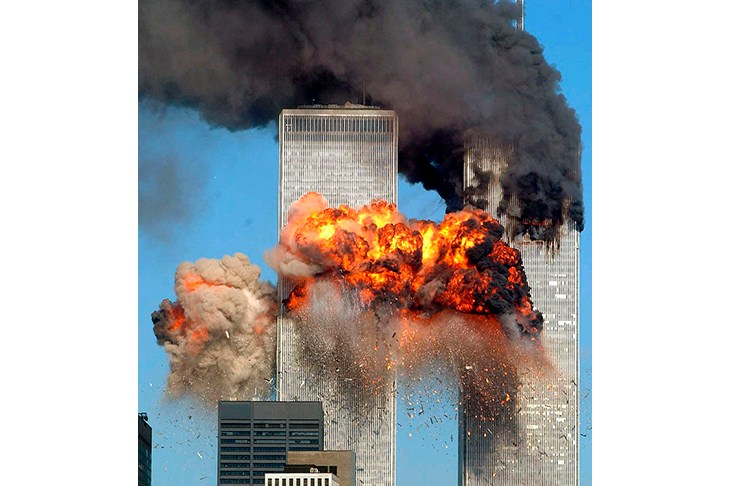
Twenty-five years on, if the 9/11 terrorist attack by al-Qaeda happened today, the response in Australia and countries such as the United Kingdom would be a master-class in institutional cowardice. Through the mind-warping phenomenon of moral manoeuvrability, the attack would turn terrorists into victims and victims into oppressors, spawning a new generation of activists, sympathisers and supporters. We would be told it is us, not them.
On 11 September 2001 nearly 3,000 people were murdered in coordinated Islamist attacks planned and celebrated by Osama bin Laden and al-Qaeda. Then, just as my grandfather’s generation did during the second world war, the West named the enemy without apology: salafi-jihadi ideology, the networks that incubated it, and the doctrine of a religious-revolutionary movement that justified mass slaughter of civilians. Governments acted with resolve and public opinion was unambiguous. Sympathy for the dead outweighed being labelled a racist and Islamophobia had never been invented.
Today the same images – planes into towers, people jumping, the collapse into a tidal wave of dust – would trigger a different narrative. Within hours, politicians would issue carefully calibrated statements describing the cause as ‘complex’. Opposition voices warning that the ideological networks within our suburbs remains intact would be dismissed. The dead would be mourned selectively while their murderers’ actions contextualised. Warnings would immediately shift to ‘Islamophobia’, ‘hate speech’, ‘community tensions’ and ‘Nazis’. Mainstream media would run packages on ‘minority anxiety’ and the danger of a backlash no one had contemplated. Opposition politicians would demand inquiries into security failures while insisting that ‘root causes’ – Western foreign policy, poverty and ‘marginalisation’ – must be treated as co-equal factors.
There is a fair chance it would be blamed on Israel. Liberal Western women would be putting on the hijab quicker than you can say ‘Allahu Akbar’ and schoolchildren would be encouraged by taxpayer-funded pop-academics to join mass protests. If only we had recognised Palestine sooner. If only we had allowed the call to prayer in our suburbs. If only we had rejected our alliance with the United States. If only we allowed greater numbers to mass migrate here from lands whose cultures despise ours. If only we stopped asking uncomfortable questions, then it wouldn’t have happened.
This trajectory of delusion tracks the pattern after Manchester Arena, London Bridge, the Bataclan and numerous disrupted plots. British authorities have spent more energy policing online speech than confronting the doctrinal drivers of jihad. With its bus conductor Prime Minister, the UK is what losing looks like in this new phase of the Islamist global insurgency’s asymmetric warfare against the West. Within days of a Sudanese asylum-seeker trying to behead Stephen Ogilvie on a street in Northern Ireland earlier this year, the BBC issued a message in ‘solidarity’ with non-British staff and offered them support.
Australian responses to local Islamist incidents have followed the same reflex: rapid emphasis on social cohesion, lectures about the dangers of free speech and reluctance to state uncomfortable demographic and ideological facts when they risk upsetting concentrated populations in suburbs that have become safe havens for Islamists. Parallel societies, imported attitudes toward apostasy, gender segregation, blasphemy and sharia law are treated as impolite data points rather than realities.
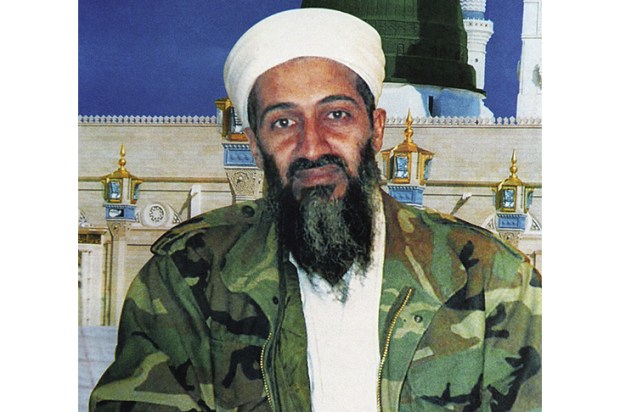
Osama bin Laden himself would be reframed with remarkable speed. In 2001 he was correctly understood as the operational and ideological leader of the Islamist global insurgency that declared war on the United States and its allies, celebrating the slaughter of civilians and rooting its programme in a coherent reading of Islamic texts and history. Who knows – his image may even be held high by Australian celebrities or emblazoned on our iconic monuments. Elites, academia, politicians and activist networks would insist on ‘context’. So perhaps bin Laden’s oldest son, Hamza, was right when he said, ‘We are all Osama.’
Osama would be presented as a complex, charismatic figure shaped by Soviet occupation of Afghanistan, American support for the mujahedin, Saudi politics and legitimate grievances against the West. Mainstream politicians would still formally condemn the attacks, yet the surrounding conversation would soften the edges: ‘Bin Laden was wrong, but he had a point.’ Replaying the videos of his statements or the celebrations that followed 9/11 might risk ‘stigmatising’ communities and could see demands by our e-Safety Commissioner for further crackdowns on what we can say and who can say it.
One reason 9/11 today would be turned upside down is a deep strategic failure to understand the enemy. As retired US Marine Corps General Jim Mattis explains in Call Sign Chaos, anyone who has studied history knows that the enemy always moves against your perceived weakness. One of ours is allowing those who hate our way of life to migrate to our country believing eventually they will love us.
One of the least-known yet most strategically influential al-Qaeda figures was Abu Musab al-Suri, who was arrested in 2005 in Pakistan. No other individual did more to transform al-Qaeda’s strategy into a globalised umbrella. He saw how jihad could become mainstreamed into many aspects of Western society – not just physical terrorism, but merged with leftist grievances and victim-based struggles now highly visible in Western cities. Al-Suri recognised the opportunity for mass mobilisation. He saw the Palestinian intifada as the prototype, scaled up to reach the home of the American invaders and their infidel allies from every race and place. Al-Suri was a revolutionary mastermind.
Sadly this revolutionary movement will not be tamed by riding the four horses of weakness: apology, appeasement, acquiescence and acceptance. Nor will it be understood through conventional Western thinking and DEI workshops run by earnest facilitators who fear the consequences of offending others with realism. As explained by Richard Belfield in Terminate with Extreme Prejudice, the 12th-century commander Saladin found when he threatened the Ismaili Assassins that they welcomed violence. Their letter replied: ‘We have read the gist and details of your letter and taken note of its threats against us with words and deeds, and by God it is astonishing to find a fly buzzing in an elephant’s ear and a gnat biting statues. Others before you have said these things and we destroyed them and none could help them…. You know the outward aspect of our affairs and the quality of our men, what they can accomplish in an instant and how they seek the intimacy of death…. Prepare means for disaster… for I will defeat you from within your own ranks and take vengeance against you at your own place and you will be as one who encompasses his own destruction.’ This is just as we see it today.
The eerie and evil manipulation by the Islamist global insurgency is the implied threat of further Bondi-style attacks if we do not accept their demands. Yet if this trajectory continues, future generations will inherit a West that has already conceded the decisive terrain – its own population, its own language and its right to name the enemy.
The price of continued denial is not theoretical. It is the slow, irreversible loss of a commitment, and a diminishing courage to fight for something greater than ourselves that is the bright light of Western civilisation.
Got something to add? Join the discussion and comment below.
You might disagree with half of it, but you’ll enjoy reading all of it. Try your first month for free, then just $2 a week for the remainder of your first year.