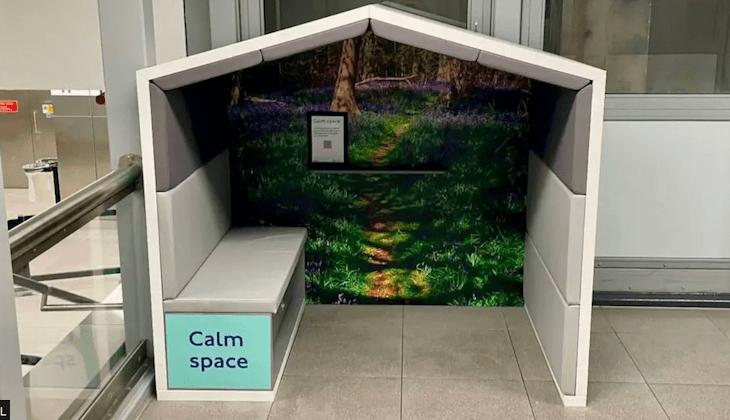
When it emerged a fortnight ago that Transport for London (TfL) had unveiled a ‘Calm Space’ at one of its stations, a trial installation at Ealing Broadway on the western fringe of the capital, as part of its ‘future neuroinclusive design initiatives’, much of the reaction on social media was predictably, and one might say justifiably, dismissive. One user on X encapsulated a common sentiment: ‘What would provide a calmer travel environment would be clean, punctual mass transit filled with people who understood the concept of public and private spaces, and some limited policing of anti-social, fare-dodging, drug-using, and sometimes mentally deranged fellow passengers.’
This somewhat pointless initiative also overlooks a well-known paradox
On the understanding that the collective opinion of people one chooses to follow on social media isn’t representative of objective reality, and that people on X can be judgemental about things which they haven’t actually seen or read, I decided to take myself off to a station which I have visited periodically over decades.
When I rolled up at the unremarkable, grey installation last week – bestriding its entrance, I estimated it to be six feet wide – fitted with one cushioned bench able to seat two, and adorned inside with a representation of a woodland scene, I spoke to a woman in her late teens busy scrolling through her smartphone. I asked her if she liked it and used it often. She said it was ‘fine’, and it was her first time here. Keeping in mind that the area announces itself as a ‘quieter space to pause, rest and reflect’, I enquired if she had come here to seek calm. ‘No. It was just somewhere to sit down.’
The first member of TfL staff I approached was less eager to chat. Asking him how long the ‘Calm Space’ had been in place, he simply raised a hand forbiddingly and said ‘No’. I was tempted to conclude that this was typical, surly TfL staff behaviour, or that he was tired of responding to questions about it, or that he had been instructed by his superiors not to reply to enquiries about an already much-derided structure.
Another member of staff happily dispelled my cynicism. He told me enthusiastically all about it, about how much it cost – a pretty penny, this being one of the first of its custom-built kind, with another being showcased at the London Transport Museum in Covent Garden – how it was regularly frequented by commuters during the week. He was conscious of the nay-sayers online, but adamant that it had its fans, and that I could also add my own feedback by scanning the QR code on the wall.
I declined his offer, content instead to sit inside and catch up on some reading in what is ultimately a dingy and charmless Wendy house. In addition, being unlit, it’s unsuitable for those wanting to read a book or magazine. It’s clearly aimed at those seeking to stare into their smartphones, the device of choice for nearly everyone these days, and ironically, the technology which is causing so many people to feel stressed and anxious in the first place.
This somewhat pointless initiative also overlooks a well-known paradox, familiar to those who listen to classical music stations, that being invited or instructed to ‘be calm’ often raises stress levels. But TfL is clearly unaware of the paradox: this year on the interchange tunnels at King’s Cross St Pancras Underground Station it has started piping classical muzak, inevitably Vivaldi, a composer whose shrill and tinny compositions rarely sooth anybody.
The ‘Calm Space’ also overlooks the inherent reserve found in the British character. As an old school friend from west London remarked of photos I shared of it: ‘Sitting inside that would make me feel ridiculous and paranoid – about as far from calm as I can imagine!’
In any case, the underwhelming structure is surplus to requirements. Ealing Broadway, like all the other surface stations on the Underground network, and the semi-subsurface ones that pepper the Circle Line, already has its calm space. It’s called the open air, and in this case, a verdant vista. A far more tranquil area at this terminal can be found on the platform which services the District Line, where you can observe on the disused platform opposite examples of the old-fashioned, solid London Underground roundel dating back to 1908, a design which evokes a more courteous and civilised era.
This ‘Calm Space’ is symbolic of our times. It’s performative. It’s a dubious use of public finances. It combines 2020s neuroticism with a lingering 2010s cult of mindfulness. It’s a tribute to a sense of passivity that pervades the land – the passivity of a TfL unwilling to grapple the acute problem of fare evasion, and to the passivity of a younger populace now resigned to feeling fragile and forever ‘stressed-out’.