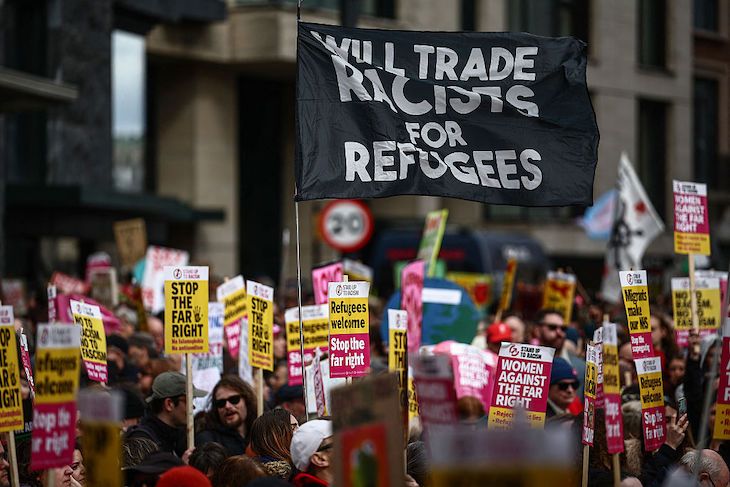
Is Britain becoming more racist? Many people like me, who are from an ethnic minority, seem to think so. It’s hard to blame these people for drawing that conclusion. Cabinet ministers tell us that racism and sexism have become normalised in Britain. Anti-immigration protests and stories of far-right mobs targeting people because of what they look like have led some black and brown Brits to say they feel less welcome in their country. The TUC tells us that black and ethnic minority workers have faced a significant increase in overt forms of racism at work over the past six years. A survey of members of the Society of Radiographers reported a similar trend over the past eighteen months. Hate crime in Britain has surged.
Britain is a society where racial tensions are bubbling to the surface
What is clear is that Britain is a society where racial tensions are bubbling to the surface. But saying that “Britain is becoming more racist” is a bold statement for anyone familiar with the history of the country. Arguably, there has never been a better time to be black or brown and living in Britain. Thanks to the Race Relations Act, passed in various forms in 1965, 1968, and 1976, and other pieces of legislation, racial discrimination has been outlawed. Occupations and institutions that were once overwhelmingly white now routinely include people from minority backgrounds at every level. When Rishi Sunak, who was born to Punjabi East African-born Hindu parents, became Prime Minister in 2022, Britain barely batted an eyelid. It was quite remarkable to think that this is a country where, between 1929 and 1987, there was not a single non-white MP. Britain has, in many ways, changed for the better.
It sometimes feels like a different story online, of course. On the internet, you don’t have to go far to encounter racial hostility. Someone, somewhere, is always behaving terribly, and the algorithm can deliver examples directly to you. The result is that a person might encounter more racial abuse before breakfast than they experience in person over several years. I am not suggesting that these incidents are not real, but what is clear is that digital proximity is gradually overcoming the physical limitations of geography. A good example is football. Almost weekly, we hear about players receiving racial abuse online, while overt racial abuse inside football stadiums has become comparatively rare. What’s going on?
Conflict produces content but normality doesn’t. The more controversial and polarising a clip or statement is, the more likely it is to go viral. This incentivises people to post stuff that generates engagement. A racial confrontation on the Tube during the morning rush hour gets filmed and attracts millions of impressions by the evening on social media. But what about the several hours in between when nothing happened, when people simply coexisted peacefully on public transport? The racist football supporter becomes nationally visible. But what about the millions of ordinary fans of different ethnicities who chant together on terraces week in, week out? The truth is that social harmony is boring to the online algorithms, which is why we don’t see it.
This distortion works in both directions. One person sees endless racist abuse, anti-Muslim rhetoric and far-right demonstrations and concludes that minorities are under siege. Another sees Islamist demonstrations, migrant crime and “Londonistan” imagery and concludes that Britain has been culturally conquered. Both may be consuming content depicting real things. The question is whether the prominence of those phenomena online bears any proportion to their prevalence in everyday British life.
The reality is that ordinary British life seems largely filled with people simply getting on with one another. Mixed marriages and friendship groups are common. Every day in Britain people are making accommodations for each other without thinking about in-group preference or how their interactions fit into some elaborate theory of multiculturalism. This doesn’t mean that awkwardness or prejudice don’t exist, but they are not as representative of Britain as some online content might suggest.
Before social media, our perception of race relations came through some mixture of personal relationships, neighbourhoods, workplaces, media and institutions. Now, as a result of these social media platforms, we possess something historically extraordinary, an archive of human ugliness.
But while what we find online differs from what we see on the street, we must take both things into account. The internet increasingly shapes our understanding of the world we inhabit. It is where we acquire our news, conduct discussions and, increasingly, share our lives. If people repeatedly encounter their neighbours through hostile representations, that can eventually alter how they approach the person in front of them. The white working-class neighbour becomes “the far right”. The new black employee becomes a “DEI” (Diversity, Equity, and Inclusion) hire. People cease to see other people as individuals; instead they become symbols.
It is difficult to say for sure whether Britain is indeed more racist today than it was. Race has certainly become more of a talking point. We speak about it far more than we once did. But is that not to be expected in a more diverse and plural society?
Two Britains seem to be forming in the public imagination: one heavily shaped by what we see online. The other, by what we see in our in-person interactions. Is Britain racist? That really depends on who you ask – and what you watch online.