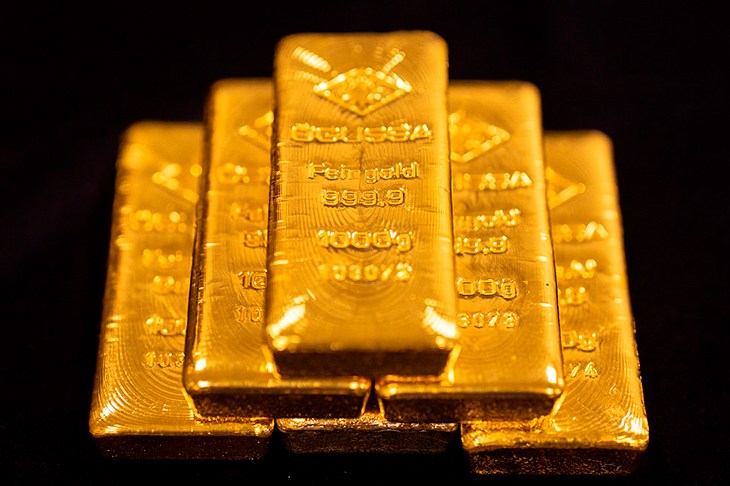
Good news? Or the harbinger of a China-led destruction of the world financial order? When Australian gold exports soared last financial year by 46 per cent to $68.4 billion surpassing coal ($67.6 billion) and natural gas ($59.4 billion) to become our second-biggest resource export after iron ore ($116.6 billion), was it just a welcome flash in the pan, boosting revenues to help out a besieged Treasurer Jim Chalmers as record gold prices encouraged increased output? Apart from a brief blip 39 years ago, this is the first time since the early-1960s that Australian gold has hit second place. And official forecasts by the federal government’s Resources and Energy Quarterly have exports from Australia, the world’s third-largest gold producer after China and Russia, powering further ahead in the current financial year by almost another $5 billion (as iron ore falls by $8 billion). So is it gold to the rescue? – or the golden road to ruin?.
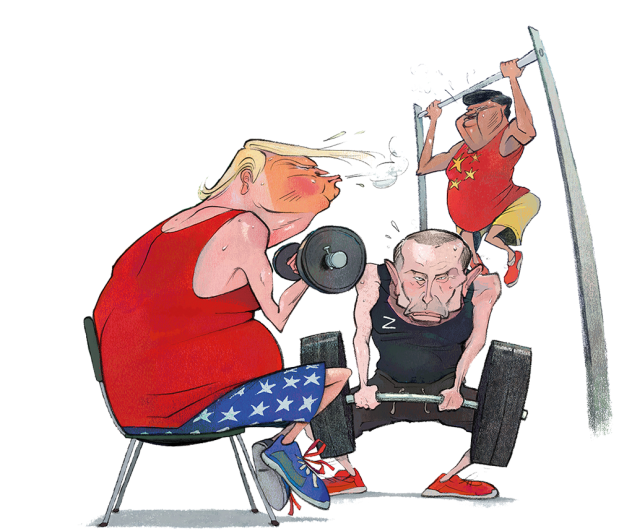
Catastrophists are warning that the boom in gold is an unnerving indicator of an inevitable disruption of world international finance led by a long-term Chinese plan to undermine the US dollar as the medium of international trade. This is at a time when there is already mounting concern that the rest of the world cannot be expected to sustain the dollar as the prime international currency by continuing to buy the trillions of dollars needed to finance the US’ (limitless?) net deficits, with an April US Reserve Bank Board report warning that ‘while there is no short-term risk, continued growth of US net foreign debt faster than GDP is “unsustainable” in the long run’ and could lead to foreigners suddenly reducing their US asset holdings resulting in financial instability and a sharp decline in the dollar’s value’.
This China-led doom theory was triggered by the fact that this time around, the worldwide boom in gold demand has depended not only on the traditional search by investors and national central banks for a safe haven in times of international upheaval and uncertainty (the Middle East, Ukraine) but because of a remarkable gold-buying spree from China. This initially, in company with other central banks, was a defensive reaction to the 2022 US freezing of Russia’s dollar reserves but ended up as a major official policy change.
Over the last five years, accelerating official Chinese central bank purchases, let alone a burgeoning Chinese investment market, has more than doubled gold’s share of China’s international reserves from a relatively low 3.3 per cent to 8.64 per cent – and rising, but by how much? The World Gold Council reports that China’s 2026 year-to-July net purchases total 60 tonnes, lifting its total gold holdings to a record 2,366 tonnes. Expert opinion is that these are all significant understatements.
This Chinese rush into gold has been paid for by a one-third slashing over the past five years of its holdings of US debt, with China’s US Treasuries falling to $633.4 billion, their lowest level since 2008. Further evidence of China’s determination to undermine the dollar?
There is more to come. Under the heading ‘China Bets Big on Gold’, the Shanghai/Vancouver advisory NAI 500 last month pointed to the consequences of a ‘decisive shift in official Chinese policy that no longer treats gold merely as a financial asset but as a pillar of national security’. This resulted from the 2025 Gold Industry High-Quality Development Action Plan for 2025–2027, formally designating gold as a ‘strategic mineral’ and a ‘cornerstone of financial and industrial security’.
S&P Global sees this as a clear signal that Beijing will keep expanding official gold holdings, deepen support for the domestic gold industry and encourage Chinese miners to outpace their global counterparts – all while consolidating China’s relatively recent status as the world’s largest producer and consumer of gold.
For NAI 500, gold’s elevation did not come out of nowhere. ‘Over the past two decades, Chinese gold policy has progressed from market liberalisation to global integration. The privatisation of the gold market in 2004 ended more than fifty years of strict state control, followed by measures that encouraged private gold ownership, opened banking channels for bullion investment, and strengthened exchange infrastructure. The results were striking: China overtook South Africa as the largest gold producer in 2007 and surpassed India as the largest consumer in 2013. The new strategic framing arrives at a moment when, in the words of China’s leader during an April 2026 meeting with the Spanish prime minister, “the international order is crumbling into disarray”. Tariff wars, geopolitical confrontation and sanctions risk have all reinforced gold’s weight in policymaking.’
So Beijing’s engagement with gold is far more comprehensive and durable than a simple buying spree. ‘The core motivations are long-term: raising economic resilience, reducing external dependence, and broadening the global use of the renminbi. These objectives imply gradual progress and sustained commitment rather than abrupt moves. In practice, the strategy spans multiple tracks – periodic accumulation of official reserves, construction of a yuan-denominated gold trading system, and support for gold exploration and production both at home and abroad.’
Taken together, concludes NAI 500, the pieces form a coherent whole. ‘The market reforms of the 2000s solved problems of supply and investment access. The globalisation push of the 2010s advanced cross-border use of the yuan. Last year’s “strategic mineral” designation embeds gold squarely within the framework of national security. This is not a play for short-term price gains but a long-term structural repositioning. As geopolitical tensions persist, China’s role in global gold markets is likely to keep expanding. Gold is moving beyond its traditional identity as a commodity and reserve asset – it is becoming a key piece in a much larger strategic game.’
As the government’s mouthpiece, the China Daily recently declared in a less-than-subtle threat to the dollar: ‘Given that gold is a globally recognised ultimate payment method, increasing China’s gold reserves can enhance the credibility of the renminbi and create favourable conditions for the currency’s internationalisation.’
Is the dollar’s reserve currency status defensible? The US shows few signs of controlling the deficits that have the potential to damage the dollar despite growing recognition of the problem. And defending its status may involve potential policy conflict with the current US drive to restore US manufacturing by onshoring and boosting exports. But the combination of China’s traditional long-term approach and the US view that the problem is only for the long term, means that in the meantime, as one pundit remarked, the US can get away with having its cake and eating it too. But for how long? And China, whose gold reserves are still only a fraction of the US’s, can keep on selling dollar debt to buy gold, much to the benefit of the Australian gold mining industry.
Australia has a lot of economic skin in the outcome for the US dollar and its relationship with our dollar.
But Australia’s Reserve Bank is ignoring the gold rush; for a country that exports 300-odd tonnes a year to feed the vaults of foreign central banks, especially China’s, the RBA’s tiny 80 tonnes, almost all stored in London, has remained unchanged for the past 29 years. Now that’s faith in the US dollar for you!
Got something to add? Join the discussion and comment below.
You might disagree with half of it, but you’ll enjoy reading all of it. Try your first month for free, then just $2 a week for the remainder of your first year.