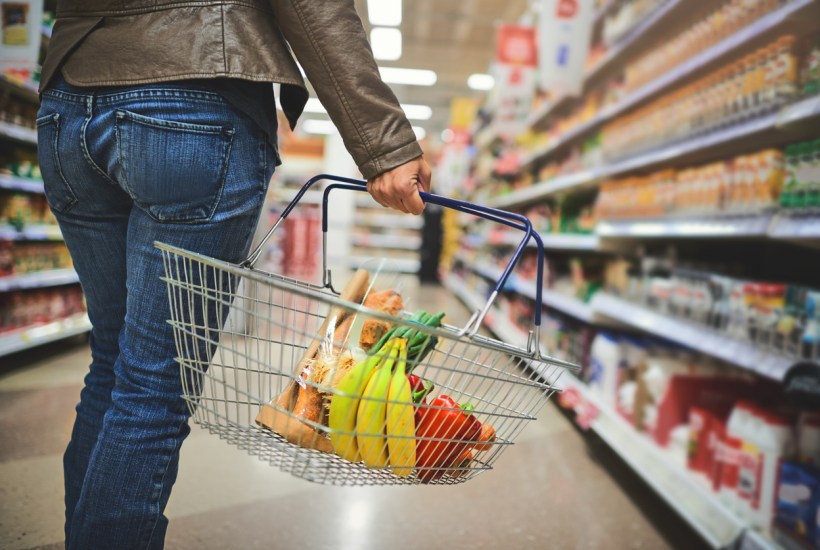
Three years ago, I embarked on a personal project that has brought about a quiet revolution in my cooking and eating habits. My decision to go ‘off-supermarket’ was prompted by the dramatic changes in Britain’s food stores. Returning from a period abroad, I found that popping into a city centre supermarket for a sandwich suddenly involved navigating airport-style security. My local Sainsbury’s had transformed from a friendly place where cashiers chatted to customers to an automated dystopia where you had to scan your goods according to instructions from a machine. As I described in The Spectator, I put down my basket and left for the last time.
My resolve to shop differently has been strengthened by the growing surveillance in supermarkets. I don’t want to be filmed close-up by the cameras that hang over most self-checkouts cameras and I object to being treated as a suspect by Sainsbury’s new facial recognition system
My resolve to shop differently has been strengthened by the growing surveillance in supermarkets. I don’t want to be filmed close-up by the cameras that hang over most self-checkouts cameras and I object to being treated as a suspect by Sainsbury’s new facial recognition system.
Breaking lifelong habits in the way you meet your daily needs is not easy, and I expected plenty of inconvenience. What I didn’t anticipate were the unexpected pleasures and discoveries that would come from sourcing most of my groceries elsewhere.
The first challenge was finding reliable, affordable sources of food in London. The solution lay in a curious mind and a flexible attitude. Visits to butchers and greengrocers nearby were an obvious first step and brought me regular friendly encounters. The shelves of local international stores revealed exotic foodstuffs I’d loved while travelling. Then there was the unexpected realisation that pound stores sell well-known brands at a discount (I can’t give up Bovril) as well as cleaning products. The experience has been like being abroad and having to learn the ropes. I’ve been seeing my own society with new eyes.
Milk is delivered to the doorstep, as it was during my childhood. Grains, pulses and other dried foods come from an online health store. Out-of-town trips are an opportunity to pick up trays of freshly-laid eggs and jars of honey. There are plenty of compromises: from the outset I was clear that I was not following a new ideology but trying to live more in accordance with my values. And – full disclosure – I still buy products such as coffee and cheese from the couple of supermarkets that haven’t completely lost my trust.
Soon I was looking back in amazement at the foolishness of my former shopping self. Why would you buy small packets of rice at a premium when a 25 kg bag would last a year or more? Gone are the days of buying tiny pots of hummus: I’ve realised it’s tastier, healthier and cheaper to cook from scratch. Homemade mayonnaise is a late-life revelation. Who (apart from Olivia Potts) knew you could whip up an additive-free version with just an egg and some olive oil?
Bulk buying and planning ahead are key to my new approach, and that means giving more thought to storage. Large quantities of food take less space than you might think and rows of glass jars are a reassuring sight. As the child of parents who grew up hungry during the second world war, having cupboards that never go bare suits me perfectly. Now that I grow potatoes and greens in the back garden, I eat in a way that resembles the 1950s but with 21st century treats of chocolate and wine.
The resulting sense of resilience meant that when I heard about the mandating of folic acid in flour I didn’t panic. I was already baking bread, cakes and pies, so why not go a step further? It turns out that wheat grains are not hard to source and can be ground in a Nutribullet. Like much of my food preparation these days, it’s a bit of an experiment: the resulting blend is too coarse for a Victoria sponge, so I’ll probably source my flour from the smaller mills that are exempt.
The quiet revolution in my kitchen is part of a wider food movement which (while not explicitly anti-capitalist) is born of a discontent with the food provided by corporations. Among the public there’s a growing understanding that processed food and lengthy supply chains do not make for healthy eating. Social media posts feature complaints about undeclared ingredients on packaging, misleading information about origin and pictures of supermarket-bought fruit and veg going off soon after purchase.
The rise in farmers markets are testament to people’s desire for high quality, local-produced food. At the producer end, regenerative farming and community food growing is a burgeoning sector. A conference I recently attended featured half-a-dozen innovative schemes within a single region, such as My Little Farm, a member-owned regenerative farm. The talk of these pioneers is a world away from supermarket bosses’ statements about profit figures; you can hear their passion and commitment as they discuss health, community and connection with nature.
What started as a personal protest against automation and surveillance has taken me into a new food movement which puts place and people at its heart.