Should Russia’s aggressive war on Ukraine, with its accompanying litany of horrific human rights abuses, disqualify it from a seat on the United Nations’ Security Council (UNSC)? That’s what Poland’s feisty foreign minister Radek Sikorsky called for yesterday in New York. The UNSC was meant to be a ‘guardian of peace, not to give immunity to aggressors’ like Russia, Sikorski told Polish television. More, he called the legal basis for Russia’s permanent seat at the Security Council table – with its accompanying veto over all resolutions – ‘questionable’ because Moscow took over the USSR’s old seat without a vote.
In moral terms, Sikorski has a point – and it’s one that the Ukrainians have been pushing for a while. On 5 April Volodimir Zelensky recorded a heartfelt personal address to the UNSC immediately after visiting the ruins of Bucha. Showing footage of murdered civilians, Zelensky accused Russia of turning its UN veto ‘into a right to cause death’. Zelensky challenged the Security Council with an ultimatum: remove Russia so it can’t block decisions on its own aggression, or dissolve itself altogether if it can’t hold Moscow accountable.
The UN is today governed by brutal realpolitik
Unfortunately for Zelensky and the world, the United Nations has long ceased to be a forum for international peace – if it ever was – and is today governed by brutal realpolitik. When the UN General Assembly voted just days after Zelensky’s video speech on suspending Russia from the Human Rights Council, 93 nations voted in favour with 24 against and 58 abstaining. That was enough to secure a suspension – and in the end Russia resigned from the Human Rights Council on its own, calling the vote ‘illegitimate and politically motivated’. But Russia was never expelled.
Kicking Russia off the Security Council would be a higher bar of two thirds of members – not to mention the basic procedural fact that such a decision could not be made by the General Assembly anyway. In practice, Western missions weighed an attempt to exclude Moscow in 2022 but found the electoral arithmetic unworkable, calculating that a failed vote would hand Moscow a propaganda win.
So Sikorski’s point was a rhetorical one, rather than a serious challenge to the UN’s fundamental hierarchy, fixed since 1949. But it raises a crucial point about Russia’s place in the world, and the failure of Western leaders to isolate Moscow in the wake of its 2022 invasion of Ukraine.
The grim reality is that the world’s pro-Kyiv coalition has shrunk to the EU and UK, Moldova, Canada, Australia, New Zealand, and a scattering of Pacific and Latin American states. The US, since the beginning of the second Trump administration, has routinely abstained on all votes that concern Ukraine. In a General Assembly vote on Thursday, 51 countries out of 193 voted for ‘a full, immediate and unconditional ceasefire’. EU Foreign Policy chief Kaja Kallas called on Russia to ‘finally do the same’. But the underlying message was that three out of four nations are against it.
Meanwhile, much of the Global South regards the five permanent members of the Security Council – the P5 – as illegitimate in any case. Britain and France – the two Western P5 members most likely to gun for Russia’s exclusion – would quickly find their own positions in shreds. Indeed, Sikorski himself agreed that the UNSC’s current permanent membership no longer reflects the global balance of power, noting that India isn’t on it, nor Brazil, nor a single African state.
But what really matters is the urgent practical necessity of bringing peace to Ukraine – and in this regard the UN has failed utterly to live up to its original aim of ‘saving succeeding generations from war’. As currently constituted, the UN has no mechanism for countering acts of aggression by its five most senior members, creating an insoluble institutional deadlock.
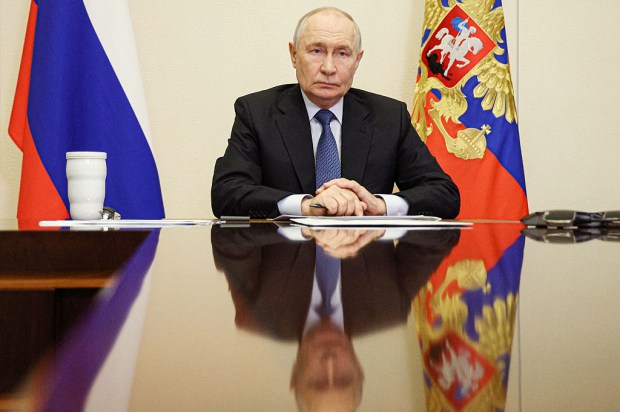
Meanwhile, Russia continues to push to recover its international standing both in the UN and beyond. This week, US Secretary of State Marco Rubio formally invited Vladimir Putin to the G20 summit in Miami. And while the Kremlin has already said it’s unlikely that Putin will attend, the return of Russia to that forum is an important symbolic victory. Moscow – and its much more powerful ally Beijing – have also been building up alternative international forums such as BRICS and the Shanghai Cooperation Organization that exclude Western powers altogether.
In a recent essay, Andrei Kortunov, former head of the Kremlin-backed Russian International Affairs Council, claimed that Russia was no longer a lagging power in decline nor a helpless vassal of China. Rather, he claimed, Moscow ‘consistently punches above its weight’ and boasts ‘one of the world’s strongest militaries’ – as well as a growing strategic partnership with Beijing. Objectively, Russia’s struggling war economy, the ongoing damage from Ukrainian attacks, the collapse of international allies like Venezuela and Syria and the deep decadence of Putin’s power vertical make those boasts ring hollow. Yet at the same time, Moscow’s soft power has by no means disappeared. At least part of the Global South has bought into the Kremlin’s fiction that they are defending themselves against Western aggression. And plenty of poorer countries are still happy to buy Russia’s oil and support Moscow’s cause in the UN.
When Sikorski speaks of punishing Russia for its aggression, he is channelling the word and spirit of the UN charter, which promises ‘to uphold justice and respect for treaties and international law’ and ‘reaffirm faith in … the equal rights of men and women and of nations large and small’. But the United Nations is, today, no place for such talk.