If you are 20, you will turn 65 in 2071. You have just started paying tax, or soon will. A common claim you will hear goes like this:
Australia is ageing. There will be more old people per worker. High immigration improves that ratio. Without it, the economy cannot cope.
This claim does not tell the whole story.
If birth rates stay low, migration slows but does not stop the population getting older. It slows but does not stop the dependency ratio increasing. The capacity to care for old people depends on how rich the country is – and that mainly depends on productivity growth, not the number of people we bring in.
What migration does change is what an older country needs to allocate resources to. With lower migration, a bigger share of the economy goes to health and aged care – call that the Care Share. With higher migration, the sheer cost of building housing and infrastructure for a much larger population rises enormously in absolute terms – call that the Build Spend.
Given Australia’s low birth rate, the share of GDP spent on health and aged care is going to rise no matter what we decide on migration. Low or zero migration means it rises more. High migration limits that rise but requires Australia to build housing and infrastructure for a much larger population. Both paths cost.
And migration levels also determine, in important ways, how different Australia becomes.
These are the trade-offs to consider. Not whether we can afford to age, but what we spend our money on while we do. And how much Australia will change.
If you’re 20, you’re voting on the Australia you’ll live in at 65.
Dependent how?
The dependency ratio – people aged 65 and over for each working-age adult – is a key metric in this debate. Treasury’s Intergenerational Report (IGR), published last week, projects what the ratio will be for different levels of positive migration. The Australian Bureau of Statistics’ Population Projections Report also includes a projection for zero migration.
Right now, the ratio is 28.3 old people for every 100 working-age adults. Using its medium assumption about birth rates, the ABS projects the dependency ratio will increase to 44.8 in 2071, even if migration is kept high. Without migration, the ABS projects it will increase more sharply to 63.1.
This is a big reason why many people support high migration. Former senior bureaucrat Mike Pezzullo says this ratio will ‘get out of control’ unless migration stays high for decades to come.
A higher dependency ratio sounds scary because it suggests more old people will ‘depend’ on each worker. But we have to be clear about what it actually means.
This ratio does not determine a country’s capacity to look after its old. Young, poorer countries often provide little aged care. Older countries can support more old people if output per worker is high. What matters is productivity – how much each worker produces – not how many workers there are relative to retirees.
A higher ratio also does not mean Australian workers will fund a rising share of GDP in pensions. Table A4.2 on page 324 of the IGR shows the calculations for various scenarios with positive migration. The dependency ratio gets bigger because the population is ageing. But the share of GDP spent on pensions falls in each scenario, because retirees will increasingly be covered by superannuation rather than the public pension.
What does increase is the Care Share. In 2025-26, we spent about 5.5 per cent of GDP on health and aged care. The IGR projects this will increase to between 8.0 and 9.0 per cent by 2065-66, depending on migration levels. Unfortunately, the IGR does not explicitly model zero net migration, but we can be confident that the share would increase more sharply in that scenario.
Lower migration means a higher Care Share, because a bigger proportion of the population is old. Higher migration holds the Care Share down – but only by raising the Build Spend instead.
The economic trade-off is Care Share versus Build Spend
Australia could import more people to keep the dependency ratio from rising too sharply. But it would take a lot of money to build the Australia that could fit all those extra people. That is what the Build Spend means in practice.
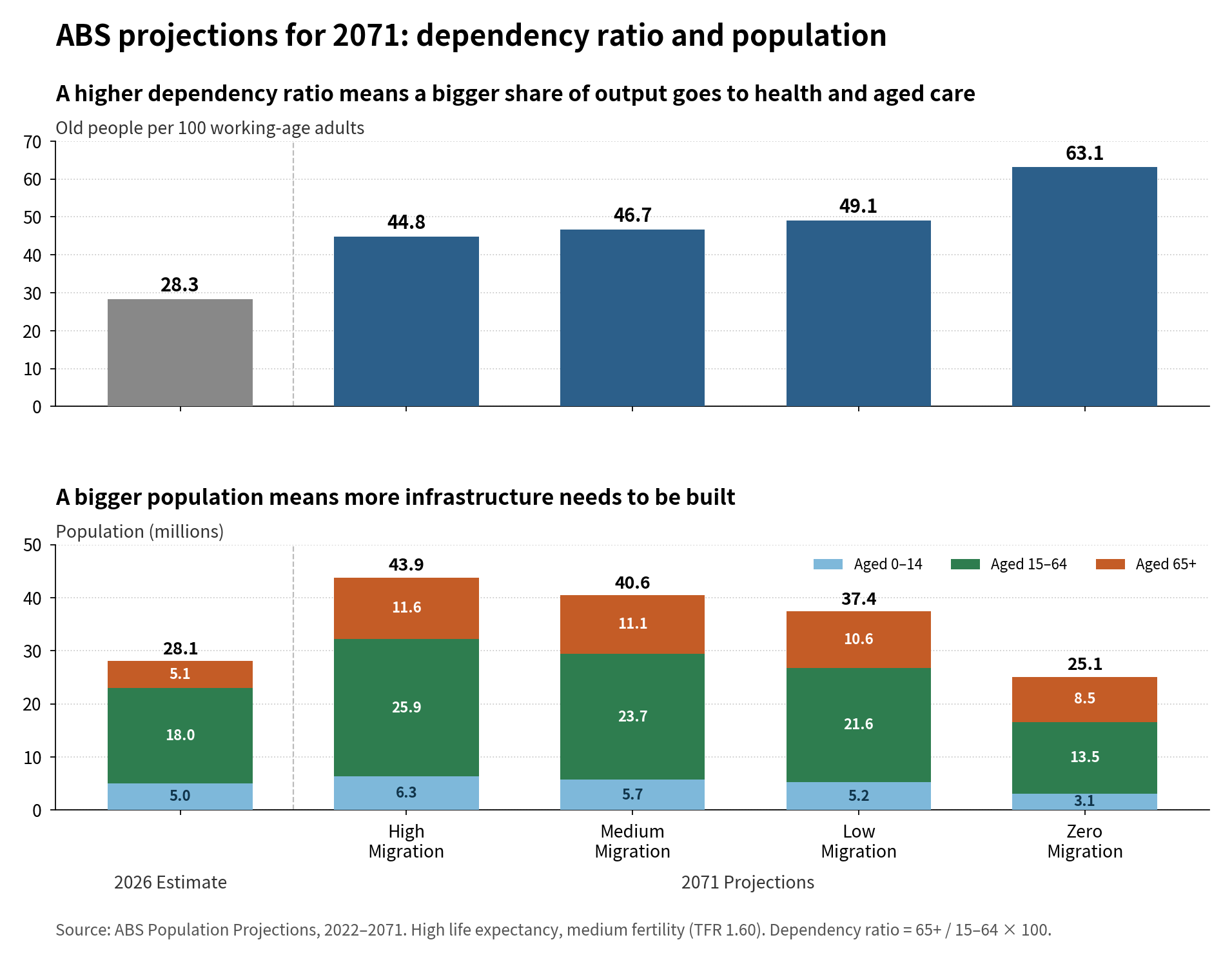
Today, there are about 28.1 million people living here. With zero migration, the ABS projects a fall to 25.1 million in 2071. But if we keep migration high to curb the rise in the dependency ratio, the population reaches 43.9 million.
It’s also important to note that the actual number of old people does not fall if we have high migration. It increases by more. Right now, we have 5.1 million. With zero migration, that would increase to 8.5 million in 2071. With high migration, it would increase to 11.6 million.
We would have to build a much bigger Australia to fit that many extra people. Perhaps we would cram most of them into Sydney and Melbourne. Perhaps we would spread them around the regions. Perhaps we would build a brand-new city.
No matter how we do it, it would take a lot of money. There are no cost-free options.
Of course, the cost of building stuff for more people would be shared by the extra people we bring in. So, it is not clear whether the per capita cost for a 20-year-old today will be higher or lower under high migration.
Official projections are clear on one thing – migration has little impact on our capacity to pay for what we need in coming decades. Output and income per person are mainly determined by workforce participation and productivity growth, not headcount. The size of the population determines the size of our economy, but not our living standards.
Migration changes the mix of what we will pay for and how labour is allocated. A smaller, older population will allocate more resources and workers to care for existing Australians. A bigger, less old population will allocate more resources and workers to build housing and infrastructure for newcomers.
That is the economic trade-off – a bigger Care Share or a bigger Build Spend. But that is not the only trade-off to consider.
How rich will Australia be in 2071? How big? How different?
If high migration continues, our population will rise towards and beyond 40 million by the time today’s 20-year-olds retire. We will be older, on average. Given the likely sources of migrants, Australia will become more ethnically and culturally diverse. The foreign-born share of the resident population, currently at 32 per cent, will keep rising. Our major cities will also likely be much more densely populated, having a big impact on the average person’s lifestyle.
That seems very different.
Australia could also halt migration over this period. If we choose to do that, our population would gradually fall to around 25 million in 2071. That’s how many people lived here in 2018. The population would be older than it is now and also older than it would be with higher migration. But the share of the population that is foreign-born would stabilise and fall. The ethnic and cultural composition of the population would also stabilise over time, assuming birth rates converge across groups. Our cities would not need to get denser.
Still different. But not as much.
Both paths lead to an older Australia. But the extent and nature of cultural change that Australia will experience in coming decades will differ depending on which path we choose. Australians, young and old, should consider that factor too, knowing that a lot of spending will be required to deal with an older population, whichever path we choose.
An informed choice requires more information
20-year-old Australians worried about the ageing population are often shown only part of the story.
The dependency ratio answers one question – how many old people there are relative to working-age adults. It does not tell you how many old people there will actually be, how big Australia will become, what that will cost, how rich Australians will be, or how different Australia will become.
The full picture looks like this. High migration curbs the rise in the Care Share – the proportion of GDP going to health and aged care. But it also means a much bigger Build Spend to provide housing and infrastructure for more than 40 million people. And it delivers a very different Australia. Low or zero migration shifts the trade-off in the other direction – a higher Care Share, a lower Build Spend, a less different Australia.
Australia will have to devote substantial resources to running the country whatever happens over the coming decades. What matters is whether we will have the economic capacity to meet whatever demands our population places on us. Productivity growth, not migration levels, will determine that.
So, let’s keep showing the dependency ratio. But let’s also show the full cost of building a bigger Australia and the absolute number of old people under different scenarios. Let’s see official projections for the foreign-born share of the population. And let’s include a zero-migration scenario, which the ABS already publishes, and Treasury does not.
Young Australians can then make a better-informed choice about the trade-off between the Care Share and the Build Spend – and the Australia they want to live in at 65.