In 2005, the Japanese pop artist Takashi Murakami wrote that the nickname for the atomic bomb dropped on Hiroshima – ‘Little Boy’– had become an apt description of Japan itself. After the second world war’s end in 1945, the United States had set its former enemy on the path towards becoming a peaceful and prosperous country, but one with a hollowed-out political identity and little sense of sovereign agency. The result, argued Murakami, was Japan as America’s little boy: cute, submissive, and populated by ‘pampered children’.
That child is now growing up. Its youthful kawaii (‘cute’) aesthetic sits ever more awkwardly alongside a demographic crisis involving an ageing and declining population. Previous levels of prosperity and pampering are long-gone, thanks to decades of low growth that have left Japan with a national debt in excess of 200 per cent of GDP. America, meanwhile, is no longer the attentive parent, pivoting from support for democracies around the world towards self-interested deal-making with no particular affection for postwar offspring like Japan.
The ‘little boy’ of the past – if ever he really existed, in the way Murakami claimed – is gone
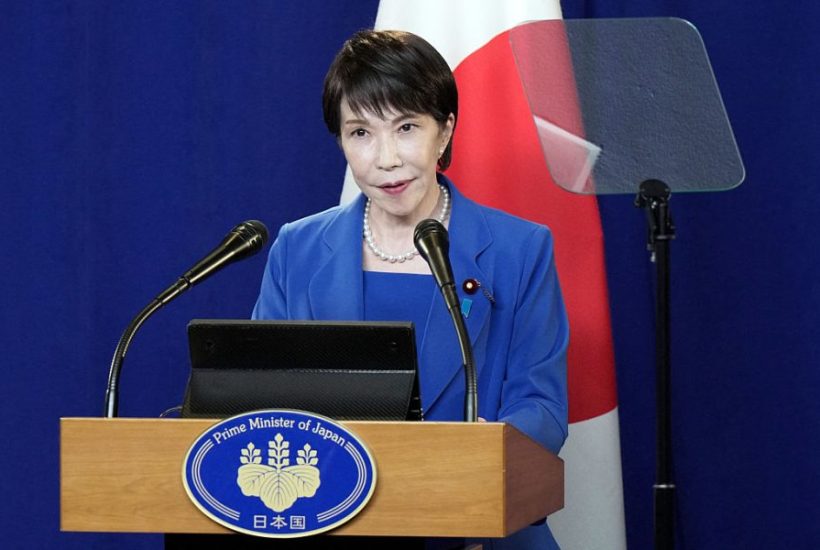
Questions in Japan over its alliance with the US, alongside the threat from China and a nuclear-armed North Korea, appear to be driving the country towards a distinctly muscular form of adulthood. Prime Minister Sanae Takaichi is leading the transformation, risking the wrath of her struggling electorate by committing the cash-strapped country to spending the equivalent of £50 billion annually on defence and security. Much of this is being ploughed into the weaponry of the future, including railgun technology – whose mastery has long eluded America – that is intended as a cheap and effective way of taking down drone swarms and hypersonic missiles. Long-range weapons are in development and missile testing has begun on Australian territory as the two countries draw closer in the face of shared threats.
Upstream of all this lie raw materials, industrial capacity and AI. Japan is looking carefully at all three. It is trying to diversify the supply of key resources such as rare earths away from China, while working with the Taiwanese semiconductor manufacturer TSMC to develop and run production facilities in Japan. Earlier this year, Takaichi removed a long-standing bar on the export of lethal arms to a select group of allies, hoping thereby to expand its domestic arms industry. One of the most significant recent contracts is for Mitsubishi to build cutting-edge Mogami-class frigates for Australia.
In the world of artificial intelligence, policymakers in Japan have long worried about being beholden to the two giants in the field, relying on American firms like Anthropic and OpenAI for frontier models and on Chinese companies for advanced robotics. Chinese humanoid robots are currently being trialled at Tokyo’s Haneda Airport for handling baggage: surely a blow to the pride of the country which, via the likes of Astro Boy and Doraemon, once dreamed bigger than anyone of a robot future. Takaichi’s government is trying to avoid this superpower squeeze by ploughing up to £4.6 billion across five years into a bid to develop sovereign AI (albeit with the help of America’s Nvidia). The plan is to use new, made-in-Japan AI to power some 10 million robots by 2040, across various sectors including healthcare and defence.
Japanese intelligence-gathering, too, is coming of age. After the fall of Japan’s authoritarian government in 1945, people decided that they had had enough of the authorities prying into their affairs. Attempts to set up a new centralised intelligence-gathering agency were duly shelved, replaced by a fragmented and poorly co-ordinated system – until this year. Japan now has a National Intelligence Council, chaired by the Prime Minister and overseeing the work of a new National Intelligence Bureau. Next year or early in 2028, Japan is expected to launch its first foreign intelligence agency since the second world war – built, it is widely believed, with help from some of the leaders in the field: CIA, MI6, and Australia’s ASIS.
Chinese state media regularly denounces these developments as remilitarisation and revisionism. The latter charge refers to a tendency in some corners of Japanese politics to push back against what they see as a western postwar narrative of Japan as Asia’s evildoer-in-chief. In their eyes, that story – told in the Tokyo Trials (Japan’s equivalent to Nuremberg) and through a Japanese education system overhauled by the US during the Allied occupation (1945-52) – conveniently left out longer-range causes of the war, including European and American imperialism in Asia.
Prime Minister Takaichi has strong links to the revisionist camp, and with her governing partners the Japan Innovation party is working on a possible amendment to Japan’s American-authored pacifist constitution, regularising the status of Japan’s armed forces. Their very name, the ‘Self-Defence Forces’, speaks to an ambiguity about Japan’s right to develop and project military power which conservatives regard as outdated.
Are the momentous changes through which Japan is currently passing a sign of reaching maturity as a normal security state, or a shedding of old inhibitions and safeguards faster than democratic oversight can keep up? Japanese lawyers and civil liberties campaigners are becoming vocal on the latter concern, with a new anti-espionage law set to be debated in the coming months. It is designed to tackle Japan’s reputation as a so-called ‘spies’ paradise’, where agents from foreign countries operate with virtual impunity. But critics are seeking reassurances that agencies charged with enforcing any new law will respect the privacy of ordinary citizens. Japan’s leading historian of intelligence, Ken Kotani, has suggested that Takaichi urgently needs to convince people that their country’s new laws and institutions are aimed at Japan’s enemies and not at them.
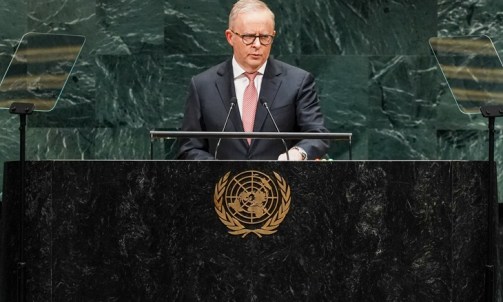
In her speech to the United Nations this week, Takaichi demanded that the old ‘enemy state’ clauses be removed from the UN’s Charter – a measure that was agreed back in 2005 but has not yet been implemented. Japan, she said, has spent 70 years contributing to the UN as a peace-loving state, alongside serving as one of the world’s most generous providers of development assistance. It is therefore wrong, she argued, that Japan should continue to remain labelled an enemy. It should also, she believes, be given a permanent seat on an expanded security council. In other words, the ‘little boy’ of the past – if ever he really existed, in the way Murakami claimed – is gone. The unsettling question, for Japan and its neighbours, is what kind of adult he will become.