The Ministry of Defence is a frustrating organisation, secretive, slow to change, often hidebound by process. In one regard, however, the department is always 110 per cent and reaching for the stars: the relentless positivity of its press office.
It is not unreasonable to sense the Panglossian hand of the MoD press office behind a recent story in the Times, for which the paper’s New York correspondent, Will Pavia, went to woodlands outside Sandhurst. Here he observed elements of the Household Cavalry on exercise, in slightly surprising circumstances which he summed up elegantly:
The soldiers were taking part in an exercise with a personnel carrier found to be capable of moving stealthily through rough, wooded terrain while emitting only a modest infra-red heat signature. It is called a horse.
We are not yet quite out of living memory of mounted warfare
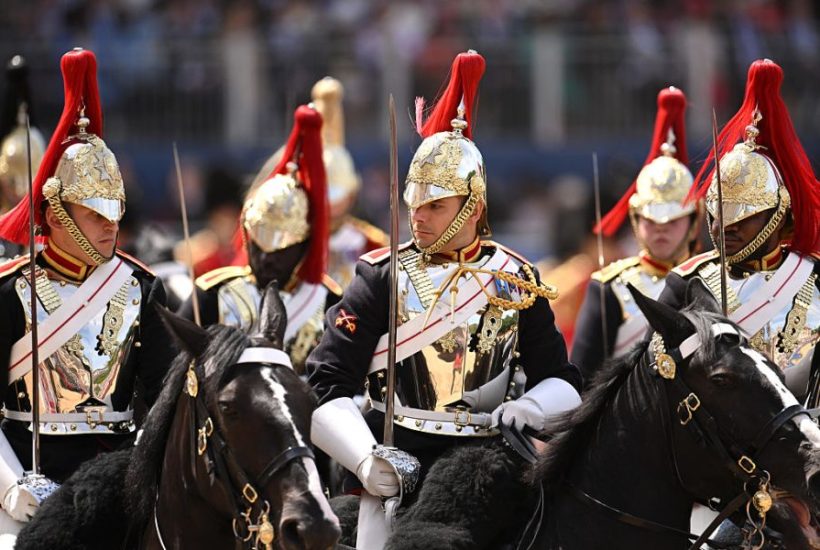
It was an exercise only the British Army could describe as ‘innovative’ and ‘cutting-edge’. Soldiers from the Life Guards and the Blues and Royals (Royal Horse Guards and 1st Dragoons), usually seen mounted wearing stainless steel cuirasses and thigh-length polished leather jackboots, were clad in multi-terrain pattern combat dress. They were, in the words of Trooper Kian Norris, ‘testing out the capabilities of the horses’. His horse Tristan was unavailable for comment.
Here is the serious part: it is well established that, even in the second quarter of the 21st century, horses can provide soldiers with mobility in a way that is agile, stealthy and adaptable. They can thread their way through dense woodland, cover long distances with relative ease and – an overriding consideration in an era of drone warfare – are much less easy for infrared thermal imaging to detect than are large, noisy, heavy armoured vehicles. There are niche uses for these qualities.
This is not an especially novel realisation. Some Russian units in Donetsk have been using horses and donkeys to transport supplies and attempt to evade the deadly attention of Ukrainian drones, and American special forces in Afghanistan made some use of both horses and mules. The US Marine Corps Mountain Warfare Training Center in Bridgeport, California, offers training courses in advanced horsemanship, teaching Marines to ‘ride horses, load pack animals, and maintain animals for military applications in remote and dangerous environments’. And any self-respecting Bond fan will remember 007 accompanying Mujahideen horsemen on a cavalry charge against a Soviet air base in Afghanistan in The Living Daylights.
There is an irony that the British Army should be advertising its eagerness to exploit mounted soldiers and frame it as groundbreaking. Some senior officers in the first half of the 20th century were painfully slow to accept that large cavalry forces were obsolete and many of their roles would be taken over by armoured vehicles. After the first use of tanks on the battlefield at Flers-Courcelette in September 1916, Lieutenant-General Sir Julian Byng, General Officer Commanding Canadian Corps, described the slow-moving metal machines as ‘a useful accessory to the infantry, but nothing more’.
We are not yet quite out of living memory of mounted warfare, either. The last recorded charge by mounted troops in British service was in March 1942, near Toungoo in Burma. Captain Arthur Sandeman, on loan from the Central India Horse (21st King George V’s Own Horse), led a 100-strong mounted patrol of the Burma Frontier Force in a desperate rush against Japanese troops; all were killed, Sandeman with his sabre still in his hand.
A revival of mounted cavalry is not, however, going to happen at any serious scale any time soon. The armed forces will continue to find discrete roles for which horses are still best suited and shake off the counter-intuition which dismisses mounted soldiers as a hopeless and vulnerable anachronism.
The Household Cavalry is doing the right thing to explore further possibilities for their horses. There is no doubt that we are at a point of profound transformation of technology, capability and force structure. Setting aside the death by a thousand cuts which is the current government’s hesitant and mendacious parsimony, the British Army in, say, 2040 will look very different from the force of today.
Autonomous vehicles and weapons systems will have developed enormously; artificial intelligence will be woven into everyday operations; conventional main battle tanks will be obsolete or out of service, though some kind of heavily armoured platform will probably still exist; one of the biggest challenges will be the management, analysis and use of data. We need to prepare ourselves for all of this and be imaginative and open-minded. But the British Army of 2040 will not be by any sensible metric a mounted one. For that, horses everywhere should probably be grateful.