‘I met Murder on the way – he had a mask like Castlereagh.’ – Percy Bysshe Shelley
With Keir Starmer being airbrushed from history it is now time to reflect, not on his potential replicant, Andy Burnham, but on wider issues.
Shelley’s poem, The Mask of Anarchy, was his response to the Peterloo Massacre of 1819, when cavalry charged a peaceful crowd gathered at St Peter’s Field in Manchester to demand parliamentary reform. Shelley turned Lord Castlereagh into the face of Murder because he represented a governing order that answered popular discontent with coercion and called the result public order.
No mounted yeomanry is cutting through reformers in Manchester. Yet the governing instinct has an echo.
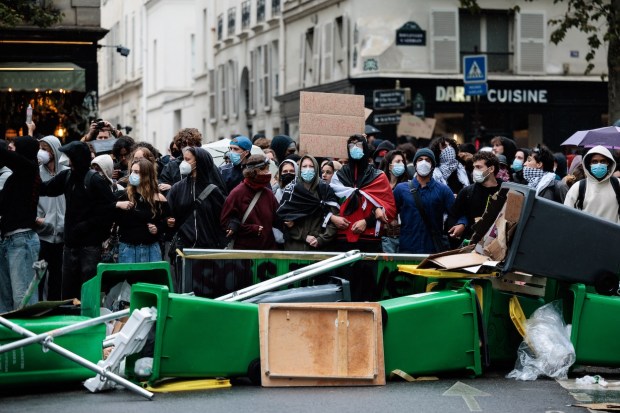
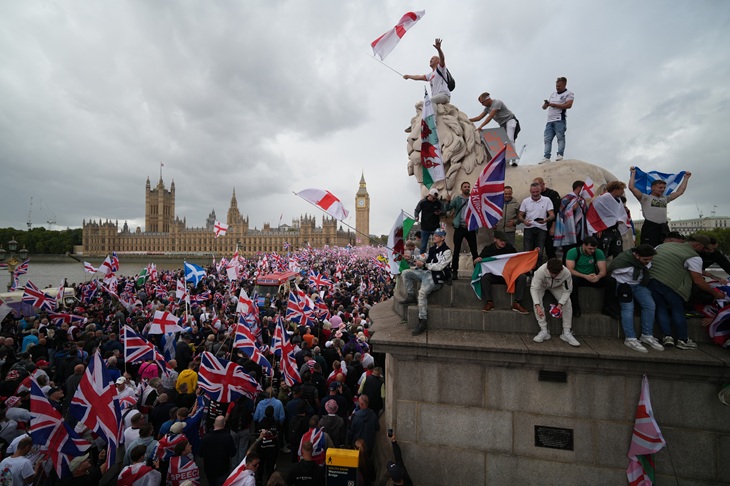
Starmer’s Britain has built upon an already restrictive public-order regime, extending police powers over repeated protests, requiring officers to consider their cumulative disruption, and creating further grounds for controlling assemblies that remain peaceful. The weapon is the condition, the exclusion zone, the arrest, the facial-recognition camera, and the statute drafted in the language of safety.
Murder no longer comes wearing Castlereagh’s mask. Authority comes wearing the expressionless face of procedure. A bit like that painful grimace of Starmer.
Britain has not collapsed. Collapse would at least be dramatic. It has done something more British and more depressing: it has filled in the appropriate forms and quietly ceased to breathe. The lights remain on (even for Lammy). The trains still travel from one station to another, sometimes. Ministers stand before flags and announce plans. Committees meet. Strategies are published. Consultants produce diagrams. Yet beneath the administrative motion lies a sense of national suspension. Like a bridge without traffic.
Britain is functioning, but it is not alive. The Lanyard people have taken over.
Its public language has become cautious and bloodless. Its institutions fear initiative. Its town centres decline. Projects that other countries complete become permanent British arguments about cost, process and environmental impact. Failure seldom brings disgrace. Nobody is responsible and the Lanyard class doubles down.
This is not a demand to make Britain great again in the nostalgic sense. Britain cannot and should not recreate 1955 or 1815. History does not provide return tickets. The task is not restoration but rebirth: the recovery of those national qualities that once made renewal possible. Britain needs to become less managed and more spontaneous; less apologetic and more confident; less absorbed by procedure; and more interested in achievement. It needs to recover humour, beauty, ambition, eccentricity, and an appetite for risk. It needs to believe that the future is something a nation may shape rather than something administered by a department.
We need to get rid of the declinist state.
It is hard to imagine Castlereagh asking whether the Congress of Vienna had a communications strategy, a stakeholder map, or an inclusive visual identity. Yet modern government can scarcely repaint a railway station without producing a mission statement. Britain is rich in strategies, frameworks, road maps and delivery units. But delivery itself remains under review. We cannot even say, as in Mussolini’s Italy, that ‘at least the trains run on time’. They don’t…
This is not to say that 19th Century Britain was well governed. It was scarred by poverty, class divisions, and political exclusion. But there was agency. They believed Britain was a participant in history, not a defendant before it. The British people are on trial for crimes they are not responsible for: reparations, historical guilt, self-flagellating teachers.
Disraeli declared that ‘the greatness and the Empire of England’ were rooted in its ancient institutions. The imperial part belongs to its time. The deeper culture survives. A nation cannot renew itself if it despises every institution, custom and memory that gives it continuity. If it despises its own families who died in war. If it hates its own flag. Blair’s reforms were not driven by greatness – but the leveraging of British people’s innate sense of fairness. ‘Reform’ became demolition conducted by people who lack the ability to rebuild. It was and is a type of nihilism.
Britain’s crisis is not that it has forgotten how to rule the world. It has forgotten how to govern itself, laugh at itself and believe in its own future. Safety has become the highest public good. ‘The Committee of Public Safety’ (Starmer, Lammy, and Rayner) resemble the prodigy of the ‘Brahmin’ generation of PC – brought up on inclusion rather than meritocracy. Procedure has replaced judgment. This has created a state that is at once everywhere and unavailable. It instructs, warns and monitors, yet fails at the ordinary tasks for which the public pays it. It can produce guidance on wellbeing, but not an appointment. It can consult on transport, but not build the railway. It can explain the causes of disorder (the white working class) while ignoring the tsunami of underlying causes.
The problem reaches beyond government. Schools confuse fairness with the concealment of excellence. Universities speak the language of intellectual courage while enforcing a timid, morality speak. Arts organisations fear their audiences. Businesses issue statements in a dialect no customer speaks. Corporate football teams bombard the public with, ‘just say no to racism’. Concentrate on the football. Public bodies have adopted a prose style designed to remove humour, conflict, and human personality. Our local MP, Angela Eagle (the minister who couldn’t tell us the number of boat people entering the UK) has started a ‘Diversity Hub’ in her constituency, Wallasey. Diversity is the least of the worries of constituents; what is needed is growth, attracting FDI, rewarding ‘greatness’, and education taken back from Nursery Nurses posing as teachers in schools.
Britain once ruled the waves. It now issues guidance about entering the paddling pool. The national instinct for ridicule once acted as a defence against pretension and officious authority. That instinct has gone. Humour has been replaced by messaging. The British no longer possess a stiff upper lip; they are looking over their shoulder in case they have upset the gender or race lobby.
Churchill wrote that courage is the first human quality because it safeguards the others. Courage is not confined to war. A teacher needs it to defend standards. An official needs it to exercise judgment. An artist needs it to risk failure. A politician needs it to tell the public that a choice carries a cost. A country without courage loses wealth and institutions for the pyrrhic victory of diversity.
A national rebirth cannot be ordered from Whitehall. The desire to direct every renewal from the centre is part of the problem. Britain’s creative strength seldom arose from a national plan. It came from cities, workshops, chapels, clubs, universities, voluntary societies, newspapers, pubs, and families.
Gladstone came to place great weight on liberty and on the tendency of human affairs to work towards good when people are left room to act. That insight now sounds radical. Modern Britain is suspicious of unapproved action. It prefers permission to initiative and supervision to trust. A free society depends on the existence of space between the individual and the state. That space was once filled by institutions with roots and character: local newspapers, trade associations, churches, clubs, friendly societies, unions, charities and civic bodies. Many have disappeared. Others survive as branches of national bureaucracies, speaking the same language and obeying the same grants regime.
Britain does not need another national awareness week. It needs more people doing strange, difficult and useful things without first applying for permission. This is why the revolution Britain needs may be anti-revolutionary. It should release society from central management and allow locality, community, association and eccentricity to return. The state should protect order and liberty, provide sound infrastructure and perform its core duties. It should not attempt to supervise every conversation, preference, and relationship. Salisbury warned that constitutional uncertainty threatens the confidence, familiarity, and security that distinguish home from travel. Patriotism begins in that sense of home. It is not a claim that one’s country is innocent or superior in every respect. It is the belief that the country is yours: inherited, flawed, and worthy of care. We have discarded this.
Modern Britain often treats patriotism as a moral examination in which the citizen must begin by confessing national sins. No account of Britain should conceal slavery or empire. Yet the mantra of ‘slavery’ never goes away. Museums are built about it. National mourning days, Black Slavery Month (every month) continues like a constant cuckoo. Whilst Cromwell sent Irish men, women, and children to effective slavery in the Caribbean – there is no constant badgering for special status, no harping on. A country that teaches only shame will not create better patriots. It will create people who regard public life as either an embarrassment or an opportunity for plunder.
Britain should begin by expecting its institutions to work. Trains should run. Streets should be safe. Courts should deliver justice. Schools should teach knowledge. Universities should pursue truth and excellence. The police should police. Government departments should be judged by outcomes rather than by the elegance of their frameworks. The country should build things worth keeping. The Victorians built town halls that resembled Florentine palaces. Today, new build houses must include an allocation for illegal migrants. Stations, schools and public buildings should convey dignity. A society reveals its opinion of ordinary people through the places it expects them to inhabit.
Britain must also reward excellence. Equality before the law is a principle of civilisation. The pretence that all performances and achievements are equal is a principle of decay. A healthy country honours the gifted while providing routes through which talent may rise. It does not lower the summit because the climb is uneven. Enterprise needs the same freedom. Britain celebrates entrepreneurship in speeches while subjecting small businesses to a mass of rules designed for corporations with compliance departments. The nation that produced inventors, engineers, merchants, and manufacturers now requires many of their successors to spend their first years proving that they have completed mandatory online training. Having built the Titanic, we sent a frigate this summer to the Mediterranean which broke down near a beach in Cyprus. You can’t blame the icebergs.
Our ancestors crossed oceans in wooden ships. We hesitate to cross the street without a feasibility study. Britain’s greatest cultural achievements did not arise from ideological uniformity. They came from argument, rivalry, oddity, and independence. The country produced amateur naturalists, dissident clergymen, self-taught engineers, argumentative pamphleteers, explorers, collectors, poets, inventors, and people who devoted their lives to subjects that no committee would have funded. Today, the celebrated are administrators, as in the EU, where they line up for a photo shoot…
British eccentricity was a source of discovery. It allowed individuals to resist fashion and pursue an idea beyond the point at which respectable opinion had lost interest. That liberty requires tolerance of disagreement. A free society is not one in which everyone is represented in the approved conversation. It is one in which people may reject the approved conversation altogether. Disraeli once remarked that England did not love coalitions. The line concerned parliamentary politics, but it captures a wider suspicion of arrangements in which all important people agree with one another. Modern Britain has become a coalition of its governing institutions. Politics, administration, universities, corporations, and cultural bodies often share the same vocabulary and assumptions. A living country needs argument. It needs rival centres of authority, local loyalties, independent institutions, and people prepared to become unpopular. Listen to Rupert Lowe (the ‘far right’) interviewing senior civil servants in Parliamentary Committee and exposing their uniform ignorance and waste of taxpayers’ money. It is brilliant and necessary.
The answer is not imperial restoration. It is not Downton Abbey or compulsory nostalgia. Rebirth means recovering national agency. It means trusting citizens, expecting competence, protecting argument It means accepting that risk is part of life and that failure is often the price of creation. It means teaching the young that they inherit not merely guilt, but duties, freedoms and possibilities.
It also requires a governing class that regards the future as a field of action.
The country that built railways across continents now treats a line from London to Birmingham as an encounter with the limits of human possibility.
Britain does not need to become what it was. It needs to remember why it was once capable of becoming something new.
Brian Patrick Bolger. He has taught International Law and Political Philosophy at Universities in Europe. His legal articles have appeared in leading magazines such as the New Law Journal, The Spectator, The Salisbury Review etc . He is an advisor to CEE Law firms.