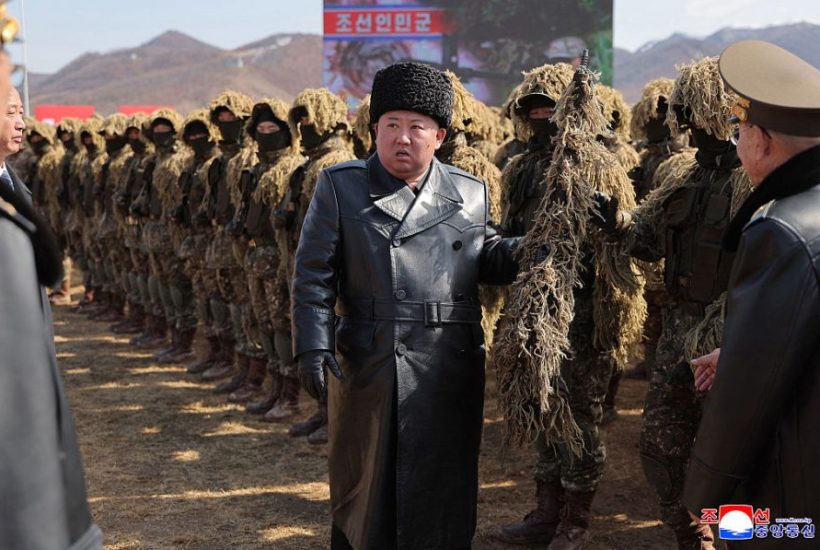
If you were Kim Jong-un, you’d be pretty happy right now. North Korea’s third supreme leader is not only the hermit kingdom’s most successful leader – he is also the richest. With the sanctions-stricken country having amassed over $20 billion (£15 billion) in foreign currency earnings as of last year, Kim is at his most emboldened since he took power in December 2011. As more North Korean artillery, missiles, and manpower head in Moscow’s direction to aid its war against Ukraine, Kim knows that for now, North Korea can count on its Cold War patrons of Russia and China for brotherly support. Pyongyang’s neighbours offer a crucial helpline in circumventing international sanctions and ensuring the Kim regime continues to reap rewards.
North Korea is no stranger to evading sanctions. Whether from individual countries such as the United States or from global institutions such as the United Nations, the ruling regime has mastered this art. Ever since Pyongyang conducted its first nuclear test twenty years ago, such efforts to curb the North’s nuclear and missile ambitions have ironically only exacerbated them. Pyongyang has gained infamy for its colourful criticisms of sanctions, deriding them as ‘acts of war’, as part of what it has long called the US’s ‘hostile policy’ aiming to catalyse regime change, and as infringing its right to exist.
Over the years, North Korea’s mastery of sanctions evasion has grown
These sanctions have been wide in scope. To name a few, they have comprised bans on North Korean imports of technologies, missile equipment, and weapons that could be used for developing weapons of mass destruction; limits on importing refined petroleum and crude oil; and freezes on North Korean assets held abroad. Individuals, too, have faced the wrath of sanctions, whether those in the ominously named Munitions Industry Department (the department responsible for overseeing nuclear and missile programmes) or state-sponsored cyber-warriors who prowl the world of cryptocurrency, extorting billions of dollars to replenish the Kim regime’s coffers and offer financial fuel for the country’s nuclear programme.
Over the years, however, North Korea’s mastery of sanctions evasion has grown, in no small part owing to helping hands from Russia and China. Ahead of the last set of UN sanctions to be imposed on North Korea, in December 2017, Russia, China, and the three other permanent members of the UN Security Council (the United Kingdom, France, and the United States) agreed to cap North Korean imports of crude oil at four million barrels per year. Countries were also instructed to return North Korean overseas workers back to their homeland within two years. This was arguably the toughest batch of sanctions to date.
It quickly became apparent that Beijing and Moscow had no intention of practising what they preached. The two countries continue to host a total of approximately 100,000 North Korean workers, whether under conditions of slave labour in construction sites or as information technology operatives seeking to infiltrate Western businesses and global markets. Around 90 per cent of these individuals’ earnings are syphoned off to the Kim regime. These workers may earn more in Russia or China than in their motherland. But while they are left with meagre salaries, for the Kim regime, it is a different story. North Korea’s global network of overseas labour draws in between $200 and $500 million (£148 to £370 million) a year. This number looks set only to increase.
What is more, who can forget when, in March 2024, the Panel of Experts – a group of experts appointed to assist the UN Security Council in monitoring North Korean sanctions violations – died a painful death? Russia’s veto and China’s abstention meant that this useful means of documenting North Korea’s sanctions circumvention would be confined to the history books. Whether with respect to hosting North Korean workers, facilitating coal exports out of North Korea and oil imports into the country (since 2024, Russia has given North Korea thousands of tons of crude oil every month), or offering military technology in exchange for missiles and troops, the Kim regime’s ability to secure Russian and Chinese support in refusing to enforce sanctions is a significant victory.
With the hermit kingdom continuing to fuel the Kremlin’s war against Kyiv, any end to the war will not see the end of the newfound alliance between Pyongyang and Moscow. With North Korea having an abundant supply of labourers and Russia’s economy on crutches, it would be no surprise if Pyongyang were to send tens of thousands of workers in Moscow’s direction. This would be a win-win for both countries. For Russia, it will be a cheap and convenient way of replenishing its chronic labour shortage. For North Korea, it will be another way of reaping rewards, whether financial, humanitarian, or in terms of its much-coveted missile and military technology.
Most concerningly, however, is that we can do little about it. Thanks to Beijing and Moscow’s zero-enforcement approach towards sanctions against their nuclear neighbour, Pyongyang has managed to further its quest to be recognised as a nuclear weapons state. Sanctions on North Korea can no longer be effectively imposed by the UN Security Council – let alone discussed or drafted. Nevertheless, to think that lifting sanctions will induce better North Korean behaviour and curtail its nuclear development is the height of geopolitical naivety.
China and Russia must not be allowed to evade scrutiny for their connivance in North Korea’s sanctions dodging. Otherwise, our ability to address the intractable problem of North Korea will only fade further into the distance.