Current energy policy in Australia is based on the arguments that greenhouse-gas emissions should be sharply reduced and that, as part of this, renewable energy should replace coal and gas for electricity generation.
Both these arguments should be challenged and a fresh approach taken to Australian energy policy.
Scientists agree that greenhouse-gas emissions contribute to global warming, but are they the major driver of warming?
This issue is hotly contested, with natural climate variations an important issue also to be considered.
Natural variations in warming and cooling are clear from the past few thousand years and are almost certainly still with us today. Although not fully understood, they are probably solar in origin.
For example, there were global warming and cooling periods in Roman times (around 250 BC to 400 AD) and in Medieval times (around 950 to 1250 AD).
In Roman and Medieval times, global temperatures increased (before subsequently falling) as much as they have in our time – a little over 1-degree centigrade.
Following 1300 AD, global temperatures declined overall until the 1800s, but with cycles of increases and decreases superimposed on the trend.
Greenhouse-gas emissions, which only started growing after 1850, are unrelated to these past temperature changes.
Today, it is arguable that natural variations in warming and cooling have a much larger impact on global temperatures than emissions.
If so, reducing emissions will make little difference to global temperatures in the 21st century.
The government’s relentless pursuit of lower emissions is inconsistent with these yet-to-be-resolved issues.
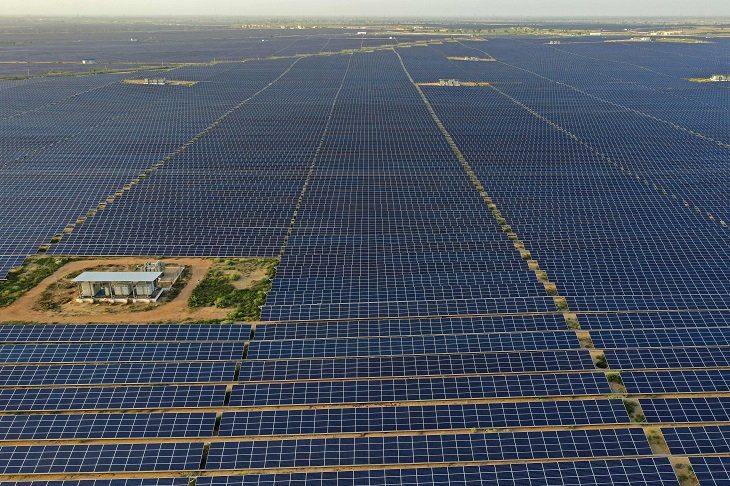
Current energy policy (Net Zero emissions by 2050) entails that we eventually rely entirely on renewable energy – notably wind and solar farms – for electricity.
However, this will require battery support that, for the country as a whole or even one state, will be impossibly expensive.
To illustrate, the large Tesla battery installed in South Australia in 2017 at a cost of $100 million would supply electricity for that state for less than half-an-hour.
On this basis, to supply Australia with electricity solely from batteries for, say, a week would require batteries costing over $500 billion.
This is nearly as much as total federal government expenditure last financial year.
And even a week would be less than that required to cover periods of weak or non-existent wind and solar energy.
Furthermore, wind and solar energy are proving expensive, with electricity prices in Australia for consumers having tripled since 2000, moving from among the lowest in the world to among the highest.
Reasons for this include:
- The high transmission costs typically associated with renewables.
- The need to backup renewables with coal or gas plants operating at below capacity and thus with high unit costs.
- The costs required to maintain frequency stability in the grid.