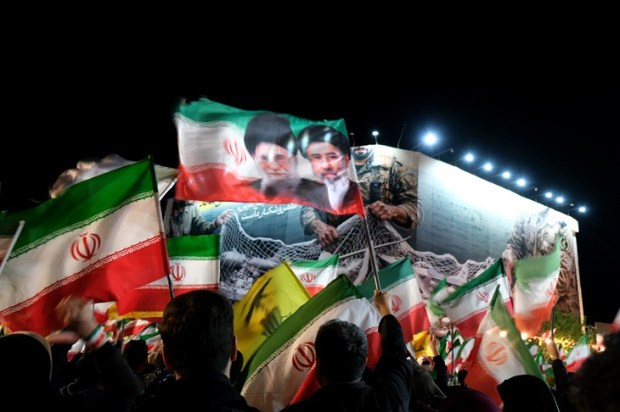
Over the last few weeks, the Islamist regime in Tehran has expanded the scope of its hostage-taking operation. Not satisfied with only taking Western citizens hostage and then extorting their governments, something that Australia itself has been a victim of, has now taken the world economy hostage by closing the Strait of Hormuz, the strategic energy corridor in the Persian Gulf.
The same way that the oceans between Iran and Australia have not prevented the Islamist regime from exporting terrorism to Australia and taking Australians hostage, they could not save Canberra from the negative effect of closure of the Strait of Hormuz.
Australians are now paying higher prices for fuel and markets have to price in the risk of repeated closure in future if the regime stays in power.
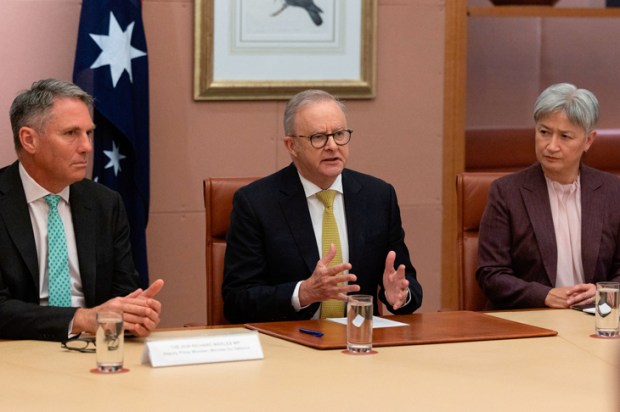
In March 2025, we warned the Australian government that it should align itself with the American policy of ‘maximum pressure’ against Tehran, as a strategic necessity tied to both its security and its values.
The behaviour of the Islamic regime has since proven this assessment correct. Not only has the disruption of oil flows, through the effective strangulation of the Strait of Hormuz by the IRGC, impacted daily life in Australia, but the IRGC’s missiles and drones targeting Persian Gulf neighbours have also led to the closure or disruption in operation of key international transit hubs such as Doha, Dubai, and Abu Dhabi. These airports serve as critical gateways for millions of travellers to and from Australia.
The full economic and human toll of these disruptions on Australia has yet to fully materialise. However, Australia appears increasingly engulfed in the notion that ‘every foreign intervention, especially in the Middle East, is wrong’, thereby avoiding a clear-eyed assessment of the situation.
It is both a moral and strategic imperative for any free nation to support a people who have lost 45,000 of their members in two days (January 8 and 9) to a repressive regime. A rogue state capable of disrupting the daily lives of Australians through missiles, drones and terrorism is not an abstract issue; it is a direct strategic challenge that must be addressed.
Australians should also be reminded of the relationship they once had with Iran before the Islamic Republic existed. Before the Islamic Revolution of 1979, Iran and Australia were developing a steadily expanding economic relationship, particularly following the Shah’s landmark visit to Australia in 1974. At the time, Iran represented a reliable partner and rapidly growing market for Australian exports.
The 1979 Islamic revolution, however, fundamentally disrupted that trajectory. The establishment of the Islamic Republic introduced political instability, war, and ultimately decades of sanctions, all of which constrained bilateral trade. What had been a relationship with strong growth potential became volatile and limited, shaped less by economic logic and more by geopolitical tensions that ultimately led to expulsion of Iran’s ambassador and the designation of the IRGC as terrorist organisation in 2025.
A free and stable Iran would not only ensure that such disruptions never occur again, but it would also transform the currently limited bilateral relationship into one of significant strategic value. With a population approaching 90 million, Iran represents one of the largest untapped consumer markets accessible to Western economies.
Yet Iran’s potential extends beyond market size. Structurally, it combines advantages that no single Middle Eastern country fully possesses: a large and youthful domestic market with 250,000 STEM graduate per year; a diversified industrial base (unlike many Persian Gulf economies); a strategic geographic position linking Central Asia, the Persian Gulf, and South Asia; and abundant energy, mineral, and agricultural resources.
Therefore, it is prudent for Australia to recognise that change in Iran is both inevitable and approaching; timely support for the Iranian people would, on the one hand, help expedite this process, and on the other, serve as an investment in Australia’s own strategic future.
The emergence of a free and stable Iran would depend on rapid and deliberate reintegration into the international system. A proposed transition framework, introduced by Crown Prince Reza Pahlavi as the Iran Prosperity Project, outlines an accelerated diplomatic and economic normalisation process. This includes, in the first week of transition, steps such as recognition of Israel, immediate negotiations with the United States, the European Union, and the United Nations Security Council to normalise relations and lift sanctions, and working with neighbours to ensure security and freedom of navigation under transitional government.
In a post-sanctions environment, Iran could play a transformative geopolitical role. A strategic partnership with the United States would position Iran as a stabilising force in the region, contributing to counterterrorism efforts, economic integration, and reduced security burdens for Western allies.
While many Western governments may be distracted by the fog of war at present, the long-term outlook for Iran beyond the Islamic Republic is only promising, driven by its human capital, natural resources, deep historical foundations, and the emerging alignment between the Iranian people and the United States and Israel. Countries such as Australia risk not only short-term economic but also missing a significant strategic opportunity if they fail to prepare for Iran’s transition.
Reza Arab is a lecturer at the University of Queensland and an advisor to Iran Prosperity Project. Saeed Ghasseminejad is Director of Iran Prosperity Project and an advisor to Crown Prince Reza Pahlavi.