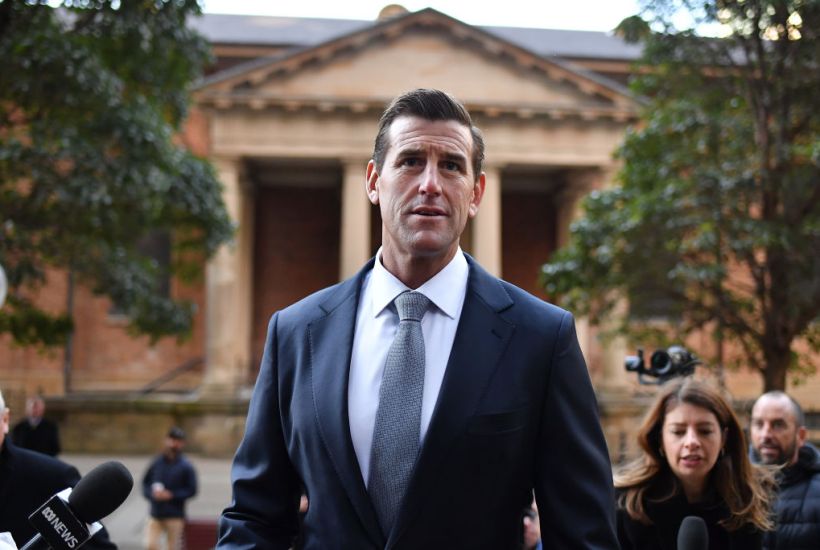
The staged arrest of Ben Roberts-Smith, just weeks before Anzac Day, is not just bad optics. It is a signal to every young Australian thinking about enlisting.
Australia is facing a military recruitment crisis.
As of early 2024, the Australian Defence Force was more than 4,300 people below its authorised strength of 62,700 permanent members. Its total workforce had actually shrunk over the preceding five years, despite the relatively favourable recruiting conditions created by Covid-era unemployment. The ADF needs to reach 66,873 uniformed personnel by 2027-28, a 14.8 per cent increase on current numbers. On its current trajectory, it will not get there. The government has outsourced its recruitment process to a Swiss firm under a $1 billion contract. That firm has been underperforming. Applicants abandon the far too lengthy process. Young Australians who might have considered service are choosing not to.
Research into why Gen Z is turning away from military service in record numbers points to two converging factors. The first is economic: low unemployment and the perception of better opportunities elsewhere. The second is cultural. As one study funded by the ADF itself found that media coverage of alleged Australian war crimes in Afghanistan has muddied the image of military service for a generation that was already less inclined toward traditional patriotism. That the ADF’s own commissioned research confirms this should give every defence planner pause. National pride data reinforces the picture. In 1981, 70.3 per cent of Australians described themselves as very proud of their nationality. By 2018, that figure had fallen to 60.8 per cent among the first Gen Z cohort to be surveyed.
Into that already fragile environment, the AFP and the Office of the Special Investigator have just dropped the image of Australia’s most decorated living soldier being walked across an airport tarmac in handcuffs, filmed, packaged, and distributed as state-produced content. Just weeks before Anzac Day.
If anyone in authority has thought carefully about what that image does to military recruitment, they have not said so publicly.
Ben Roberts-Smith is innocent until proven otherwise. That is not a sentiment. It is the foundation of the legal system under which he will be tried, and it deserves to be stated plainly before anything else in this debate.
He is a recipient of the Victoria Cross; the highest military honour Australia bestows. He served in conditions that most Australians will never experience and cannot fully comprehend. The physical and psychological demands placed on SAS soldiers in Afghanistan were extreme. The moral environment in which they operated, fighting an enemy that used civilians as shields, that planted bombs in children’s toys, that executed prisoners without hesitation, was one of genuine ambiguity and constant danger.
None of that automatically excuses conduct that violates the laws of armed conflict. The laws of war exist precisely for wartime, not as a peacetime luxury. If Roberts-Smith committed the offences alleged, a court must determine that, and the consequences must follow.
But a criminal trial has not yet begun. The charges have not been tested and whatever ultimately happens in court, the manner of Roberts-Smith’s arrest demands condemnation from anyone who takes due process seriously.
The AFP and the Office of the Special Investigator did not merely arrest a man. They staged an event. They issued a media release directing journalists to a portal where ‘arrest vision’ was available for download. They issued a second release shortly afterwards, in case anyone had missed the first. The footage, featuring Roberts-Smith’s blurred face but universally recognisable figure, was distributed by the state itself, not captured by bystanders, not leaked from a source inside the investigation. Produced, packaged, and released.
Roberts-Smith is one of the most publicly prominent figures in Australian military history, a man who had been subject to years of investigation and was fully aware of the scrutiny upon him. There was no scenario in which a quiet arrest was beyond the capacity of the agencies involved. They chose the spectacle. They chose the airport. They chose the camera. They chose to distribute the footage themselves.
The arrest occurred weeks before Anzac Day. Roberts-Smith was not a flight risk. He had been in the public eye for years. There was no operational necessity that required this particular Tuesday, this particular airport, this particular fortnight.
Anzac Day is not simply a date. It is the emotional centrepiece of Australia’s national relationship with its military, the day the country gathers before dawn to honour sacrifice, to remember those who served, and to ask itself what it owes to the people it sends to war. It is the one day of the year when the image of a soldier in handcuffs lands with the maximum possible cultural weight.
Whether the timing was deliberately chosen for effect, or whether those responsible simply did not stop to consider the implications, the result is the same. Every Anzac Day service this year will carry the shadow of this arrest. Every act of remembrance will occur in the context of the image the state chose to create and distribute. That is an extraordinary thing for a government and its agencies to have allowed, and nobody in authority has been asked to account for it.
Return to the recruitment numbers. The ADF needs tens of thousands of new personnel. It is already thousands below authorised strength. It is competing for recruits in a tight labour market against employers who offer better pay, no deployment risk, and no prospect of being prosecuted for decisions made under fire in a foreign war.
Research tells us that the coverage of alleged war crimes in Afghanistan is already a factor in young Australians’ reluctance to enlist. It has muddied the picture of what military service means, and what the state will do for those who serve when things go wrong.
Now add this: a Victoria Cross recipient, the most decorated soldier of his generation, arrested in a public place, filmed by the state, and distributed as content. Weeks before the nation is supposed to honour its military. A $300 million investigation. Years of proceedings. And the outcome is an arrest of a Corporal, while the chain of command above him goes unscrutinised.
What does a 19-year-old considering enlistment make of that picture? What does it say about the bargain between the state and the people it asks to serve? You will be deployed into morally complex situations, with rules of engagement that may shift under you, against enemies who play by no rules at all. And if something goes wrong, or if the political winds change, the state will not protect you. It will film your arrest and put it on the internet.
That is the message the AFP and the Office of the Special Investigator sent last Tuesday. Whether they intended it or not.
A country that is serious about its own defence does not stage the arrest of its most decorated soldier as a media event just over a fortnight before Anzac Day. It does not spend $300 million prosecuting a Corporal while the command culture that allegedly surrounded him goes unexamined.
Ben Roberts-Smith will have his day in court. He is entitled to it, and he is entitled to be presumed innocent until the evidence proves otherwise beyond reasonable doubt. But the conduct of the agencies involved in his arrest has already failed a test that had nothing to do with his guilt or innocence.
It has sent a message to the young Australians this country desperately needs to recruit. And it is not a message that will make the job any easier.