After my article last week on what is called the ‘civilianisation’ of military justice, I found myself in a series of conversations with former servicemen. These are practical unsentimental men, but on the question of Ben Roberts-Smith they are remarkably clear-eyed but feel betrayed. What struck me was not a reflexive defence of Roberts-Smith. Quite the opposite. More than one assumed some level of alleged wrongdoing had likely occurred. That wasn’t the point of the agitation.
The sense of betrayal lies elsewhere, and it is unambiguous and uniform. It is directed at the way this entire process has unfolded: the sense that what is now playing out in the courts and the media was set in motion by the Defence establishment itself. A four-year inquiry initiated within Defence, vast in scope, publicly ventilated, followed by years more of investigation by the Office of the Special Investigator and now prosecution, with all the accoutrements of a high-profile case: the new and inevitable media leaks, a very public arrest, the sense of a narrative taking shape long before a jury is empanelled. This is the logical endpoint of the civilianisation of military justice, and it isn’t pretty.
But there is something more serious, expressed in the blunt language I cannot repeat here: that once again those at the top have insulated themselves from the realities they commanded. Sitting behind that instinct is an institutional framework that helps explain the feelings.
Article 28 of the Rome Statute deals with command responsibility. It states that a military commander is criminally responsible for crimes committed by forces under their effective control where they knew, or, owing to the circumstances at the time, ought to have known that those forces were committing or might commit crimes, and failed to take all necessary and reasonable measures to prevent or repress them.
It is an ambitious formulation for good reason. It seeks to push criminal liability upwards, beyond the perpetrator, into the chain of command. It recognises, at least in theory, that war is not a series of isolated acts but a system of organised violence.
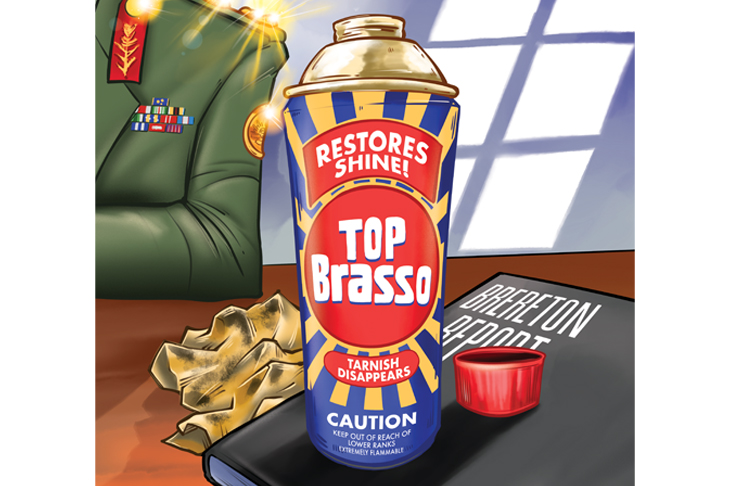
But that formulation has not been carried into Australian criminal law. When the Statute of Rome was implemented through the Commonwealth Criminal Code, the concept of commander liability was translated into the language of domestic criminal liability: knowledge, intention, recklessness. That was inevitable. A criminal trial requires precision about state of mind. But the international law was necessarily modified because what a commander ‘ought to have known’ cannot easily sit in a criminal justice system. By necessity, under civilian criminal law, command culpability is diminished. In the context of the criminal charges now laid against Oliver Schulz and Ben Roberts-Smith, it is important to recall that the Brereton Report, which set this entire process in motion, draws a careful distinction between moral responsibility and criminal responsibility.
The report finds credible evidence of unlawful killings at the patrol level. It also records troubling practices: the use of ‘throwdowns’ (weapons or equipment placed with a body after the fact to suggest the person killed was an armed combatant when he might not have been), the routine use of boilerplate or fabricated after-action reports, and the fact that, by late 2012 to 2013, there was at least at troop level suspicion, if not knowledge, that throwdowns were occurring.
But when it comes to the question that matters for criminal law, whether those higher up the chain knew, or can be proven to have known, of specific unlawful killings, the report draws back. It concludes that the threshold for criminal liability is not met. It is explicit that the discreditable use of throwdowns to conceal deliberate unlawful killings was not known to senior commanders.
And yet the report does not exonerate command entirely. It says expressly that the absence of knowledge or suspicion that war crimes were being committed does not relieve commanders of all responsibility. It finds that commanders indirectly contributed to potential criminal behaviour by accepting deviations from professional standards, by sanitising or embellishing reporting, and by not challenging or interrogating accounts given by those on the ground.
Of course, every army since time immemorial has lived with the uneasy reality that responsibility in war does not sit neatly with a single individual. The chain of command exists because action in war is collective, structured, and dependent on authority flowing downward.
The civil criminal law asks a narrower question: who did what, and with what intent, beyond reasonable doubt? Yet as Article 28 shows, the doctrine of command responsibility extends liability beyond direct perpetrators to those who knew, or should have known, of crimes committed and who failed to prevent or punish them.
Scholars Emily Crawford and Aaron Fellmeth have argued that the Brereton Report adopts a narrow view of that doctrine, distinguishing sharply between actual knowledge and the more elusive idea of what a commander ought to have known. On their account, practices such as throwdowns and manipulated reporting might have warranted closer scrutiny, inquiry and perhaps even legal consequence.
It is worth recalling, too, that none of this was inevitable. The Afghanistan Inquiry was initiated within Defence itself. It was framed broadly, ran for years, and produced a detailed – although heavily redacted – and public account of alleged wrongdoing. The choice to conduct an expansive, systemic retrospective inquiry rather than a narrower, more targeted investigation, shaped everything that followed.
Other countries make different choices. The United States, for example, has been far more reluctant to externalise these matters into prolonged, highly public processes. Allegations are investigated, and where appropriate prosecuted, but typically quickly and, where at all possible, within military systems of justice. Where civilian prosecutions have occurred, they have tended to involve cases at the furthest end of the spectrum: incidents so stark, so aberrant, that they can be isolated from the wider system within which they occurred. A massacre. A rape and several murders at once. Conduct that can be characterised, without much difficulty, as the perpetrators having gone completely Awol in a particular instance.
That does not appear to be quite the case here. What the Brereton Report was tasked to investigate was not a single rupture, but patterns of conduct, not a breakdown confined to one individual or a tight group, but practices that generated warning signs within the chain of command. It is in this domain that the doctrine of command responsibility is meant to operate.
The spectacle of the civilian jury trial now bearing down upon the charged soldiers does not accommodate the international law of war to its fullest and most protective extent.
It is little wonder the instinctive response from those who have served is not confusion, but clarity and recognition – and in many cases white-hot anger.
Got something to add? Join the discussion and comment below.
You might disagree with half of it, but you’ll enjoy reading all of it. Try your first month for free, then just $2 a week for the remainder of your first year.