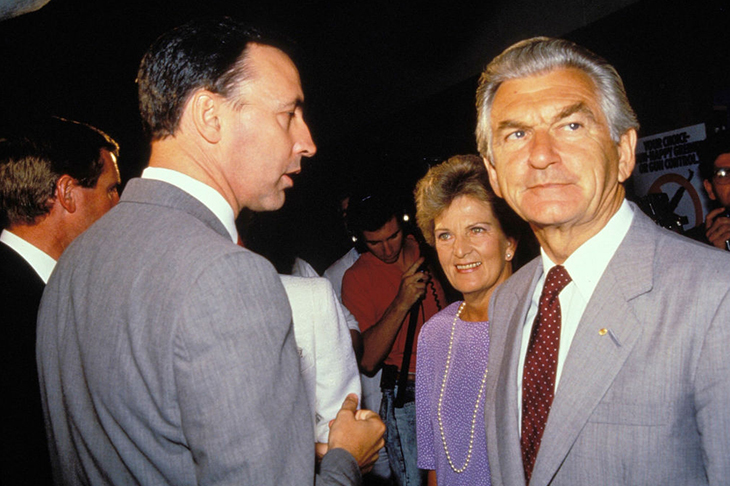
The Hawke government, with Paul Keating as Treasurer, spent the 1980s dragging Australia away from the economic model that was strangling it. Protected industries, proliferating regulators, bloated public payrolls, and government picking winners and taxing productive enterprise into submission. They grasped what Friedrich Hayek had argued decades earlier: that retaining government as the prime mover in the economy was not stability but the well-paved road to serfdom.
Forty years later, this model is back. Not by accident. Not by drift. But by deliberate policy choice, pursued with genuine conviction by people who apparently learned nothing from the experiment the first time.
In the last financial year, spending across all three tiers of Australian government rose by 7.7 per cent to just over one trillion dollars. The economy, over the same period, grew by 1.3 per cent. Government spending, thus, grew six times faster than the economy itself.
This is not a quirk. It is not a post-pandemic hangover. It is a structural condition, and it is the key to understanding almost every other economic problem Australia now faces.
The three tiers of Australian government consume more than 44 per cent of GDP, up from 41 per cent the previous year. Add in the off-budget vehicles designed to obscure the true scale of public expenditure. Add what might be called the ‘because-of-government’ sector, being the lawyers, accountants, consultants, lobbyists and compliance officers who exist purely to navigate the machinery of the state, and a reasonable case can be made that more than half of the Australian economy is now government-driven.
At what proportion do we stop calling Australia a free-market economy and start calling it something else?
Productivity, not government direction, is the mechanism by which economies achieve real growth and workers achieve real wage gains. It is the engine of rising living standards, and when it stalls, living standards follow.
Australia has endured four years of near-continuous per capita recession. Real per capita household disposable income has fallen by approximately eight per cent since mid-2022, the largest such decline on record. The causation is not complicated: an economy that produces less per unit of labour input generates less income per head. These are not the statistics of a country managing a rough patch. They are the statistics of a country making a sustained series of bad choices.
Australians are frequently assured that weak productivity is a global phenomenon, an external condition to be accepted rather than a domestic failure to be corrected. This is false. Productivity is rising in the United States. It is rising across Asia. The problem is European, and Australia has made the catastrophic decision to import European habits.
In a 2023 speech, Italian Prime Minister Giorgia Meloni observed that Europe’s share of global GDP had fallen from 26.5 per cent to 16.1 per cent over 35 years, even as the EU expanded from 12 to 27 member nations. The United States held steady at around 26 per cent. China rose from 1.8 percent to 18 per cent. Meloni distilled the explanation simply: ‘America innovates, China replicates. Europe regulates.’ The EU has since even declared its ambition to become a regulation superpower, a goal almost as economically self-defeating as aspiring to be a clean energy superpower.
Australia, apparently inspired by Europe’s vision, has not merely replicated it but extended it, adding industrial policy dressed up as nation-building, the creeping suppression of speech, and a deliberate dismantling of the energy market that once gave Australian industry some of the lowest power prices in the developed world.
Ronald Reagan observed that government approaches the economy in three stages: if it moves, tax it; if it keeps moving, regulate it; if it stops moving, subsidise it. Australia has now arrived at the third stage. The centrepiece is the $15 billion National Reconstruction Fund (NRF), directing public money toward businesses that offer the best photo opportunities and maintain the most effective lobbying operations.
Recent beneficiaries of NRF largesse include the Hong Kong-owned Patties Food Group and the American-owned Arnott’s, makers respectively of Four’N Twenty meat pies and TimTam chocolate biscuits. A $200-million investment has also been announced into ASX-listed Macquarie Technology Group to build data centres, despite dozens already being under development without government assistance. If there is a coherent industrial logic at work, it has not been articulated.
Regulatory burdens compound every other problem. Business investment has fallen to historic lows. Compliance costs have ballooned as firms divert resources from productive activity toward navigating black, red and green tape of ever-increasing elaboration. Regulatory bodies now operate as gatekeepers exercising authority from the outset of any commercial activity, targeting not actual harm but theoretical risk. Argentina, by contrast, has been growing rapidly, due in large part to the elimination of 14,000 regulations.
The concept of ‘social licence’ to operate has migrated from activist vocabulary into the official regulatory lexicon and that of the opposition front-bencher Andrew Hastie. Australia now also holds the distinction, according to the Economist, of having the highest per capita number of public sector workers in the world.
Add to this the dysfunction of the electricity market. The transition away from reliable baseload power has left businesses reluctant to invest in energy-intensive equipment when power is both unaffordable and unreliable. Energy policy now functions as a force multiplier across the entire productivity crisis.
What is most dispiriting is the absence of any serious political response. Both major parties appear to have concluded that managed decline is the realistic ambition and differ only on the preferred velocity of descent.
This term, ‘managed decline’, was used to describe post-war Britain, where successive governments presided over the slow unwinding of an industrial economy until Margaret Thatcher decided that decline was not, in fact, inevitable and that the alternative to managing it was reversing it.
The Hawke government showed that the model of decline could be dismantled and that prosperity followed when it was. What their successors have chosen instead is to rebuild it, piece by piece, with apparently no recollection of why it was torn down in the first place.
The experiment has failed repeatedly all over the world, yet Australia is running it again, expecting a different result.
Got something to add? Join the discussion and comment below.
You might disagree with half of it, but you’ll enjoy reading all of it. Try your first month for free, then just $2 a week for the remainder of your first year.