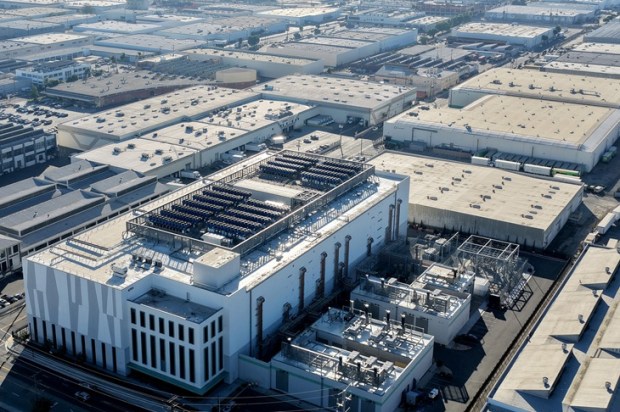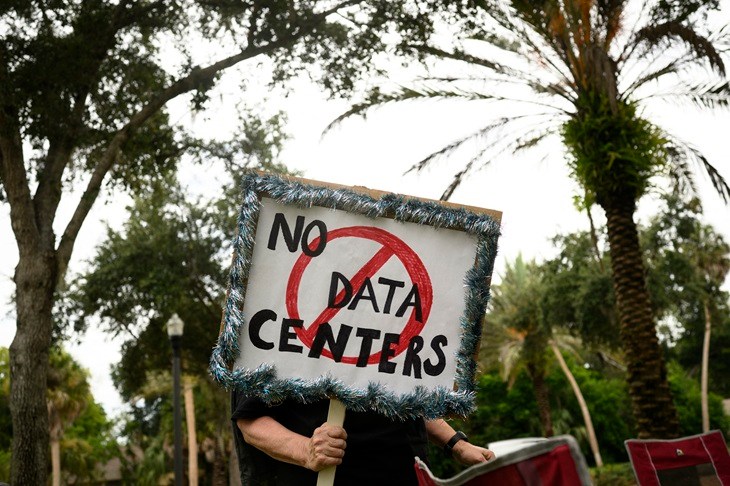
Data centres are more unpopular than potholes, and the industry seems unable to shift public perceptions with facts and figures.
Big Tech hasn’t grasped that this opposition is rooted less in environmental impacts than in deeper anxieties about AI.
People are not necessarily opposed to data centres because of what they are. They are opposed to what they represent.
That is why arguments about ‘closed-loop’ versus ‘open-loop’ cooling systems don’t move the dial.
It is why evidence that data centres have historically caused electricity prices to fall is so easily dismissed.
In America, Democrats and Republicans who once championed data centres are turning against them, while Silicon Valley panics as billions spent on lobbying fail to bear fruit.
Polling shows that people would rather live next to a nuclear power plant than a data centre (and people really don’t like nuclear power plants).
In fact, they dislike them more than wind farms, solar farms, and even ‘non-AI’ data centres.
Big Tech has every reason to be nervous about the same thing happening here: Australia is the world’s second largest destination for data centre investment, behind only the US.
But whatever you think of AI, the discussion around data centres has become hyperbolic.
Netflix, Zoom, cloud storage all run on the same infrastructure we’re suddenly panicking about.
If you took some of the claims circulating on social media seriously, you would conclude that data centres are going to drain the water table, break up your marriage, and orchestrate a third Brisbane Lions premiership.
The industry’s response has been predictable: more statistics, more billion-dollar investment figures, more claims about jobs and economic growth.
But that clearly isn’t enough.
Opposition has hardened anyway: in the first quarter of this year alone, more American projects were blocked or delayed than in the entirety of 2025.
It doesn’t help that some of the industry’s spokespeople resemble Weyland-Yutani synthetics, parroting statistics and talking points apparently written by their AI masters.
For many, the data centre has become a physical symbol of anxieties about AI: automation, the erosion of humanity itself, gratuitous display of wealth inequality.
Of course, the environmental impact of data centres requires scrutiny, as with any other infrastructure.
But the public debate has become littered with claims that are exaggerated, contradictory, or simply wrong.
A recent US study found that data centres actually caused average retail electricity prices to fall between 2015 and 2024.
And the effect on future prices depends on the scale of new loads and whether generation and network capacity can keep pace with demand.
We do not describe a new hospital as an electricity drain. We do not demand a moratorium on schools because classrooms need heating and lighting.
Instead, we build more power generation to support the infrastructure we want. The issue isn’t power consumption per se.
The Tomago aluminium smelter in New South Wales uses twice as much electricity as Australia’s entire data centre fleet, yet politicians are falling over themselves to keep it running.
Perhaps the most exaggerated claim is that they use massive amounts of water.
Many new Australian data centres are ‘closed loop’: they recycle their own water, with some using less than your local French bistro.
Almond orchards consume far more water than all of North America’s data centres combined, yet there’s no national talkback flooded with calls for a moratorium on smoothie bowls, even though Australia is the second largest almond producer in the world.
There is something distinctly Don Quixote about it, tilting at windmills in the belief they are giants.
But none of this cuts through because the objection is about more than litres or kilowatts.
People struggling to make ends meet, with parents working multiple jobs just to survive, see data centres popping up all over the place. They know someone is getting very rich from it all, and they don’t think it’s fair.
And they are right.
Ordinary people cannot stop AI replacing them at work. They cannot stop AI turning the internet to slop. They cannot stop a billionaire becoming a trillionaire.
They can, however, try to stop the dystopian warehouse going up down the road.
What can Big Tech do about it? Research into opposition to other developments offers a clue.
One study of residential apartment developments found people were more likely to oppose projects when they believed developers were making large profits, a resentment that may also be fuelling opposition to data centres.
The same research found that community benefits substantially increased support, with 63 per cent of participants becoming more favourable.
Bribes work too, just don’t call them that. An English study of offshore wind farm development found that support disappeared when financial compensation was framed as ‘bribery’.
People care about whether development feels legitimate, whether the benefits are fairly shared, and whether they have any meaningful say over what happens to their community.
That is ultimately a question of trust: whether people believe the companies building these facilities are acting in their interests, and whether they will share in the benefits.
The mining industry learned this the hard way: social licence cannot be won by bombarding communities with statistics.
Data centre companies have a much better hand to play than the mining industry ever did. AI could transform everything from medical research to productivity, potentially making the services we rely on cheaper and more accessible.
If Big Tech wants Australians to accept the infrastructure of the AI economy, it needs to understand that the argument is no longer about what a data centre does. It is about what people think it represents.